
About This Worksheet
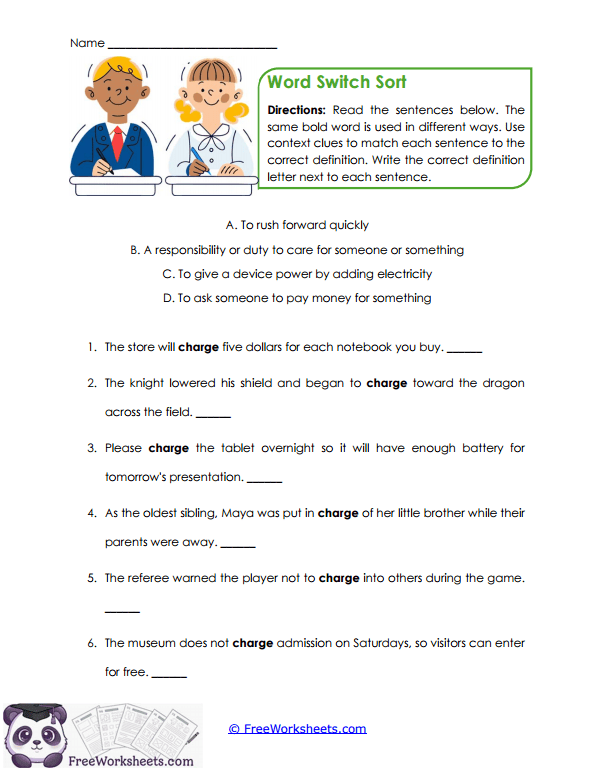
Word Switch Sort explores how a single vocabulary word can communicate different meanings depending on the surrounding context. This 6th grade vocabulary worksheet focuses on the word charge, presenting six sentences that use the term in situations involving money, movement, electricity, and responsibility. Students must interpret each sentence carefully and match the meaning of charge to one of four provided definitions. By examining how context changes the interpretation of the same word, learners strengthen their understanding of multiple-meaning words and the importance of reading beyond isolated vocabulary terms.
Curriculum and Grade Alignment
Understanding multiple-meaning words supports vocabulary development, reading comprehension, and language flexibility within the 6th grade curriculum. This activity reinforces the ability to use contextual information to determine which definition of a familiar word applies in a particular situation. Students encounter charge as an action involving payment, physical movement, or supplying electricity, as well as within an expression describing responsibility. Recognizing these distinctions helps learners interpret language more accurately when words have different meanings across conversational, academic, and informational texts.
Student Tasks
Learners read six numbered sentences containing the bold word charge and determine which of four definitions matches its use in each situation. The definitions are labeled A through D and describe rushing forward, having responsibility, supplying electrical power, and requesting payment. For example, the sentence about charging a tablet overnight requires students to recognize that the word refers to adding electrical power rather than collecting money. Students write the correct definition letter on the line following each sentence, with some definitions applying to more than one example.
Common Challenges and Misconceptions
Students may associate charge primarily with paying money and overlook its other meanings in unfamiliar contexts. The expression “in charge” can create additional confusion because it communicates responsibility rather than describing the same action as the other examples. Learners may also assume that each definition should be used only once, even though the worksheet includes repeated meanings. Encouraging students to identify the action or situation described in each sentence before selecting a letter can help them distinguish the different uses accurately.
Implementation Guidance
Begin by comparing the sentence about a store charging five dollars with the sentence about charging a tablet overnight. Ask students what is being transferred or requested in each situation and explain how the surrounding words establish two different meanings. Encourage learners to replace charge with the corresponding definition and reread the sentence to check whether the meaning remains logical. As an extension, students can write original sentences demonstrating another meaning of charge or create a similar matching exercise using a different multiple-meaning word.
Details and Features
The worksheet includes four lettered definitions arranged near the top of the page, followed by six numbered sentences containing the same bold vocabulary word. Each sentence has a short response line where students record the letter of the matching definition. The examples use familiar settings involving shopping, a knight approaching a dragon, electronic devices, family responsibilities, sports, and museum admission. Several meanings appear more than once, requiring learners to evaluate each context independently rather than matching every definition exactly once.