
About This Worksheet
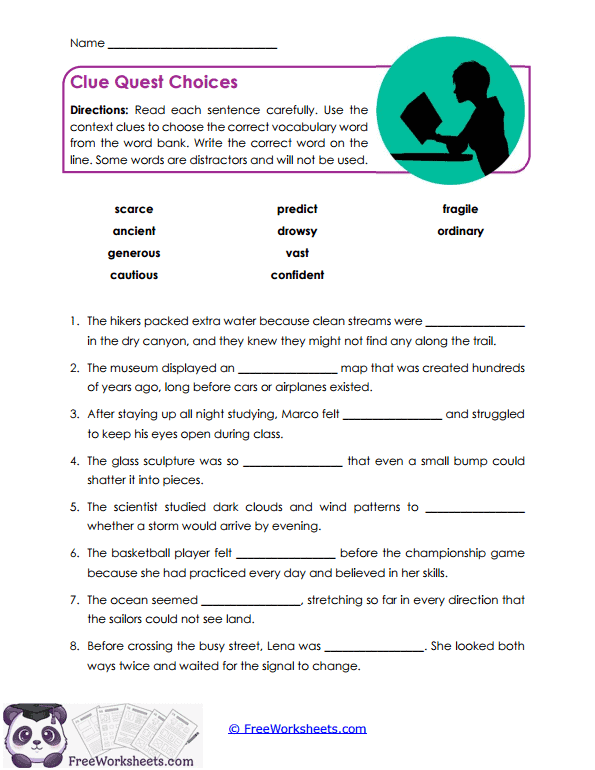
Clue Quest Choices challenges students to select vocabulary words that logically complete sentences using clues embedded in the surrounding language. This 6th grade vocabulary worksheet presents eight contextual sentences and a word bank containing ten possible answers. Learners must interpret descriptions, actions, and situations to determine which word best fits each blank while recognizing that some choices are intentionally unnecessary. The activity emphasizes accurate word selection and the ability to distinguish appropriate vocabulary from distractors that do not match the intended meaning.
Curriculum and Grade Alignment
Selecting words based on contextual meaning reinforces vocabulary comprehension and sentence-level reading skills within the 6th grade curriculum. Students practice recognizing how descriptive details and situational information reveal the meaning of an unfamiliar or omitted word. The vocabulary includes scarce, ancient, drowsy, fragile, predict, confident, vast, and cautious, along with additional word-bank choices that require careful evaluation. This exercise provides useful supporting practice for applying context clues, interpreting precise word meanings, and checking whether vocabulary fits both the meaning and grammatical structure of a sentence.
Student Tasks
Learners read eight numbered sentences and select the most appropriate completion from a ten-word vocabulary bank. Each sentence provides contextual information that points toward a particular word, such as hikers packing extra water because clean streams were difficult to find along their route. Other questions involve an old map displayed in a museum, a student struggling to stay awake, a delicate glass sculpture, and a scientist studying weather patterns. Students write the selected vocabulary word directly on the blank within each sentence, leaving the unused distractor words unselected.
Common Challenges and Misconceptions
Some students may select words based on a loose association with the sentence rather than identifying the specific contextual details that establish the intended meaning. For example, confident and cautious both describe attitudes or behaviors, but the surrounding information determines which one fits a particular situation. Learners may also confuse scarce with ordinary or overlook how phrases such as “could shatter into pieces” clarify the meaning of fragile. Encouraging students to reread each completed sentence and identify the supporting clue can help them recognize when an answer does not fit the context.
Implementation Guidance
Begin by reviewing the word bank and asking learners to explain the meanings of several words without matching them to specific sentences. Demonstrate how the first question provides evidence for scarce through the hikers’ concern that clean streams might not be available during their journey. Encourage students to underline the most informative words in each sentence before choosing a vocabulary term, then reread the completed statement to check its meaning. As an extension, ask learners to identify the unused distractors and compose original sentences that provide clear contextual clues to their meanings.
Details and Features
The worksheet includes a ten-word vocabulary bank arranged in three columns near the top of the page, followed by eight numbered sentence-completion exercises. The word bank contains a mixture of descriptive adjectives and a verb, requiring learners to consider both meaning and grammatical usage. Each sentence provides a blank within a realistic situation involving travel, history, school, science, sports, or personal safety. The directions clarify that some words are distractors and will not be used, encouraging careful comparison rather than automatic elimination of every available choice.