
About This Worksheet
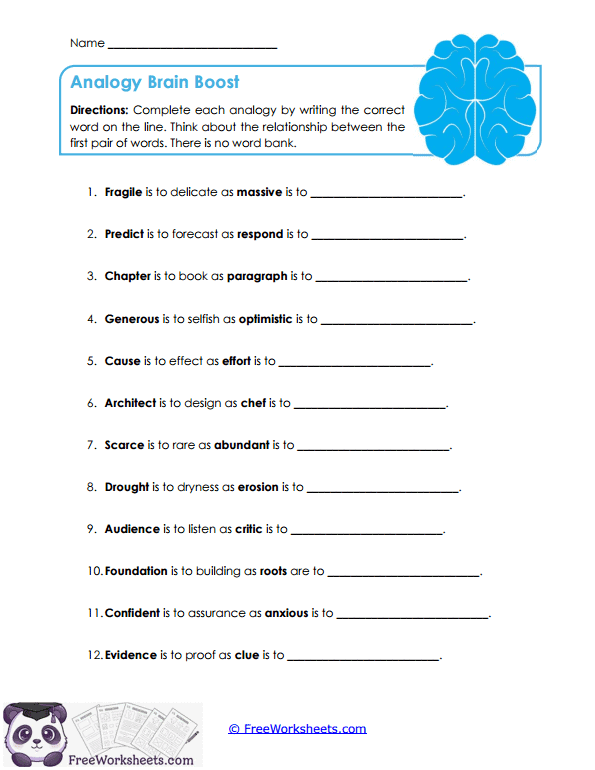
Analogy Brain Boost challenges learners to recognize meaningful relationships between words and apply those relationships to complete verbal comparisons. This 6th grade vocabulary worksheet presents twelve open-ended analogies involving synonyms, antonyms, cause and effect, and relationships between objects, actions, and concepts. Rather than relying on multiple-choice answers, students must independently determine which word best completes each comparison. The varied relationships encourage careful interpretation of word meanings and strengthen the ability to recognize connections between seemingly unrelated vocabulary terms.
Curriculum and Grade Alignment
Understanding analogies supports vocabulary development, semantic reasoning, and reading comprehension within the 6th grade language arts curriculum. Students practice identifying relationships between words and transferring those patterns to new vocabulary, reinforcing their understanding of synonyms, antonyms, and conceptual associations. Several exercises incorporate more advanced academic vocabulary, including fragile, abundant, erosion, assurance, and evidence. This activity provides useful practice for learners developing the flexible word knowledge needed to interpret unfamiliar vocabulary and recognize relationships within increasingly complex texts.
Student Tasks
Learners complete twelve numbered analogies by writing an appropriate word on each response line. Each exercise provides a complete first word pair and an incomplete second pair, requiring students to determine the original relationship before supplying the missing term. For example, “Fragile is to delicate as massive is to” asks learners to recognize a synonym relationship and select a word with a meaning similar to massive. Other prompts involve identifying opposites, connecting causes with effects, recognizing structural relationships, and associating professions with actions.
Common Challenges and Misconceptions
Some students may identify the meanings of individual words without recognizing the specific relationship connecting the first pair. Others may choose a word that is generally associated with the prompt but does not maintain the same relationship in the second pair. Analogies involving different grammatical forms, such as confident and assurance, can create additional difficulty because the missing word must preserve the original relationship between an adjective and a noun. Encouraging learners to state the relationship in a short phrase before selecting an answer can help distinguish meaningful analogies from loosely connected word associations.
Implementation Guidance
Begin by examining a familiar synonym analogy and demonstrating how the relationship between the first two words guides the missing-word selection. Encourage students to identify whether the paired words express similarity, opposition, a functional connection, or another meaningful relationship before writing their answers. For learners who need additional support, consider discussing the meanings of less familiar terms such as scarce, abundant, and erosion before independent practice. As an extension, invite students to create original analogies using vocabulary from their current reading assignments and explain the relationship represented by each pair.
Details and Features
The worksheet contains twelve numbered analogies arranged in a single vertical column with a dedicated response line for each answer. Important vocabulary terms appear in bold within the sentences, helping readers identify the words that establish each comparison. The directions explicitly state that no word bank is provided, requiring students to generate their own responses rather than select from predetermined options. The exercise set incorporates several types of semantic relationships without separating them into labeled categories, encouraging learners to evaluate each analogy independently.