
Area And Perimeter On The Coordinate Plane Worksheets
Area and perimeter on the coordinate plane give 10th grade math students a practical way to combine geometric measurement with ordered pairs, distance, and spatial reasoning. These free, ready-to-print PDF worksheets support immediate classroom lessons, homework, review, tutoring, intervention, and independent coordinate-geometry practice. Students calculate side lengths, decompose irregular figures, compare measurement strategies, and design polygons while building the analytical skills expected across the 10th grade curriculum.
About This Collection of Worksheets
Coordinate-plane measurement asks 10th grade students to do more than apply a memorized area or perimeter formula. They must read ordered pairs, determine how vertices connect, recognize whether sides are horizontal, vertical, or diagonal, and choose an efficient way to measure each figure. In many problems, simple coordinate differences are enough, while others require the distance formula, decomposition, an enclosing rectangle, or a combination of methods.
This collection moves from direct measurement into increasingly strategic and open-ended work. Students plot polygons, calculate perimeter from coordinate paths, break irregular figures into smaller shapes, use enclosing rectangles, investigate mistakes, solve backward for missing vertices, choose efficient methods, apply scale in park-design situations, create figures with equal areas but different perimeters, compare measurements, solve themed coordinate challenges, and design original polygons that meet stated conditions. The variety helps students see area and perimeter as connected geometric ideas rather than isolated formulas.
Teachers can use these worksheets throughout a 10th grade coordinate-geometry unit for guided instruction, independent practice, homework, partner work, enrichment, test review, or problem-solving stations. Parents, tutors, and homeschool educators can also select activities based on whether a student needs more support with distance, irregular figures, scale, or geometric design. The progression from calculation to method choice and construction gives students repeated opportunities to reason about both the shape and the mathematics behind each answer.
Paul’s Teacher Tip
Before students choose a formula, have them sketch the figure and label each side as horizontal, vertical, or diagonal. Horizontal and vertical lengths can usually be found with coordinate differences, while diagonal sides should trigger the distance formula. For irregular figures, encourage students to compare decomposition with an enclosing-rectangle method before calculating so they learn to choose the cleaner strategy. Keep area and perimeter visibly separated by requiring square units for area and linear units for perimeter on every problem. When scale is involved, remind students that linear measurements and square measurements scale differently, so an area scale factor must be squared.
Worksheet Collection Skill Spotlights
Coordinate Shapes
What Kids Do:
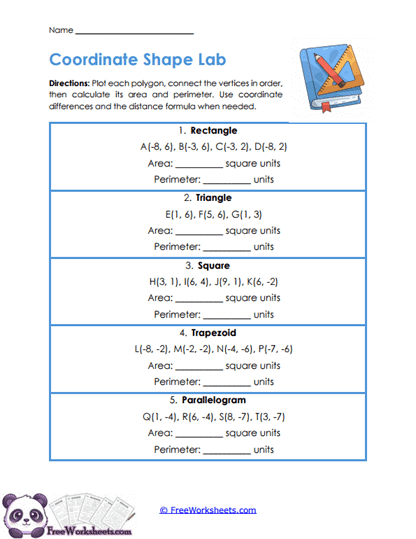
Students plot five polygons from ordered pairs, connect the vertices in sequence, identify each resulting figure, and determine both its area and perimeter. They use coordinate differences for horizontal and vertical sides, apply the distance formula to diagonal segments when needed, and select the appropriate area formula for each shape.
Target Skill:
This activity combines several coordinate-geometry skills in one setting. Students strengthen plotting accuracy, side-length reasoning, polygon identification, area formulas, perimeter calculation, and the distinction between linear and square units while developing a complete 10th grade measurement process.
Enclosure Method
What Kids Do:
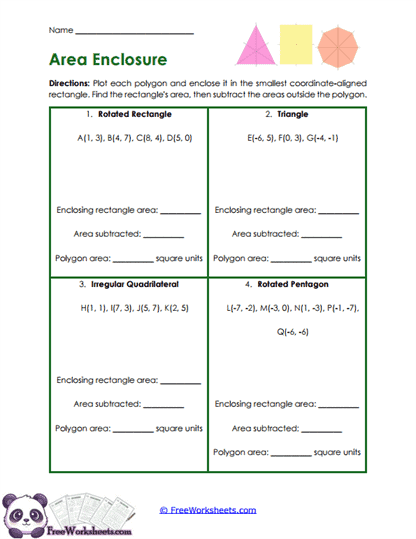
Students place four coordinate polygons inside the smallest horizontal-and-vertical rectangle that completely contains each figure. They calculate the enclosing rectangle’s area, identify the extra triangles or regions outside the target polygon, and subtract those areas to determine the exact area of the original shape.
Target Skill:
Students develop a flexible subtraction-based strategy for irregular and rotated polygons. The worksheet reinforces extreme-coordinate reasoning, rectangle and triangle area, visual decomposition, and strategic method selection while showing 10th grade students that difficult figures can often be measured indirectly.
Error Investigation
What Kids Do:
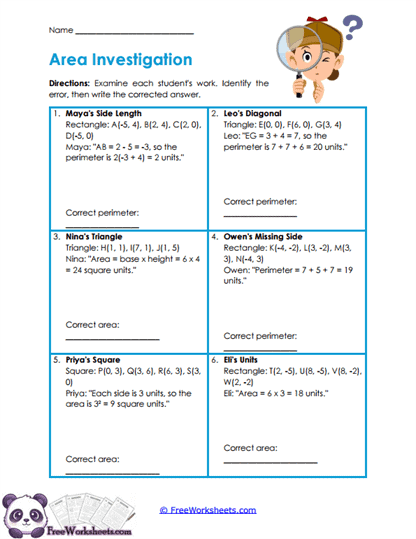
Students examine six worked coordinate-geometry solutions containing mistakes with side lengths, diagonal measurements, triangle area, missing perimeter segments, or units. They identify the first incorrect step, explain why the method fails, and recalculate the measurement using the correct geometric approach.
Target Skill:
Error analysis strengthens students’ ability to choose the right measurement tool for each segment and figure. They reinforce coordinate differences, the distance formula, area and perimeter formulas, unit conventions, and mathematical explanation while building stronger habits for checking complex 10th grade work.
Measure Duel
What Kids Do:
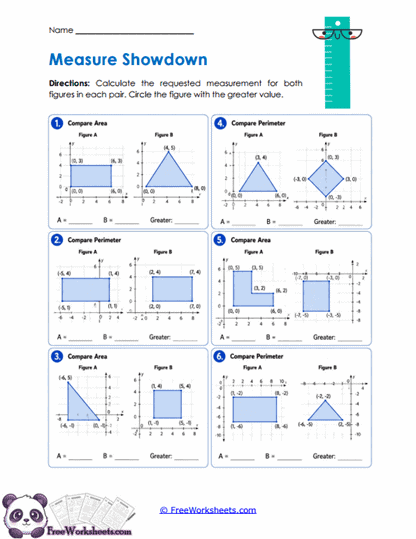
Students compare pairs of coordinate-plane figures by calculating the requested area or perimeter for both and deciding which measurement is greater. They use coordinate differences, standard area formulas, decomposition, or the distance formula depending on the figures before interpreting the final comparison.
Target Skill:
This activity moves students beyond isolated calculations and into comparison of geometric quantities. Students strengthen method choice, measurement vocabulary, unit awareness, and 10th grade reasoning about how area and perimeter describe different features and do not necessarily increase together.
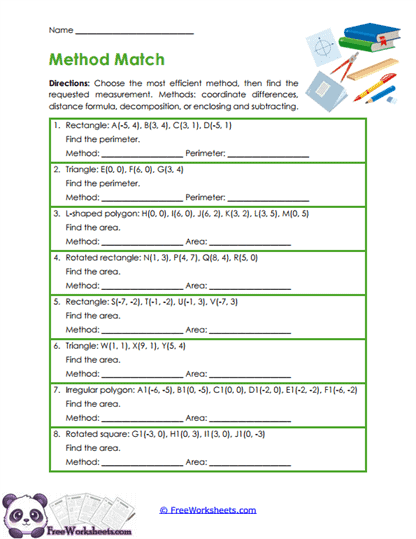
Method Choice
What Kids Do:
Students inspect eight coordinate figures before calculating and select the most efficient strategy for each one. Depending on the structure, they may choose direct coordinate differences, the distance formula, decomposition, or an enclosing-and-subtracting approach, then carry out the selected method to find area or perimeter.
Target Skill:
Students develop strategic flexibility instead of applying the same procedure to every coordinate problem. The worksheet reinforces figure analysis, efficiency, distance reasoning, composite-area methods, and the 10th grade habit of planning a solution before beginning calculations.
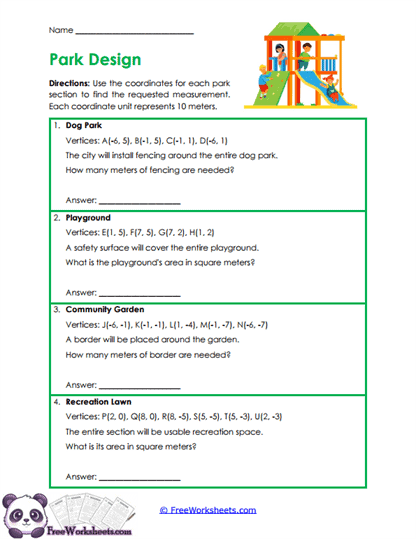
Park Planning
What Kids Do:
Students calculate area or perimeter for four park sections represented by coordinate polygons, including a dog park, playground, garden, and recreation lawn. They use the coordinate scale of 10 meters per unit and convert final measurements into meters or square meters based on the quantity requested.
Target Skill:
Students apply coordinate geometry to a realistic planning context while distinguishing linear scale from area scale. The activity strengthens perimeter, area, distance, unit conversion, and geometric modeling while helping 10th grade students see how coordinate measurements can describe actual spaces.
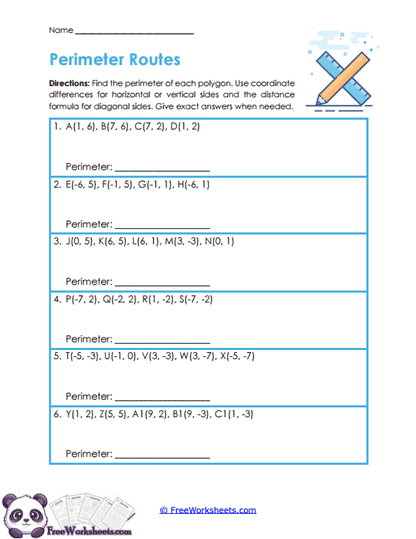
Perimeter Paths
What Kids Do:
Students determine the perimeter of six coordinate polygons by finding every side length in order and then adding the complete boundary. Horizontal and vertical segments are calculated through coordinate differences, while diagonal sides require the distance formula and may remain in exact radical form.
Target Skill:
This worksheet develops careful coordinate-based perimeter reasoning. Students practice recognizing segment type, applying the appropriate distance method, preserving exact values, and remembering the closing side of a polygon while reinforcing the 10th grade connection between coordinates and geometric length.
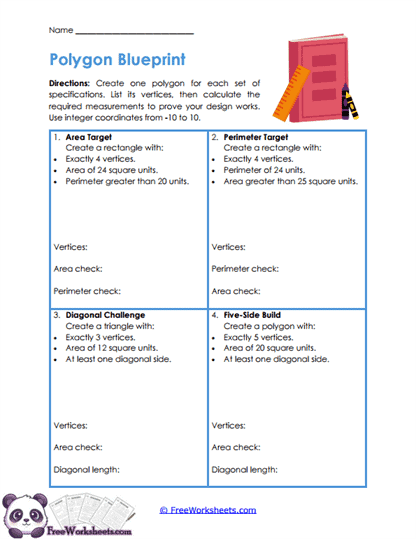
Polygon Design
What Kids Do:
Students create original coordinate polygons that satisfy stated area, perimeter, vertex, and diagonal requirements. They choose integer-coordinate vertices, sketch or plot the figure, calculate the requested measurements, revise the design if necessary, and provide mathematical verification that every condition has been met.
Target Skill:
This open-ended activity turns area and perimeter formulas into design tools rather than answer-producing rules. Students strengthen backward reasoning, coordinate construction, measurement verification, distance reasoning, and creative problem solving while working with multiple geometric constraints at once.
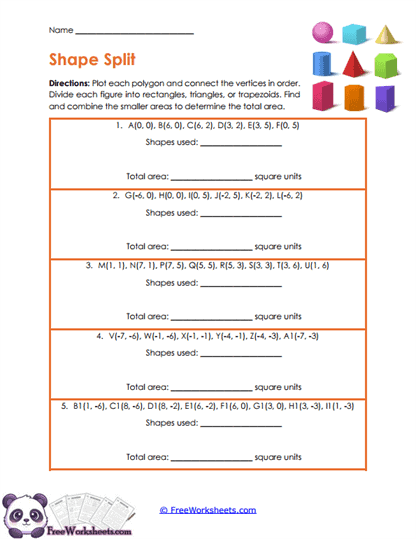
Shape Decomposition
What Kids Do:
Students plot five irregular polygons and divide each figure into familiar rectangles, triangles, trapezoids, or other manageable pieces. They calculate the area of every section separately and combine those values, while recognizing that different valid decompositions can produce the same total area.
Target Skill:
Students learn to solve unfamiliar area problems by reducing them to shapes they already know. The worksheet reinforces coordinate differences, composite-area reasoning, visual organization, and strategic flexibility while helping 10th grade students rely less on memorized single-shape formulas.
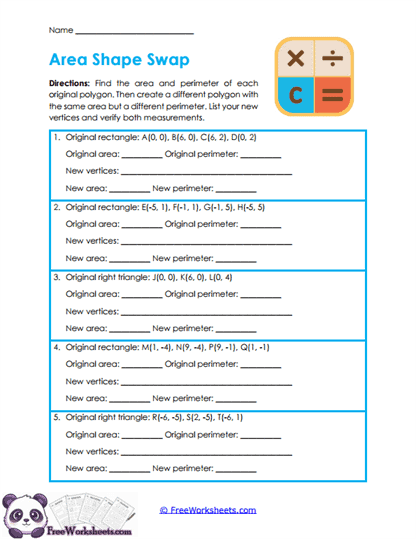
Shape Swap
What Kids Do:
Students calculate the area and perimeter of original coordinate figures and then design new rectangles or pentagons with the same area but a different perimeter. They list new vertices, calculate both measurements, and verify that the redesigned figure satisfies the required conditions.
Target Skill:
This activity directly challenges the misconception that equal area implies equal perimeter. Students strengthen coordinate design, comparison, verification, and geometric reasoning while learning how changes in dimensions and shape can preserve enclosed space but alter boundary length.
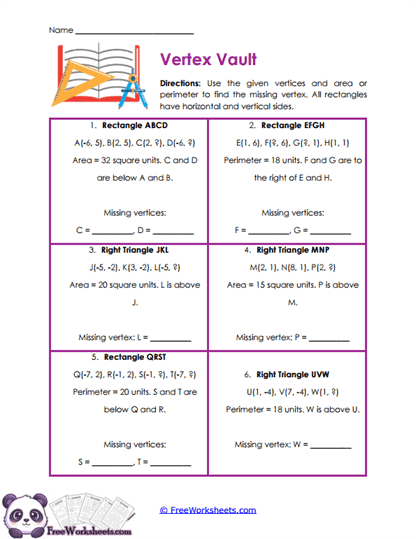
Vertex Finder
What Kids Do:
Students use a given area or perimeter along with known rectangle or right-triangle vertices to determine missing coordinates. They work backward to find an unknown side length and then use horizontal or vertical alignment, shared x-values, and shared y-values to place the missing point correctly.
Target Skill:
Students reverse the usual coordinate-measurement process by using geometric properties and formulas to recover missing locations. The activity combines algebra, area, perimeter, coordinate structure, and 10th grade reasoning about how measurements constrain the placement of vertices.
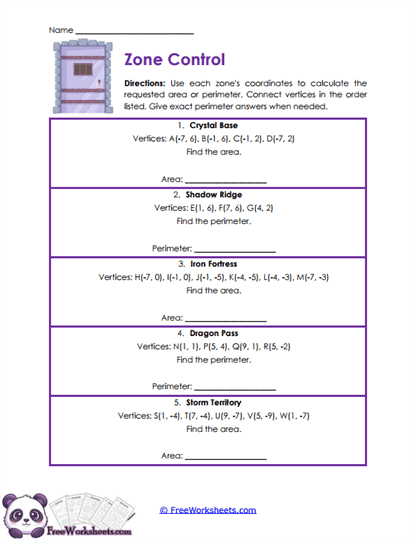
Zone Measures
What Kids Do:
Students calculate area or perimeter for five themed coordinate regions with names such as Crystal Base, Shadow Ridge, and Dragon Pass. They connect the vertices in order, identify the requested measurement, choose coordinate differences, formulas, decomposition, or exact diagonal distances as needed, and report the result accurately.
Target Skill:
This mixed practice develops independence with coordinate-plane measurement because students must decide both what is being asked and how to solve it. They reinforce area, perimeter, distance, radical precision, and strategy selection while preparing for broader 10th grade coordinate-geometry assessments.