
Pythagorean Theorem Worksheets
These worksheets help students solve right triangle problems using equations, diagrams, coordinate grids, and real-world applications. These free, ready-to-print worksheets come in PDF format for immediate classroom use, homework assignments, intervention, or independent review. Students strengthen geometry reasoning, algebra skills, square root operations, and distance calculations through guided practice and applied problem-solving activities
About This Collection of Worksheets
This collection of Pythagorean Theorem worksheets gives students structured practice with right triangle relationships, missing side calculations, coordinate geometry, and applied problem solving. Students solve for hypotenuses and legs, identify right triangles, measure distances on coordinate grids, and apply geometric reasoning in practical situations. The activities support both procedural fluency and conceptual understanding through repeated equation setup and visual modeling.
The worksheets include labeled triangle diagrams, graph-based measurement tasks, real-world scenarios, guided examples, and reasoning activities. Students work through problems involving ladders, maps, distances, triangle proofs, coordinate paths, and construction challenges while strengthening their ability to organize equations and interpret measurements. The variety of problem types helps learners connect geometry formulas to meaningful visual and practical contexts.
Teachers can use these printable PDF worksheets for classroom lessons, small-group instruction, intervention support, homework, enrichment, review, or assessment preparation. The layouts provide clear workspaces for calculations, diagrams, and written explanations. Visual models and repeated practice structures also help students build confidence while reinforcing important geometry vocabulary and problem-solving habits.
Paul’s Teacher Tip
Students are far more successful with the Pythagorean Theorem when they consistently identify the hypotenuse before writing the equation. Encourage learners to label the legs and hypotenuse directly on each triangle so they avoid placing numbers in the wrong position. Many mistakes happen because students forget to square values first or skip the square root step at the end of the problem. Modeling one example slowly while explaining every step aloud can help students understand why the theorem works instead of simply memorizing the formula. Graph-based problems and real-world applications also help students see that the theorem is more than just an equation on paper. Asking students to explain whether they are solving for a leg or a hypotenuse before calculating often improves both accuracy and confidence.
Worksheet Collection Skill Spotlights
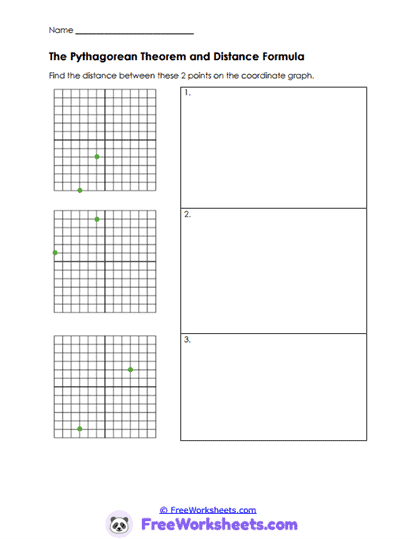
Coordinate Paths
- What Kids Do:
Students examine coordinate graphs, measure horizontal and vertical movement between points, build right triangles on grids, and calculate diagonal distances using geometric relationships and graph-based reasoning. - Target Skill:
Students strengthen coordinate geometry and measurement skills by connecting graph movement to right triangle relationships, organizing calculations clearly, and applying geometric formulas to distance problems on the coordinate plane.
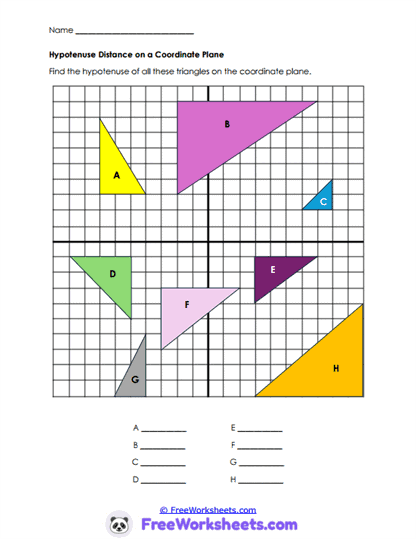
Grid Distances
- What Kids Do:
Students study right triangles drawn on coordinate grids, count horizontal and vertical leg lengths, and calculate hypotenuse measurements while comparing distances and organizing graph-based calculations carefully. - Target Skill:
Students develop spatial reasoning and geometry fluency by applying right triangle relationships to graphing situations, identifying legs and hypotenuses correctly, and solving distance measurements using organized equation work.
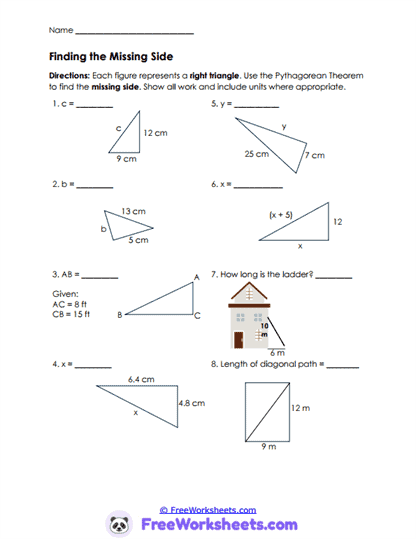
Missing Measures
- What Kids Do:
Students solve for missing side lengths in right triangles by substituting values into equations, simplifying squared numbers, and applying geometry concepts to practical measurement and diagram-based situations. - Target Skill:
Students improve algebraic and geometric reasoning skills by solving missing-side problems accurately, organizing equations step by step, and applying right triangle relationships to real-world measurement tasks.
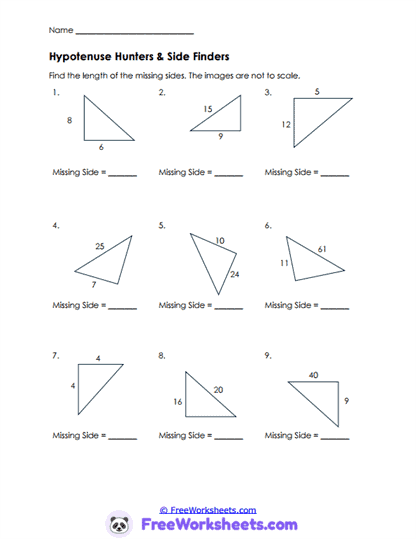
Side Hunters
- What Kids Do:
Students identify unknown sides in right triangles, decide whether to solve for a leg or a hypotenuse, and complete repeated practice problems using diagrams and structured equation setup. - Target Skill:
Students build confidence with right triangle calculations by identifying the hypotenuse correctly, choosing appropriate operations, and simplifying equations accurately while reinforcing geometry vocabulary and reasoning.
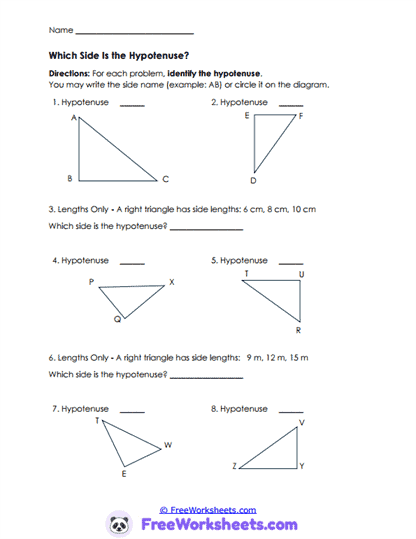
Side Search
- What Kids Do:
Students identify hypotenuses in multiple right triangle diagrams and numerical examples while studying how triangle orientation and side placement affect geometric relationships and measurements. - Target Skill:
Students strengthen foundational geometry understanding by recognizing the hypotenuse consistently, identifying right-angle relationships, and preparing for more advanced right triangle problem-solving activities.
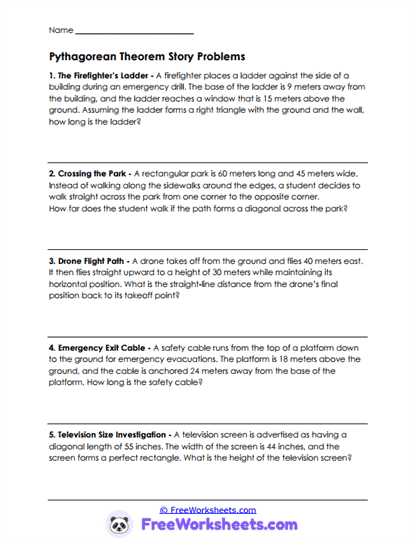
Story Triangles
- What Kids Do:
Students solve real-world right triangle problems involving ladders, parks, cables, screens, and distances while organizing information, sketching triangles, and interpreting measurements within story-based situations. - Target Skill:
Students apply geometry reasoning and measurement skills by translating word problems into right triangle equations, solving for unknown distances, and explaining how calculations connect to practical situations.
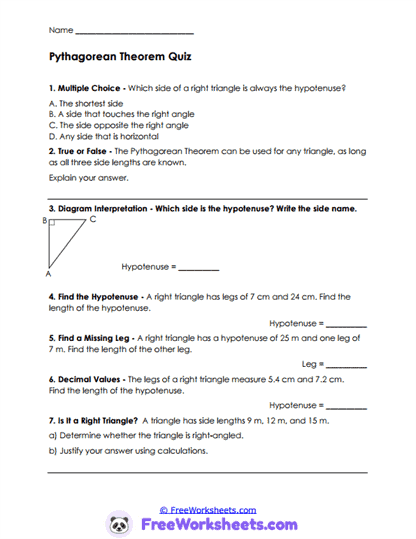
Theorem Check
- What Kids Do:
Students complete review questions involving hypotenuse identification, missing side calculations, and right triangle verification while solving equations, interpreting diagrams, and explaining geometric reasoning. - Target Skill:
Students reinforce overall theorem understanding by combining vocabulary, calculations, and reasoning skills while checking right triangle relationships and organizing geometry work accurately across mixed problem types.
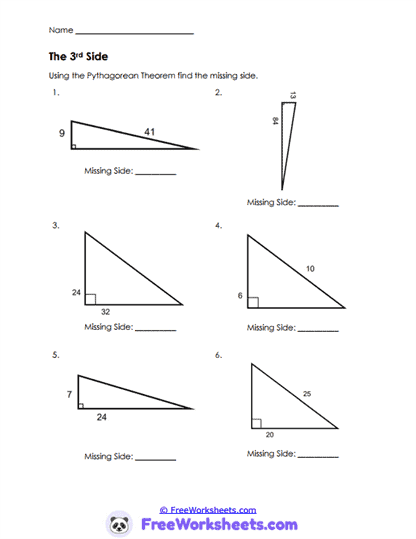
Third Length
- What Kids Do:
Students examine right triangle diagrams, determine whether the missing side is a leg or hypotenuse, and solve for unknown measurements using organized equation setup and square root operations. - Target Skill:
Students improve right triangle problem-solving accuracy by identifying side relationships correctly, applying equations carefully, and simplifying measurements through structured geometric reasoning and algebraic thinking.
Triangle Basics
- What Kids Do:
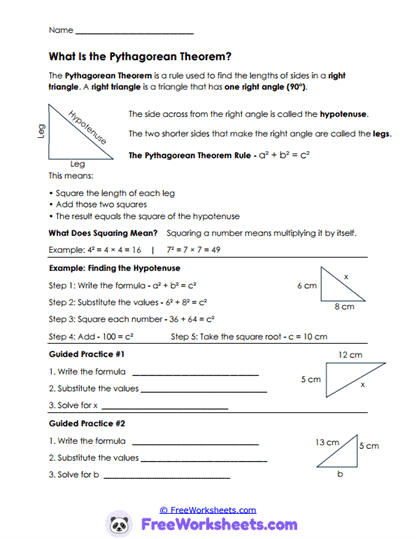
Students learn the parts of right triangles, identify legs and hypotenuses, substitute measurements into equations, and complete guided examples that explain how right triangle relationships work. - Target Skill:
Students build foundational understanding of right triangle geometry by identifying key triangle parts, organizing equations correctly, and connecting squared side relationships to missing measurement calculations.
Triangle Builder
- What Kids Do:
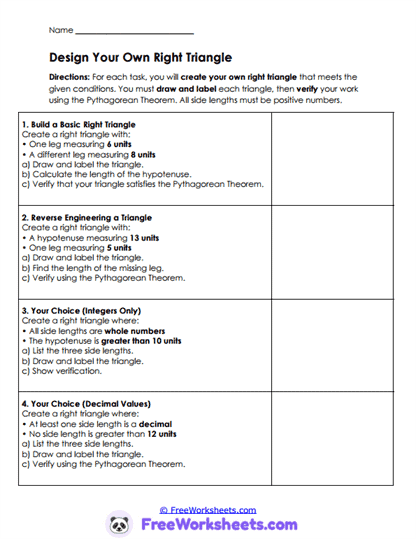
Students create and label their own right triangles, test whether side lengths satisfy geometric relationships, and verify solutions using equations, drawings, and organized measurement comparisons. - Target Skill:
Students strengthen geometric reasoning and mathematical modeling skills by constructing valid right triangles, testing side relationships accurately, and explaining how equations confirm triangle properties.
Triangle Proofs
- What Kids Do:
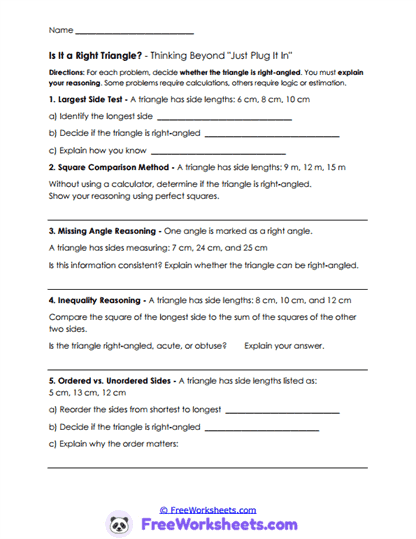
Students compare triangle side lengths, square measurements, and determine whether triangles satisfy right triangle relationships while explaining reasoning through equations and written responses. - Target Skill:
Students deepen conceptual understanding of geometry relationships by analyzing side-length patterns, testing equations carefully, and using mathematical reasoning to classify triangles accurately.
Triangle Tools
- What Kids Do:
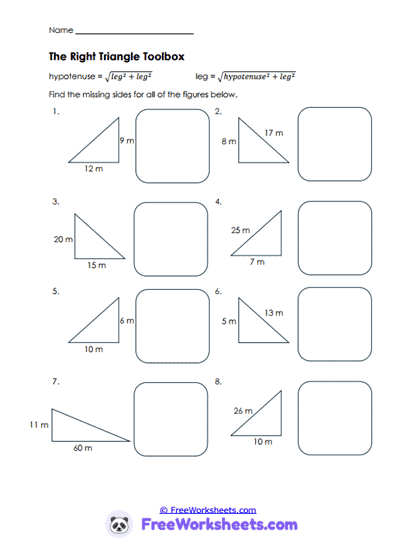
Students solve for missing hypotenuses and legs using different right triangle setups while deciding when to add or subtract squared values and organizing calculations step by step. - Target Skill:
Students strengthen equation-solving fluency and geometric reasoning by applying right triangle relationships correctly, distinguishing between missing-side types, and simplifying measurements accurately.