
About This Worksheet
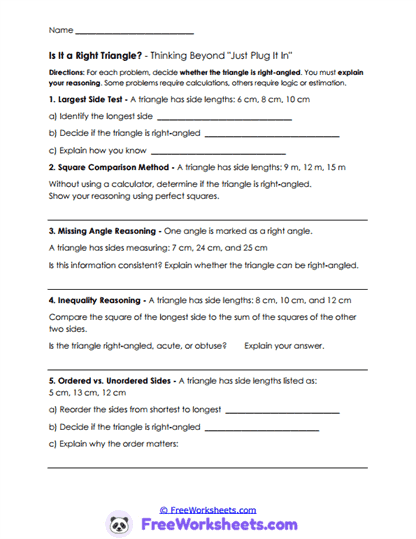
The Pythagorean Theorem can also help determine whether a triangle is a right triangle. This worksheet asks students to compare side lengths and explain their reasoning using squares and triangle relationships. Students work through problems that involve checking whether a2 + b2 = c2. For example, a triangle with sides 9, 12, and 15 forms a right triangle because the equation is true. The activity focuses on reasoning and explanation instead of only calculation.
Curriculum and Grade Alignment
This worksheet supports geometry standards related to right triangle relationships and mathematical reasoning. The main learning goal is to determine whether given side lengths create a right triangle. Students should already understand the Pythagorean Theorem and how to square numbers before beginning. The next step is using geometric proofs and classification skills within larger geometry problems. This aligns with HSG-SRT.C.8 because students analyze right triangle relationships using the theorem.
Student Tasks
On this worksheet, students will compare squared side lengths to determine whether triangles are right-angled. They will identify the longest side and test whether the theorem works correctly for each set of measurements. Students also explain their reasoning using equations, square comparisons, and triangle rules. Some questions ask learners to analyze side lengths that are not listed in order.
Common Challenges and Misconceptions
Some students may forget to place the longest side in the hypotenuse position before solving. Others may compare side lengths without squaring the values first. A common mistake is assuming a triangle is right-angled just because the numbers seem close to a known pattern. Teachers can help by reminding students to organize the side lengths from shortest to longest before starting calculations.
Implementation Guidance
This worksheet works well as deeper practice after students already know how to solve missing-side problems. Teachers can encourage students to explain why a triangle is or is not right-angled instead of giving only a final answer. Parents helping at home can ask students to read the equation aloud while checking the side lengths. Hearing the relationship spoken clearly often helps students follow the reasoning more carefully.
Details and Features
The worksheet includes reasoning questions, square comparisons, and multiple right-triangle tests. Students practice explanation skills along with calculation skills throughout the activity. The printable format provides room for showing equations and written reasoning. The mix of direct and open-response questions helps students think more deeply about the theorem.