
Geometry Word Problems Worksheets
These worksheets help students apply coordinate geometry, measurement, angle relationships, and reasoning skills to practical situations. These free, ready-to-print worksheets come in PDF format for immediate classroom use, homework, intervention, or independent review. Students build confidence solving distance, perimeter, area, triangle, circle, and multi-step geometry problems through real-world examples and visual reasoning activities.
About This Collection of Worksheets
This collection of geometry word problem worksheets gives students meaningful practice applying geometry concepts in realistic and engaging situations. Students solve problems involving coordinate distances, perimeter, area, circles, angle relationships, reflections, and proportional reasoning across a wide range of themes and settings. The activities encourage students to organize information carefully, choose appropriate formulas, and explain their mathematical thinking clearly.
The worksheets include coordinate grids, diagrams, multi-step scenarios, and practical applications tied to navigation, technology, gaming, music, sports, fashion, and design. Students work through geometry challenges that connect classroom learning to situations they can picture in everyday life. The variety of contexts helps learners understand that geometry supports planning, measurement, movement, design, and problem solving far beyond the math classroom.
Teachers can use these printable PDF worksheets for guided instruction, math centers, independent practice, review lessons, enrichment, or assessment preparation. The layouts provide room for calculations, written explanations, and organized problem-solving steps. Mixed problem types also help students strengthen critical thinking skills while building fluency with important geometry formulas and reasoning strategies.
Paul’s Teacher Tip
Geometry word problems become much easier for students when they learn to slow down and organize information before solving. Encourage students to underline important details, identify what the question is asking, and choose a formula only after understanding the situation fully. Many students rush into calculations too quickly, which often leads to using the wrong strategy or missing key details in the problem. Modeling one problem step by step can help students develop stronger habits for showing work and explaining reasoning. It also helps to connect geometry situations to familiar topics like maps, sports, gaming, architecture, or technology so students can visualize the math more clearly. Asking students to explain their thinking aloud before solving often improves both accuracy and confidence.
Worksheet Collection Skill Spotlights
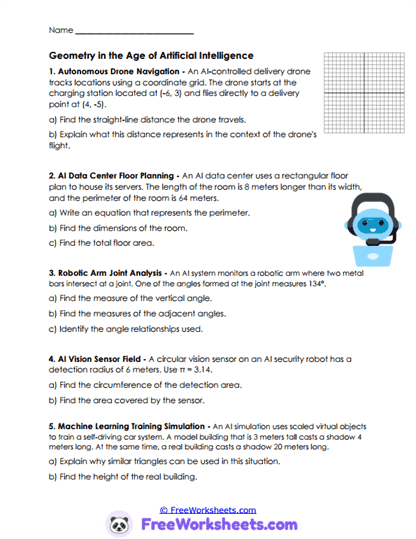
AI Geometry
- What Kids Do:
Students solve geometry problems connected to drones, robotic systems, sensors, and automation while calculating coordinate distances, perimeter measurements, circle dimensions, angle relationships, and scaling situations tied to technology-based examples. - Target Skill:
Students strengthen applied geometry reasoning by combining coordinate geometry, proportional relationships, angle calculations, and circle formulas while interpreting how mathematical measurements support movement, design, and positioning in modern technology systems.
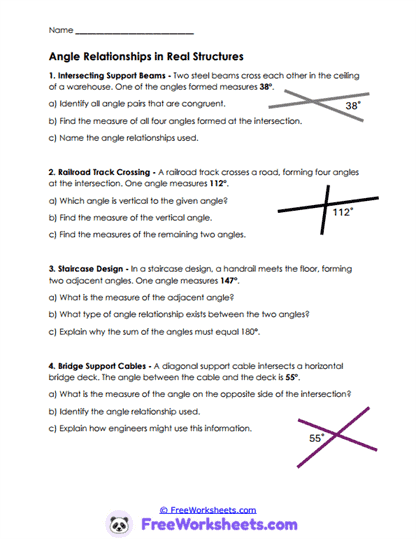
Angle Links
- What Kids Do:
Students identify vertical, adjacent, and supplementary angles in diagrams connected to structures, bridges, and intersecting lines while calculating missing angle measures and explaining which geometry relationships apply to each situation. - Target Skill:
Students develop geometric reasoning skills by recognizing angle relationships, solving for unknown measurements, and using intersecting-line properties accurately while strengthening visual analysis and mathematical explanation skills.
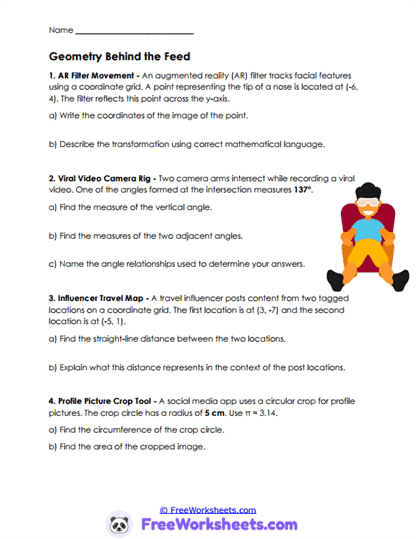
Digital Shapes
- What Kids Do:
Students solve geometry problems tied to digital design, social media, augmented reality, and mapping situations while working with reflections, coordinate distances, circles, and intersecting angle relationships across technology-themed scenarios. - Target Skill:
Students apply multiple geometry concepts together by interpreting coordinate transformations, calculating circle measurements, and analyzing angle relationships while strengthening real-world problem-solving and visual reasoning abilities.
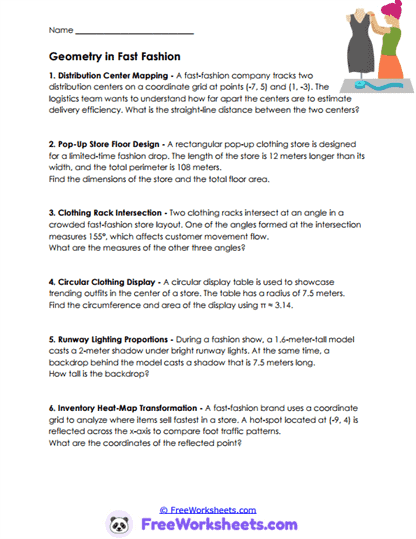
Fashion Figures
- What Kids Do:
Students solve geometry problems involving store layouts, runway planning, display measurements, and coordinate mapping while calculating distances, perimeter, circles, and intersecting angles in fashion-themed situations. - Target Skill:
Students strengthen measurement and geometry application skills by combining coordinates, perimeter formulas, angle relationships, and circle calculations while understanding how geometry supports organization, planning, and design work.
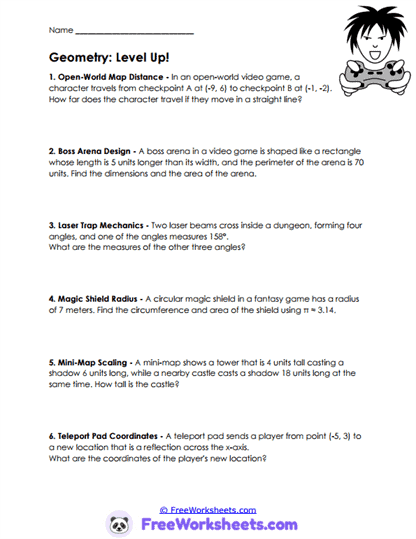
Gaming Geometry
- What Kids Do:
Students solve gaming-themed geometry problems involving maps, arenas, shields, reflections, and movement while calculating distances, perimeter, angle measurements, and circle dimensions connected to digital game environments. - Target Skill:
Students improve applied geometry fluency by using coordinate formulas, angle relationships, and measurement strategies to solve multi-step problems while connecting geometry concepts to visual and interactive situations.
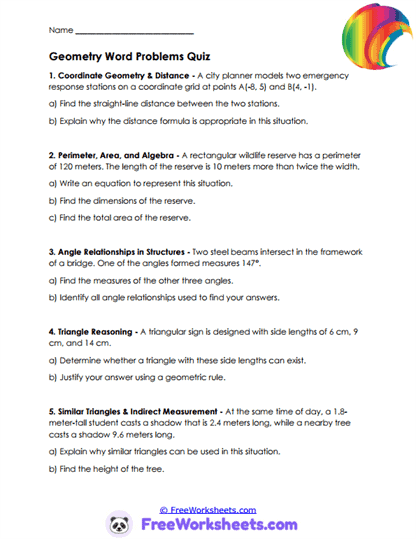
Geometry Check
- What Kids Do:
Students complete mixed geometry review problems involving coordinate distances, perimeter equations, angle relationships, triangle rules, and proportional reasoning while solving practical multi-step word problems. - Target Skill:
Students strengthen geometry problem-solving accuracy by identifying appropriate formulas, applying reasoning strategies across different problem types, and explaining mathematical thinking through organized calculations and written responses.
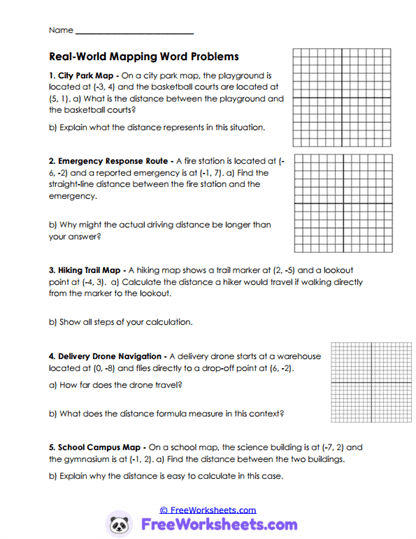
Mapping Paths
- What Kids Do:
Students calculate straight-line distances between coordinate points in situations involving maps, hiking routes, navigation systems, and travel planning while showing work and comparing different travel paths. - Target Skill:
Students build confidence with coordinate geometry by applying distance calculations accurately, organizing formula steps clearly, and interpreting how geometric measurements represent movement and location in practical situations.
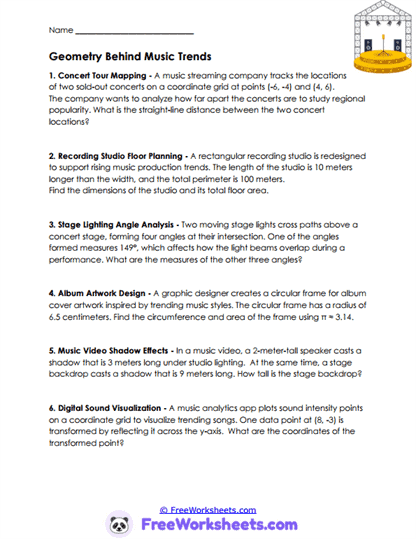
Music Mapping
- What Kids Do:
Students solve geometry problems connected to concert layouts, recording studios, lighting systems, and sound design while calculating coordinate distances, perimeter measurements, circle dimensions, and angle relationships. - Target Skill:
Students develop applied geometry reasoning by combining measurement formulas, coordinate geometry, and spatial analysis while understanding how geometry supports planning, layout, and organization in creative environments.
Problem Steps
- What Kids Do:
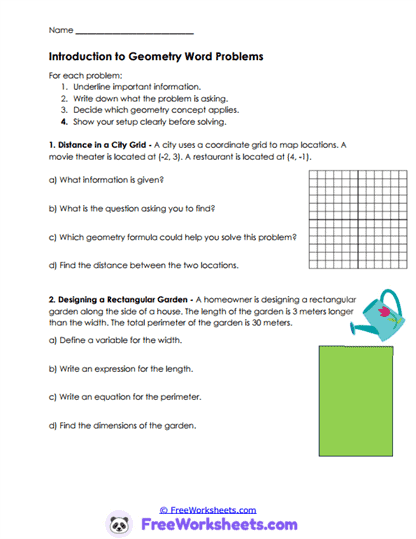
Students practice breaking down geometry word problems by identifying important information, organizing equations, solving perimeter and coordinate problems, and showing step-by-step reasoning before calculating final answers. - Target Skill:
Students strengthen mathematical problem-solving habits by learning how to organize information carefully, select appropriate geometry formulas, write equations clearly, and explain reasoning through structured multi-step work.
Security Shapes
- What Kids Do:
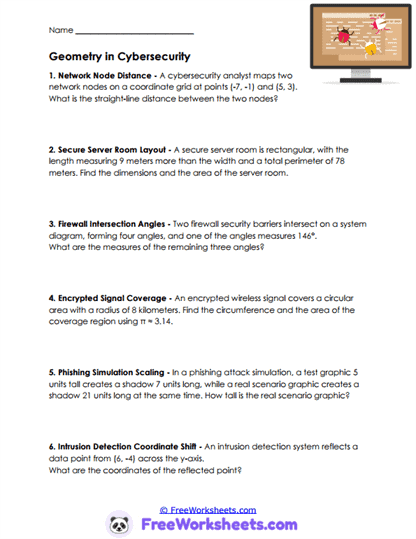
Students solve cybersecurity-themed geometry problems involving server layouts, network distances, signal ranges, reflections, and angle measurements while working through technology-focused coordinate and measurement tasks. - Target Skill:
Students apply geometry concepts within practical technical scenarios by combining coordinate reasoning, circle formulas, perimeter calculations, and angle relationships while improving multi-step problem-solving accuracy.
Shape Mix
- What Kids Do:
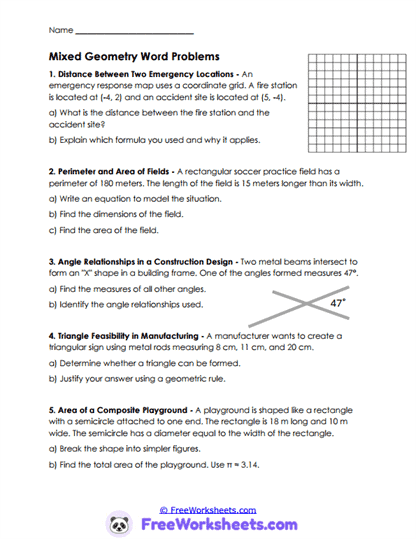
Students solve mixed geometry problems involving coordinate distances, perimeter, area, composite figures, angle relationships, and triangle rules while applying different geometry strategies within one activity. - Target Skill:
Students strengthen geometry fluency by identifying which formulas and reasoning methods fit different situations, organizing calculations clearly, and solving multi-concept problems involving measurement and spatial reasoning.
Sports Angles
- What Kids Do:
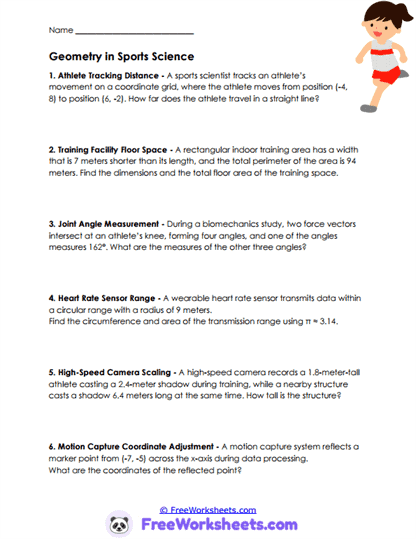
Students solve geometry problems tied to sports tracking, movement analysis, athletic layouts, and sensor ranges while calculating coordinate distances, perimeter measurements, angle relationships, and circle dimensions. - Target Skill:
Students improve geometry application skills by combining formulas, spatial reasoning, and measurement concepts to analyze movement, positioning, and design within practical sports and performance-based situations.