
Sentences, Fragments, and Run-ons Worksheets
10th Grade sentences, fragments, and run-ons worksheets help students build a strong foundation in sentence structure and effective written communication. Free, ready-to-print worksheets are available in PDF format for immediate classroom use and independent practice. Students strengthen skills such as identifying complete sentences, correcting fragments, repairing run-ons, improving sentence variety, and revising writing for greater clarity and fluency.
About This Collection of Worksheets
Strong writing begins with strong sentences. Whether students are composing essays, research papers, reports, or creative pieces, they need to understand how sentences are constructed and how ideas connect. This collection helps learners recognize the differences between complete sentences, fragments, run-ons, comma splices, and more advanced sentence structures. Through engaging editing and revision activities, students develop the skills necessary to communicate ideas clearly and effectively.
The worksheets provide practice with a broad range of sentence-level concepts, including sentence completeness, clause analysis, run-on correction, punctuation, conjunction usage, sentence combining, paragraph revision, semicolon application, and sentence expansion. Students learn not only how to identify errors but also how to revise writing strategically to improve readability, organization, and style. These activities emphasize practical writing skills that transfer directly to academic and professional communication.
Teachers, parents, and homeschool educators can use these resources to support grammar instruction, writing workshops, intervention programs, test preparation, and independent review. Each worksheet focuses on a specific sentence-construction skill while encouraging students to apply grammar concepts in authentic contexts. Together, these activities help students become more confident editors, stronger writers, and more effective communicators.
Paul’s Teacher Tip
Many students focus so much on individual words that they forget to examine how ideas connect within a sentence. Encourage students to look for complete thoughts first. A simple question such as “Can this stand alone as a sentence?” can quickly reveal whether a fragment, run-on, or comma splice is present. It is also helpful to teach students that good editing involves more than correcting errors. Strong writers revise sentences to improve flow, variety, and clarity. The more students practice analyzing sentence structure during reading and writing, the more naturally these skills will appear in their own work.
Worksheet Collection Skill Spotlights
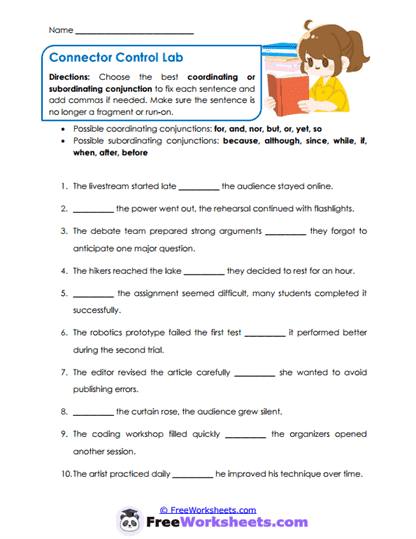
Connector Choice
- What Kids Do:
Students select coordinating and subordinating conjunctions to complete sentences and create logical relationships between ideas. They analyze meaning as well as grammar before making decisions. - Target Skill:
Students strengthen sentence-construction skills by choosing connectors that clearly communicate relationships between clauses.
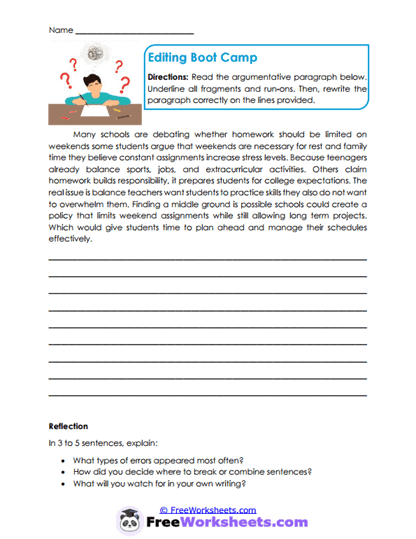
Error Fixer
- What Kids Do:
Students edit an argumentative paragraph containing both fragments and run-on sentences. After revising the passage, they reflect on the corrections they made and explain their reasoning. - Target Skill:
Students develop editing and revision skills by identifying multiple sentence-structure errors within authentic writing.
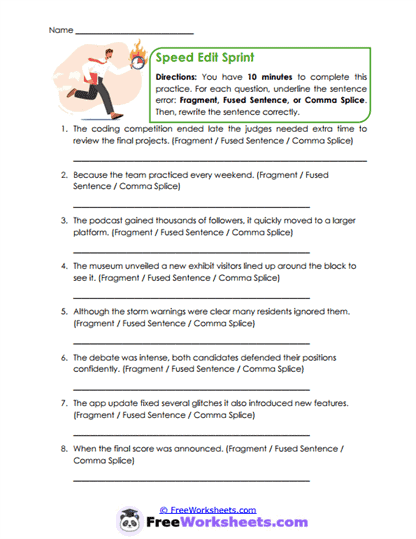
Error Sprint
- What Kids Do:
Students participate in a timed challenge where they classify examples as complete sentences, fragments, comma splices, or fused sentences before making corrections. - Target Skill:
Students strengthen sentence-error recognition and editing fluency through repeated practice with common grammar issues.
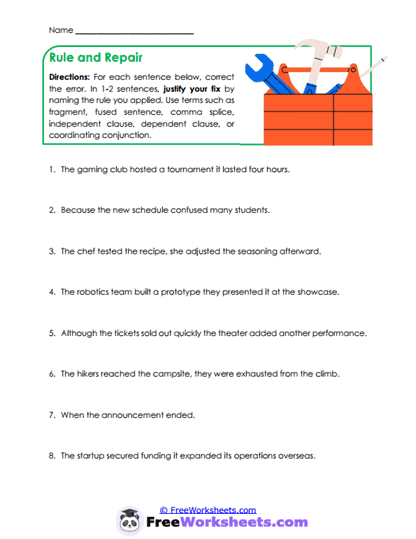
Grammar Repair
- What Kids Do:
Students revise sentence errors and explain their corrections using grammar terminology such as independent clause, dependent clause, fragment, and comma splice. - Target Skill:
Students build deeper grammar understanding by connecting editing decisions to specific sentence-structure concepts.
Paragraph Flow
- What Kids Do:
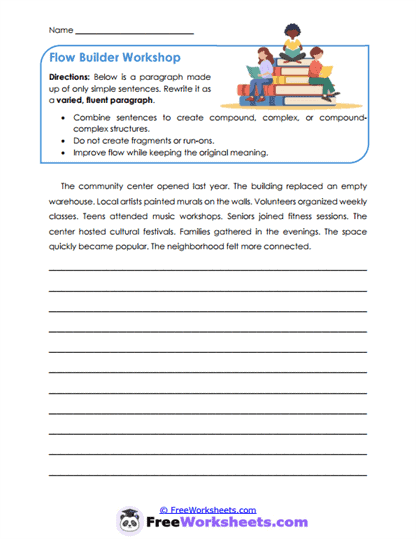
Students transform a collection of simple sentences into a cohesive paragraph using transitions, sentence variety, and effective organization. - Target Skill:
Students strengthen writing fluency and paragraph-development skills by combining ideas into clear, unified writing.
Paragraph Repair
- What Kids Do:
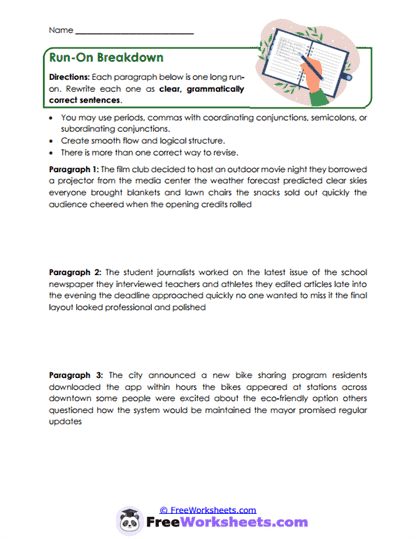
Students edit entire paragraphs containing run-on sentences and revise them using punctuation, conjunctions, and other correction strategies. - Target Skill:
Students develop practical editing skills by correcting sentence-boundary errors within longer passages.
Run-On Rescue
- What Kids Do:
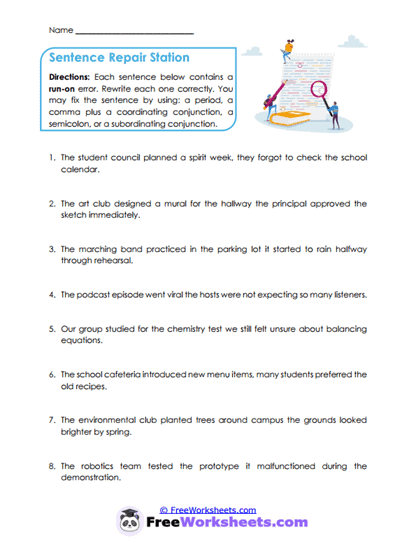
Students repair run-on sentences using periods, semicolons, coordinating conjunctions, and subordinating conjunctions. They evaluate which strategy works best for each example. - Target Skill:
Students strengthen punctuation and sentence-boundary skills while improving sentence fluency.
Semicolon Mastery
- What Kids Do:
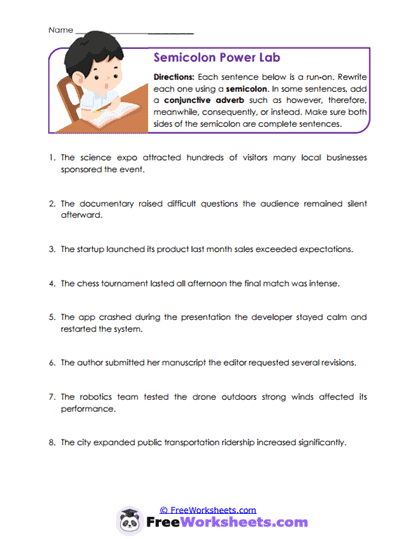
Students revise run-on sentences by inserting semicolons and, when appropriate, conjunctive adverbs. They analyze how punctuation affects sentence relationships. - Target Skill:
Students build advanced punctuation skills through the correct use of semicolons between independent clauses.
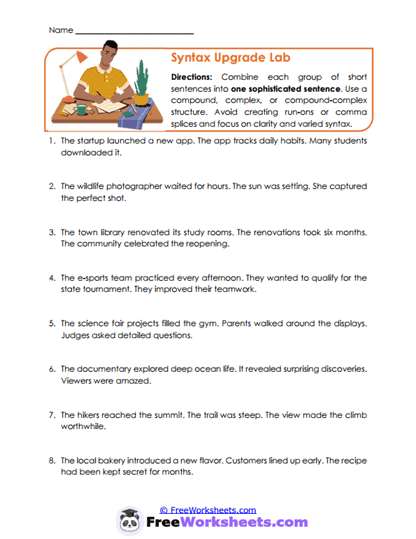
Sentence Builder
- What Kids Do:
Students combine short related sentences into compound, complex, and compound-complex structures. They experiment with different ways of connecting ideas. - Target Skill:
Students strengthen sentence variety and writing sophistication through sentence-combining practice.
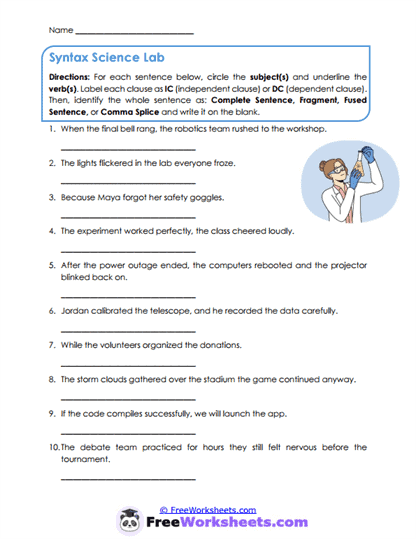
Sentence Detective
- What Kids Do:
Students analyze science-themed examples and classify them as complete sentences, fragments, comma splices, or fused sentences. They identify subjects, verbs, and clauses before making decisions. - Target Skill:
Students develop foundational sentence-analysis skills by distinguishing between correct and incorrect sentence forms.
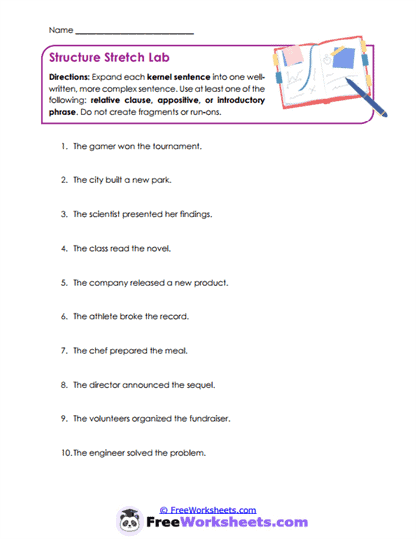
Structure Expansion
- What Kids Do:
Students expand simple kernel sentences by adding appositives, relative clauses, and introductory phrases. They create richer and more detailed sentences. - Target Skill:
Students strengthen sentence-development skills by increasing complexity while maintaining clarity and correctness.
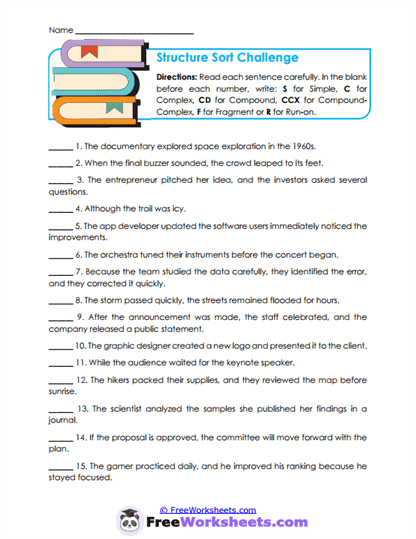
Structure Sort
- What Kids Do:
Students classify examples as simple, compound, complex, compound-complex, fragment, or run-on sentences. They analyze how clauses function within each structure. - Target Skill:
Students build advanced sentence-analysis skills by comparing and categorizing multiple sentence forms.