
Nouns Worksheets
These worksheets help students analyze how nouns function within complex sentences and academic writing. Free, ready-to-print worksheets in PDF format are designed for immediate classroom use and independent practice. Students strengthen sentence analysis, editing accuracy, and vocabulary precision through skills aligned to curriculum expectations.
About This Collection of Worksheets
This collection of noun worksheets moves beyond basic identification and challenges students to examine how nouns function within sophisticated academic writing. Learners analyze noun roles, evaluate sentence structure, edit authentic passages, and revise writing for greater precision. Each activity is designed to help students understand how nouns contribute to meaning, clarity, and effective communication.
Students encounter a wide range of grammar applications, including possessive nouns, appositives, noun clauses, capitalization conventions, abstract and concrete nouns, and advanced sentence construction. Rather than relying on isolated drills, these worksheets place grammar concepts within meaningful contexts that require critical thinking and close reading. This approach helps learners transfer grammar knowledge into their own writing.
Teachers can use these printable resources for direct instruction, independent practice, intervention support, homework assignments, assessment preparation, or writing workshops. The variety of activities encourages students to analyze language from multiple perspectives while building confidence with grade-level grammar standards. Whether used individually or as part of a larger grammar unit, these worksheets provide rigorous and practical language instruction.
Paul’s Teacher Tip
When teaching nouns at this level, encourage students to explain why a noun functions in a particular way rather than simply labeling it. Having students identify verbs and sentence patterns before analyzing noun roles often leads to stronger accuracy. Pair grammar practice with writing revision so students can immediately apply new concepts in authentic contexts. Reading sentences and passages aloud also helps learners notice issues involving clarity, punctuation, capitalization, and noun reference. For deeper learning, ask students to compare original and revised versions of sentences and discuss how noun choices affect meaning and readability.
Worksheet Collection Skill Spotlights
Abstract Sorting
- What Kids Do:
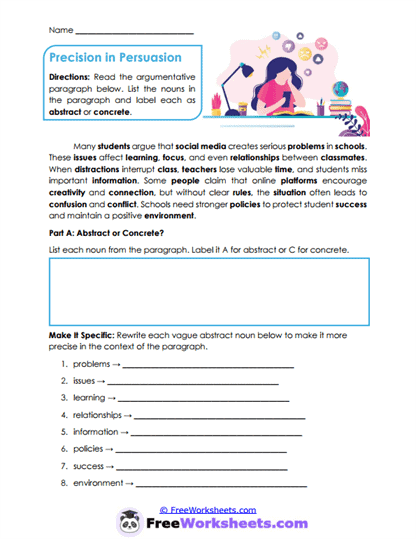
Students read a persuasive passage and locate nouns throughout the text before classifying each one as abstract or concrete. They examine how ideas, emotions, qualities, and physical objects are represented in writing, then revise selected vocabulary to make language more precise and effective. The activity combines reading comprehension, vocabulary analysis, and grammatical classification within a meaningful argumentative context. - Target Skill:
Students develop the ability to distinguish between tangible and intangible noun forms while analyzing how authors communicate ideas. This supports language standards focused on grammar application, vocabulary acquisition, and interpreting word meaning in context. Learners strengthen analytical thinking by evaluating how specific noun choices contribute to clarity, persuasion, and overall effectiveness in written communication.
Appositive Precision
- What Kids Do:
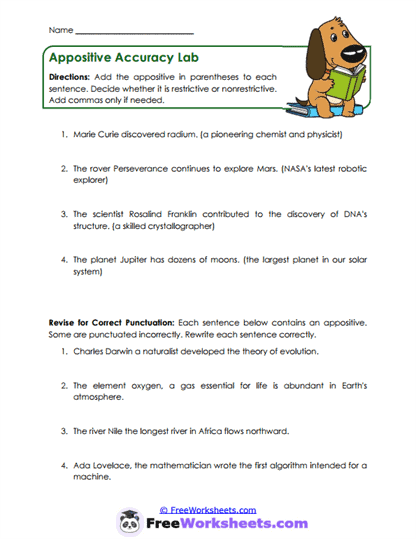
Students insert appositives into sentences, determine whether information is restrictive or nonrestrictive, and apply punctuation rules accordingly. They revise incorrectly punctuated examples and evaluate how additional noun information changes sentence meaning. The work requires close reading, thoughtful editing, and careful attention to sentence structure and grammatical purpose. - Target Skill:
Students strengthen understanding of noun phrases, sentence expansion, and punctuation conventions used in formal writing. This activity supports language standards involving grammar, usage, and sentence construction while helping learners improve editing accuracy. Students learn to make informed decisions about commas and sentence clarity based on meaning rather than memorized rules alone.
Capital Corrections
- What Kids Do:
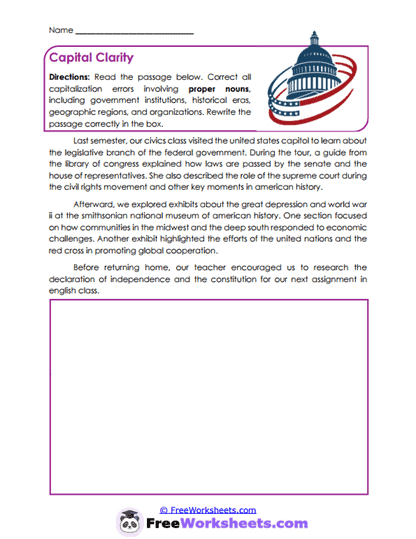
Students proofread an informational passage containing capitalization errors involving people, places, organizations, institutions, and historical events. They identify incorrect forms and rewrite the passage using standard capitalization conventions throughout. The task promotes detailed reading and systematic editing within a realistic nonfiction context. - Target Skill:
Students apply capitalization rules accurately while recognizing different categories of proper nouns in authentic writing. This reinforces language conventions related to grammar and editing while improving proofreading habits. Learners strengthen their ability to recognize patterns, evaluate context, and consistently apply standard English conventions across extended texts.
Capital Decisions
- What Kids Do:
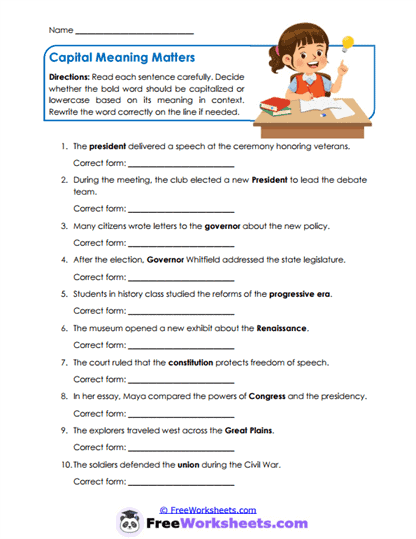
Students analyze sentences containing titles, geographic terms, historical references, and institutional names that may or may not require capitalization. They determine the correct form based on context and rewrite words appropriately. Each example encourages students to think carefully about meaning before making editorial decisions. - Target Skill:
Students build mastery of capitalization by evaluating how context influences whether a noun functions as common or proper. The activity supports language standards related to conventions of written English and helps learners develop flexible editing skills. Students practice applying rules thoughtfully rather than relying on memorization or assumptions.
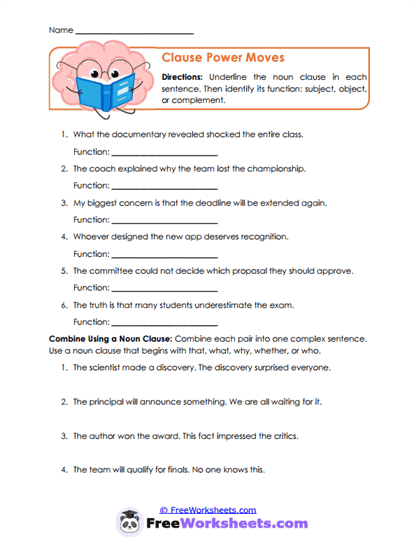
Clause Connections
- What Kids Do:
Students identify noun clauses embedded within complex sentences and determine the grammatical role each clause performs. They also combine simple statements into more sophisticated constructions that incorporate noun clauses naturally. The activity blends sentence analysis with sentence creation to deepen understanding of advanced syntax. - Target Skill:
Students strengthen knowledge of clause structure, sentence variety, and grammatical relationships within complex writing. This supports language standards emphasizing command of grammar and effective sentence construction. Learners develop greater confidence interpreting and producing sophisticated sentence patterns commonly found in academic texts.
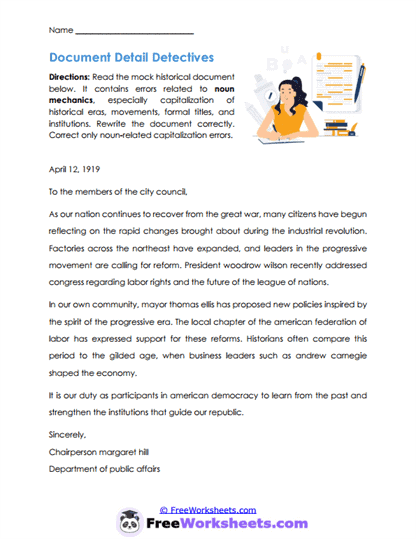
Document Editing
- What Kids Do:
Students review a mock historical document and identify capitalization mistakes involving historical eras, government entities, organizations, official titles, and geographic locations. They revise the complete document using standard conventions while maintaining the original meaning and tone. The task mirrors authentic proofreading situations. - Target Skill:
Students apply capitalization rules within extended nonfiction writing and strengthen editing accuracy through contextual practice. This supports language standards related to conventions of English and careful revision. Learners improve attention to detail while developing a stronger understanding of how proper nouns function in formal and historical documents.
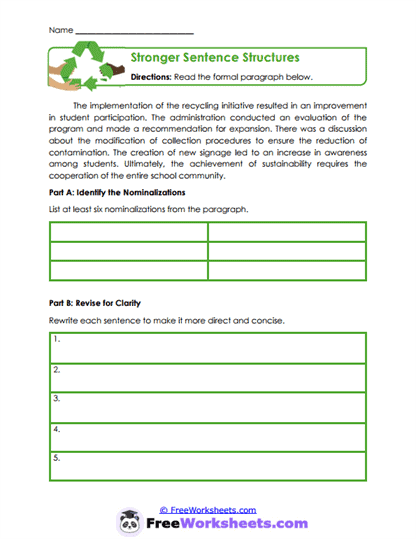
Nominalization Repair
- What Kids Do:
Students examine an informational paragraph containing noun forms derived from verbs and adjectives. They identify nominalizations, evaluate how those word choices affect readability, and revise sentences to create clearer and more direct communication. The activity encourages thoughtful revision and comparison of alternative sentence structures. - Target Skill:
Students develop awareness of how grammar choices influence style, clarity, and effectiveness in academic writing. This supports standards related to language use, revision, and communication. Learners strengthen editing skills by transforming indirect constructions into concise sentences that improve readability and strengthen author intent.
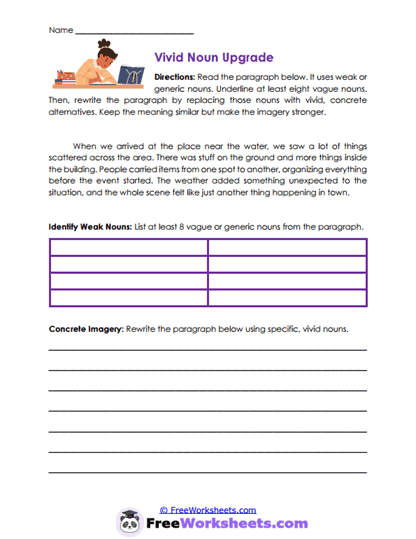
Noun Precision
- What Kids Do:
Students analyze a paragraph filled with broad and generic nouns, then replace them with more specific alternatives that create stronger imagery and clearer meaning. They consider context carefully while revising entire passages for precision. The activity connects grammar knowledge directly to writing improvement. - Target Skill:
Students strengthen vocabulary selection and descriptive writing by choosing nouns that communicate ideas accurately and effectively. This supports language and writing standards emphasizing precise word choice and clear communication. Learners gain experience revising text to improve reader understanding, detail, and overall writing quality.
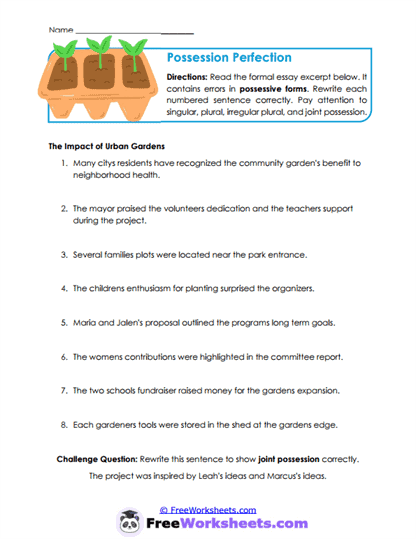
Ownership Fixes
- What Kids Do:
Students locate and correct errors involving singular possessives, plural possessives, irregular plural possessives, and joint ownership. They rewrite sentences using proper apostrophe placement and evaluate how ownership relationships affect meaning. The activity provides structured editing practice within realistic writing situations. - Target Skill:
Students build proficiency with possessive noun conventions and apply grammar rules accurately in context. This supports language standards related to usage, mechanics, and written communication. Learners strengthen proofreading abilities while developing a deeper understanding of how ownership is represented in standard English.
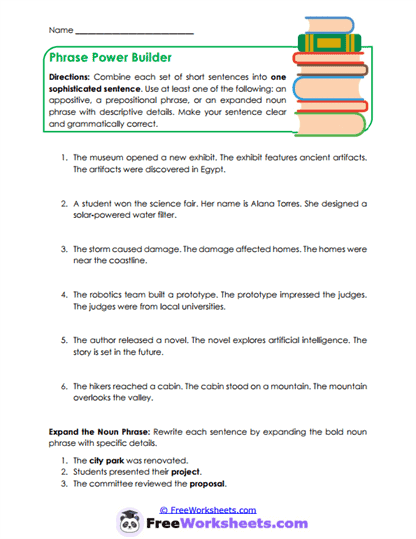
Phrase Expansion
- What Kids Do:
Students combine simple sentences into richer, more detailed constructions by expanding noun phrases with modifiers, appositives, and prepositional phrases. They revise basic descriptions and incorporate meaningful details that improve sentence flow. The activity encourages creativity while reinforcing grammar concepts. - Target Skill:
Students develop sentence variety, descriptive writing techniques, and effective use of noun phrases within academic compositions. This supports standards related to language, writing development, and communication. Learners practice adding relevant detail while maintaining clarity, organization, and grammatical accuracy.
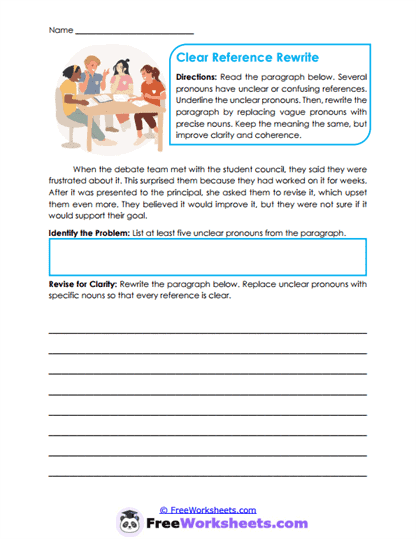
Reference Clarity
- What Kids Do:
Students evaluate a paragraph containing confusing pronoun references and determine where specific nouns should replace vague language. They explain why certain references create confusion and revise the passage for improved coherence. The activity combines editing, reading comprehension, and sentence-level analysis. - Target Skill:
Students strengthen understanding of noun-pronoun relationships and improve writing clarity through precise reference. This supports language and writing standards focused on revision and effective communication. Learners develop the ability to anticipate reader confusion and make strategic edits that improve coherence and understanding.
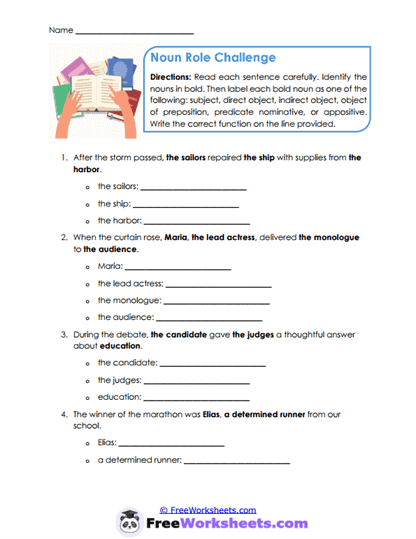
Role Mapping
- What Kids Do:
Students read sentences containing highlighted nouns and determine whether each noun functions as a subject, direct object, indirect object, object of a preposition, appositive, or predicate nominative. They analyze sentence structure carefully and use contextual evidence to justify grammatical classifications. - Target Skill:
Students deepen understanding of sentence structure by identifying how nouns function within different grammatical roles. This supports language standards emphasizing grammar knowledge and syntactic analysis. Learners strengthen foundational skills needed for advanced writing, close reading, and interpretation of complex sentence patterns.