
About This Worksheet
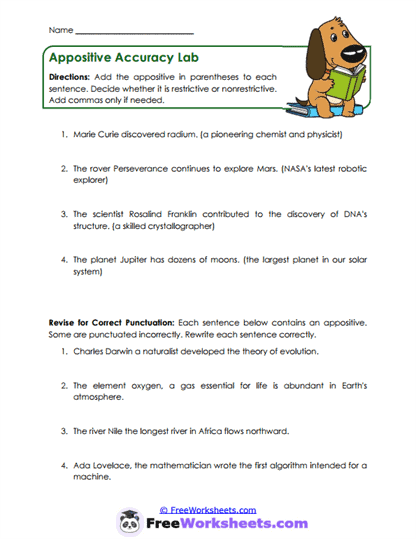
This worksheet teaches students how appositives work within sentences and how punctuation affects their meaning. An appositive is a noun or noun phrase that renames or identifies another noun. Students practice deciding whether an appositive is restrictive, meaning it is essential to the sentence, or nonrestrictive, meaning it provides extra information. For example, “My brother Jake” becomes restrictive because the name identifies which brother, while “Jake, my brother,” becomes nonrestrictive because the identity is already clear. This activity helps Grade 10 students strengthen both grammar knowledge and sentence-writing skills.
Curriculum and Grade Alignment
Students build upon earlier lessons involving nouns, noun phrases, and sentence structure. Understanding appositives helps learners create more sophisticated and informative sentences in both academic and professional writing. This skill also supports reading comprehension because appositives frequently appear in textbooks, articles, and historical documents. The worksheet aligns with Common Core Standard L.9-10.1, which focuses on applying conventions of grammar and usage. It also supports TEKS standards related to sentence construction and editing for clarity.
Student Tasks
On this worksheet, students will insert appositives into sentences and determine whether commas are needed. They analyze whether the information is essential or additional before making punctuation decisions. Learners also revise sentences that contain incorrectly punctuated appositives. Careful reading is necessary because small punctuation changes can alter sentence meaning. Students must apply grammar rules while considering the purpose of the information being added.
Common Challenges and Misconceptions
Many students believe all appositives require commas, even when the information is essential to identifying a noun. Others add commas in the wrong locations or forget to include them around nonrestrictive appositives. Some learners focus on punctuation without first deciding whether the information is necessary to the sentence. Restrictive and nonrestrictive structures can be especially confusing when proper nouns are involved. Teachers should encourage students to ask whether the sentence would still make sense if the appositive were removed.
Implementation Guidance
Teachers can use this worksheet during a unit on sentence structure, punctuation, or editing skills. It works well as guided practice before students begin revising their own writing. Parents can help by reading sentences aloud and discussing whether the extra information is essential or simply descriptive. This conversation helps students understand the reason behind the punctuation rules rather than memorizing them. The worksheet is also useful as a review activity before grammar assessments.
Details and Features
This printable worksheet combines identification, editing, and revision tasks within a single lesson. Real-world examples involving scientists, explorers, and historical figures make the activity engaging and meaningful. Dedicated answer spaces allow students to rewrite sentences neatly and clearly. The format encourages both grammar analysis and practical application. It is suitable for classroom instruction, homework, tutoring, and homeschool language arts lessons.