
Pronouns Worksheets
10th Grade grammar and mechanics pronouns worksheets help students strengthen their understanding of pronoun usage, agreement, reference, and sentence clarity. Free, ready-to-print worksheets are available in PDF format for immediate classroom use and independent practice. Students build skills such as maintaining clear antecedent references, selecting correct pronoun case, improving sentence fluency, and revising writing for greater precision and effectiveness.
About This Collection of Worksheets
Pronouns may be small words, but they play a critical role in effective communication. When used correctly, pronouns help writers avoid repetition, improve sentence flow, and connect ideas smoothly. When used incorrectly, however, they can create confusion, ambiguity, and grammatical errors that weaken a writer’s message. This collection helps students develop a deeper understanding of how pronouns function within sentences and larger pieces of writing.
The worksheets cover a wide range of advanced pronoun concepts, including pronoun-antecedent agreement, pronoun case, reflexive and intensive pronouns, relative pronouns, pronoun reference, point-of-view consistency, comparative structures, and sentence revision. Students learn not only how to identify errors but also how to make purposeful choices that improve clarity, style, and readability. Through realistic editing tasks and authentic writing scenarios, learners gain practical experience applying grammar skills in meaningful contexts.
Teachers, parents, and homeschool educators can use these resources to support grammar instruction, writing workshops, editing practice, essay revision, and language review. Each worksheet focuses on a specific pronoun-related skill while encouraging students to think critically about audience, clarity, and communication. Together, these activities help students become more effective writers who can express ideas accurately and confidently.
Paul’s Teacher Tip
One of the easiest ways to improve writing is to check every pronoun and ask, “What does this word refer to?” Many grammar mistakes occur because writers know what they mean but forget that readers may not have the same context. Encourage students to circle pronouns during revision and identify the antecedent for each one. If the reference is unclear, the sentence probably needs revision. This simple habit helps students strengthen clarity, eliminate confusion, and develop stronger editing skills that transfer to essays, research papers, and professional writing.
Worksheet Collection Skill Spotlights
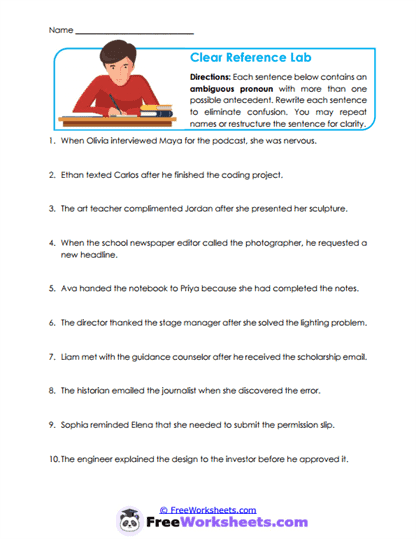
Antecedent Detectives
- What Kids Do:
Students examine sentences containing multiple possible antecedents and revise ambiguous pronouns to improve clarity. They act as editors, identifying places where readers might become confused. - Target Skill:
Students strengthen pronoun-reference and editing skills by ensuring antecedents are clear, specific, and easy for readers to identify.
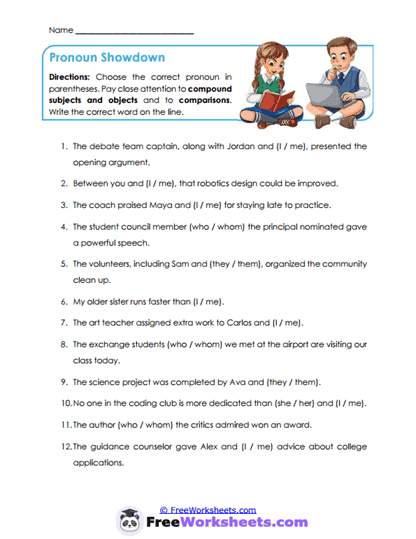
Case Choices
- What Kids Do:
Students select the correct subjective, objective, or relative pronoun for sentences involving school, academic, and community situations. They analyze grammatical function before making choices. - Target Skill:
Students develop a stronger understanding of pronoun case and learn how grammatical roles determine correct pronoun usage.
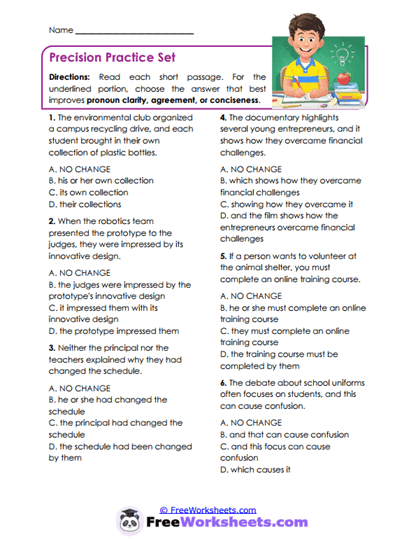
Clarity Check
- What Kids Do:
Students compare multiple revision options and select the pronoun choices that create the clearest, most concise sentences. They evaluate writing from a reader’s perspective. - Target Skill:
Students strengthen editing and revision skills by improving pronoun clarity, agreement, and sentence effectiveness.
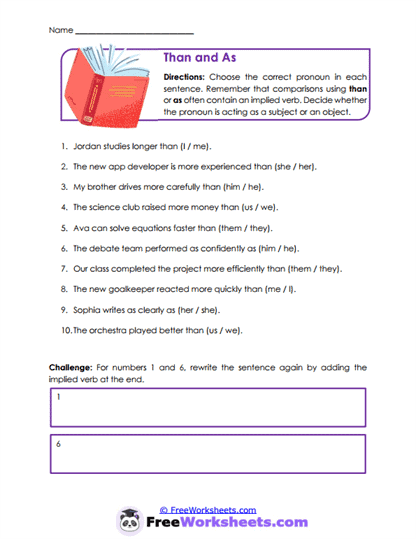
Comparison Cases
- What Kids Do:
Students analyze comparison structures using words such as than and as. They determine whether subject or object pronouns are required and expand shortened comparisons when needed. - Target Skill:
Students build advanced pronoun-case skills by understanding the implied meaning within comparative structures.
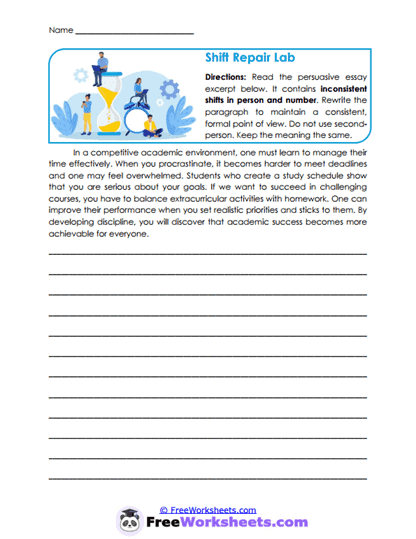
Perspective Shift
- What Kids Do:
Students revise a persuasive paragraph about time management that shifts between first, second, and third person. They create a consistent point of view throughout the passage. - Target Skill:
Students strengthen writing consistency by maintaining a unified perspective and avoiding unnecessary shifts in person.
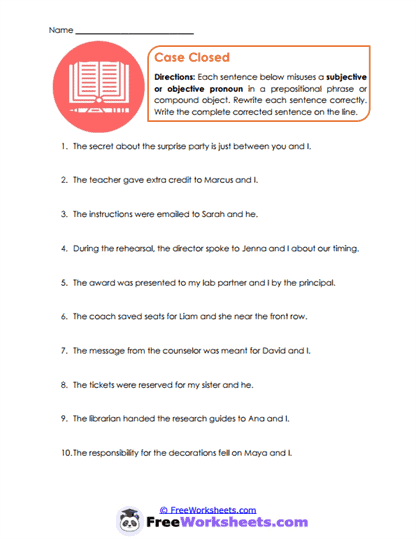
Pronoun Corrections
- What Kids Do:
Students edit sentences that contain pronoun-case errors involving compound objects, prepositions, and formal sentence structures. They rewrite each sentence correctly. - Target Skill:
Students develop confidence with subjective and objective pronouns through targeted editing practice.
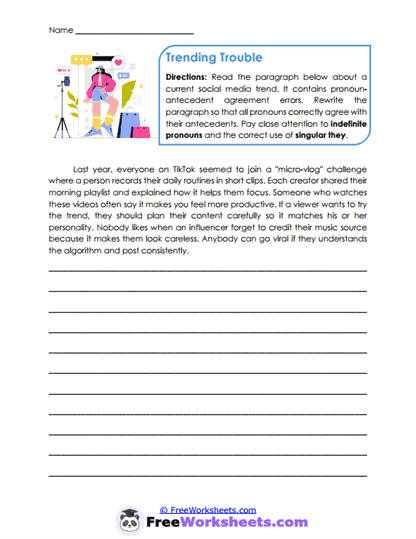
Pronoun Repair
- What Kids Do:
Students revise a paragraph about social media trends by correcting pronoun-antecedent agreement errors, vague references, and unclear pronoun usage. - Target Skill:
Students strengthen editing and revision skills while improving clarity and grammatical accuracy.
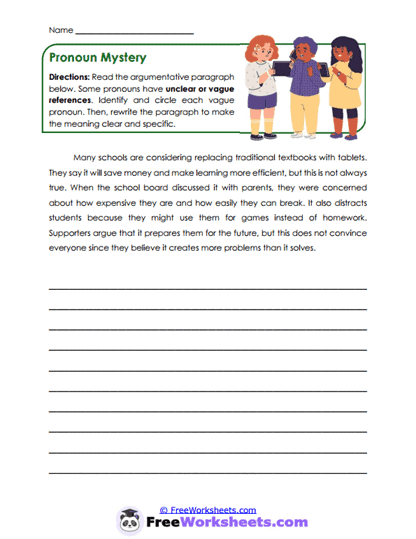
Reference Rescue
- What Kids Do:
Students identify vague pronouns in a technology-focused argumentative paragraph and revise sentences to make references precise and easy to understand. - Target Skill:
Students build audience-awareness skills by ensuring every pronoun clearly points to the correct antecedent.
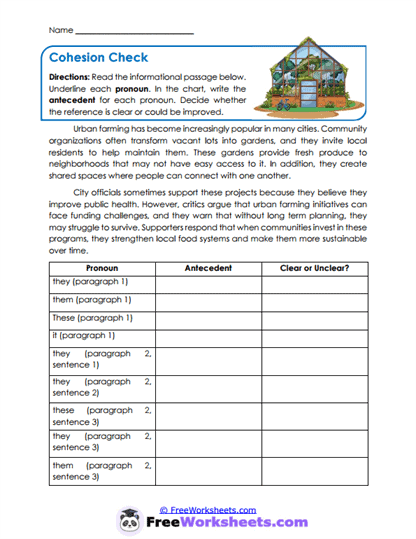
Reference Review
- What Kids Do:
Students read an informational passage about community gardens and trace pronouns back to their antecedents. They evaluate whether each reference is clear or potentially confusing. - Target Skill:
Students strengthen close-reading and pronoun-analysis skills by identifying and evaluating antecedent relationships.
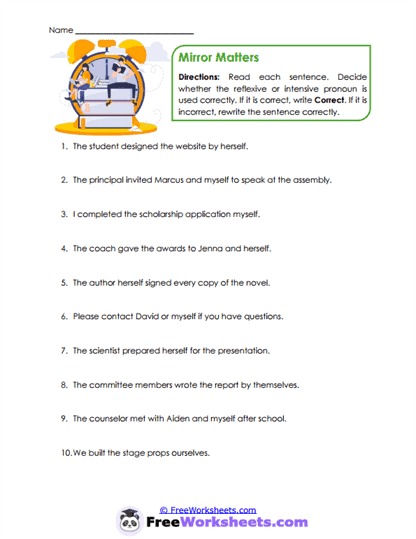
Reflection Rules
- What Kids Do:
Students determine whether reflexive and intensive pronouns are used correctly in realistic situations involving leadership, volunteering, and workplace communication. They revise errors when necessary. - Target Skill:
Students develop a stronger understanding of reflexive and intensive pronouns and avoid common misuse.
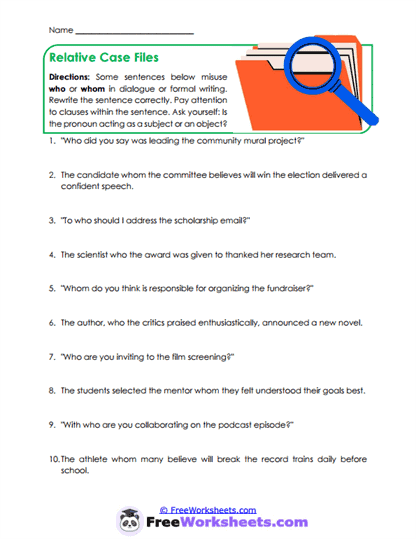
Relative Choices
- What Kids Do:
Students analyze sentences requiring who and whom and determine which form fits the grammatical role within the clause. They revise incorrect examples. - Target Skill:
Students strengthen relative-pronoun and pronoun-case skills while improving formal writing accuracy.
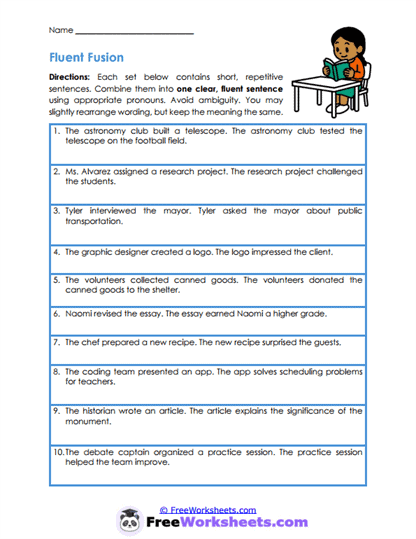
Sentence Flow
- What Kids Do:
Students combine repetitive sentence pairs by replacing repeated nouns with appropriate pronouns. They improve fluency while maintaining clarity. - Target Skill:
Students build revision and sentence-fluency skills by using pronouns effectively to create smoother writing.