
Dilations and Scale Factors Worksheets
These worksheets help students explore coordinate transformations, proportional reasoning, and geometric similarity concepts. These free, ready-to-print worksheets come in PDF format for immediate classroom use, independent practice, homework, or intervention support. Students strengthen skills involving coordinate graphing, similarity transformations, scale factor reasoning, and proportional relationships.
About This Collection of Worksheets
This collection of dilation and scale factor worksheets gives students structured practice with coordinate geometry, proportional reasoning, and transformation rules. Students work through enlargements, reductions, image coordinates, scale factor calculations, and similarity relationships using both visual models and numerical examples. The activities encourage learners to connect graph movements with multiplication, ratios, and geometric reasoning in meaningful ways.
The worksheets include coordinate grids, polygons, real-world scaling problems, image comparisons, and transformation exercises designed to support geometry instruction. Students practice identifying centers of dilation, rewriting ordered pairs, comparing corresponding side lengths, and applying scale factors to practical situations involving blueprints, models, and maps. The progression of activities supports both skill-building and conceptual understanding.
Teachers can use these printable PDF worksheets for guided instruction, independent practice, math stations, homework assignments, review lessons, or assessment preparation. The layouts are clean, easy to follow, and designed to support visual learners while reinforcing mathematical vocabulary and procedural accuracy. The variety of problem types also helps students apply the same transformation concepts across multiple contexts and levels of complexity.
Paul’s Teacher Tip
When introducing dilations and scale factors, start with visual comparisons before moving into formal coordinate rules. Students often understand enlargements and reductions more quickly when they can physically compare shapes on a graph. Encourage learners to label the original figure, image figure, and scale factor before beginning calculations so they avoid reversing ratios or applying operations incorrectly. During graph work, have students check one ordered pair at a time rather than trying to transform the entire figure at once. For struggling learners, repeated verbal reminders like “same shape, different size” can reinforce the idea that dilations preserve similarity. Real-world examples involving maps, architecture, and digital images also help students connect transformations to familiar situations.
Worksheet Collection Skill Spotlights
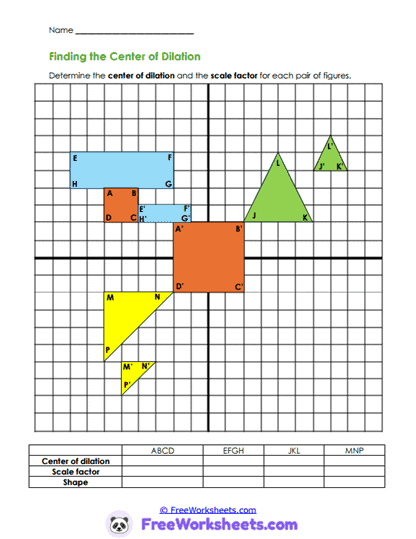
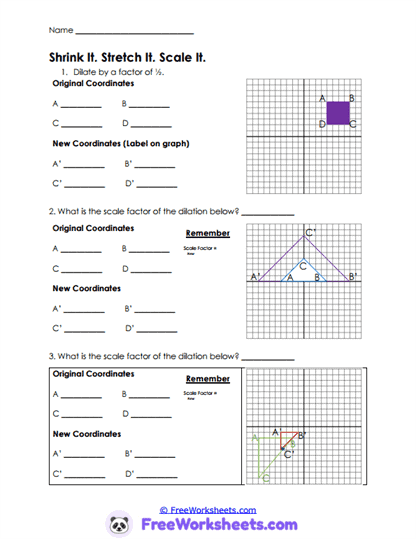
Center Search
- What Kids Do:
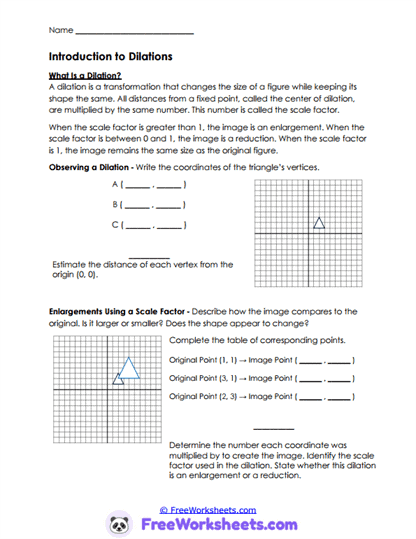
Students study original figures and image figures on coordinate grids to determine centers of dilation, identify enlargements or reductions, compare distances from fixed points, and organize transformation details into structured comparison charts using geometric reasoning. - Target Skill:
Students strengthen transformation skills by analyzing how dilations create similar figures, identifying proportional relationships between coordinates, and explaining how scale factors affect size while preserving geometric similarity and shape structure.
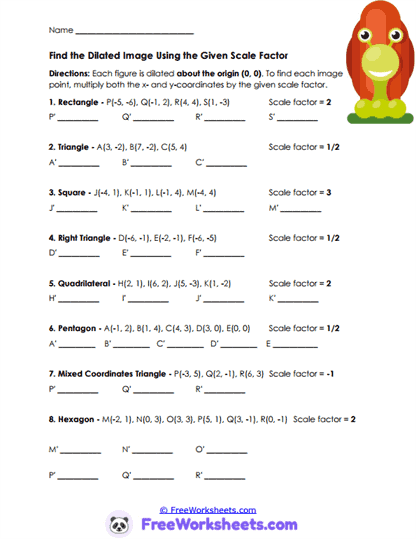
Coordinate Stretch
- What Kids Do:
Students calculate image coordinates for polygons after applying whole-number and fractional scale factors, complete missing ordered pairs, compare original and transformed figures, and analyze how coordinate values change during enlargements and reductions. - Target Skill:
Students apply coordinate geometry and transformation concepts by multiplying coordinates correctly, interpreting proportional changes on the coordinate plane, and using dilation rules to describe similarity relationships through graph-based reasoning.
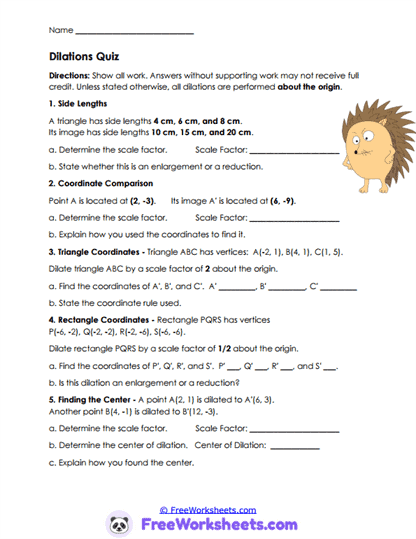
Dilation Review
- What Kids Do:
Students review multiple dilation concepts by solving coordinate problems, comparing figures, finding missing measurements, determining scale factors, and deciding whether transformations represent enlargements or reductions across mixed geometry exercises. - Target Skill:
Students reinforce transformation fluency through repeated practice with coordinate dilations, proportional reasoning, and similarity concepts while strengthening accuracy in graph interpretation, ratio analysis, and mathematical explanation.
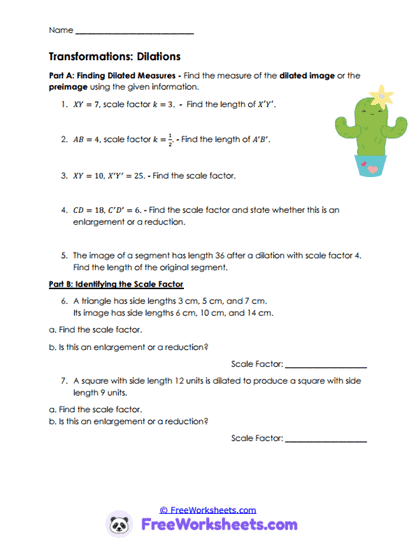
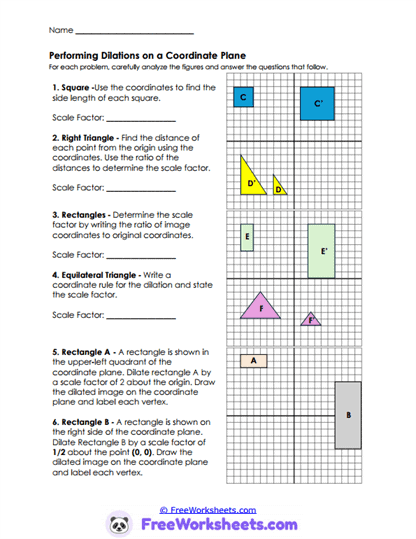
Factor Practice
- What Kids Do:
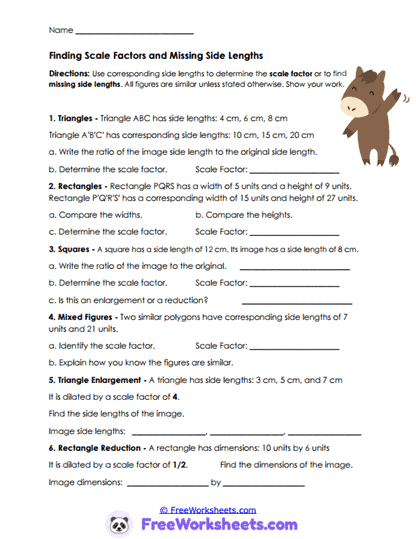
Students solve missing side-length problems, determine unknown scale factors, compare original figures to image figures, and decide whether transformations enlarged or reduced geometric shapes using multiplication and division strategies. - Target Skill:
Students develop proportional reasoning and similarity skills by applying scale factors to geometric measurements, solving ratio-based problems accurately, and understanding how corresponding lengths change during dilations.
Graph Resize
- What Kids Do:
Students graph original figures and image figures, calculate new coordinates after dilations, compare resized polygons, and identify how scale factors change the size and placement of shapes on coordinate planes. - Target Skill:
Students strengthen coordinate transformation understanding by applying dilation rules to ordered pairs, analyzing enlargements and reductions visually, and connecting proportional coordinate changes to geometric similarity relationships.
Plane Growth
- What Kids Do:
Students compare coordinate-plane figures, identify scale factors from side lengths and coordinates, write transformation rules, and draw new image figures directly on graphs while practicing visual and numerical transformation skills. - Target Skill:
Students build mastery with coordinate dilations by connecting graph movements to multiplication rules, analyzing proportional changes between figures, and explaining how transformations preserve shape while altering size.
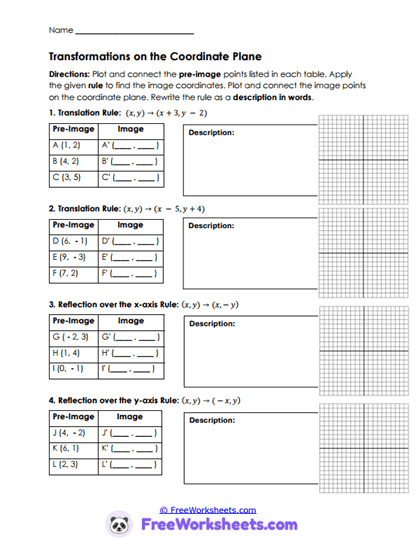
Plane Motion
- What Kids Do:
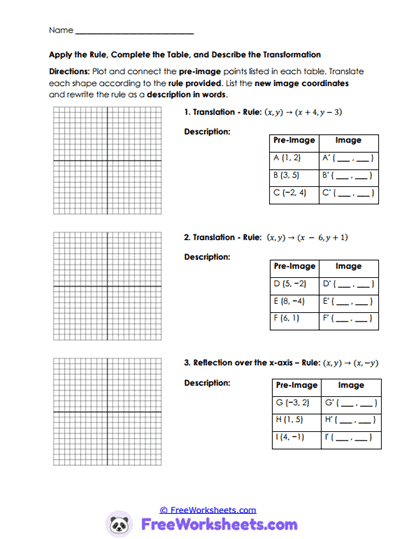
Students apply translations and reflections to ordered pairs, rewrite image coordinates, graph transformed points, and describe geometric movements using directional language and coordinate transformation rules on structured grids. - Target Skill:
Students improve transformation fluency by identifying how reflections and translations affect coordinates, interpreting movement across axes, and representing geometric transformations accurately using coordinate-plane reasoning.
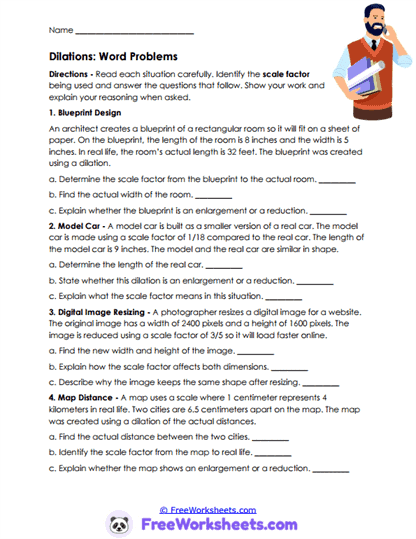
Problem Scaling
- What Kids Do:
Students solve real-world scaling problems involving maps, blueprints, models, and resized images while determining missing measurements, interpreting scale factors, and comparing original dimensions to transformed dimensions in practical situations. - Target Skill:
Students apply proportional reasoning and similarity concepts to authentic measurement contexts by calculating scale relationships, choosing correct operations, and interpreting how dilations model real-world geometric changes.
Rule Practice
- What Kids Do:
Students complete coordinate tables, graph image points, apply translation and reflection rules, and describe figure movement using mathematical language that connects coordinate changes to visual transformations on the plane. - Target Skill:
Students strengthen coordinate transformation accuracy by practicing reflections and translations, analyzing movement across axes and quadrants, and representing geometric rules precisely using coordinate-plane concepts.
Scale Compare
- What Kids Do:
Students compare corresponding side lengths from similar figures, calculate scale factors, solve missing dimensions, and determine whether geometric figures represent enlargements or reductions using ratio reasoning and measurement analysis. - Target Skill:
Students deepen understanding of similarity and proportionality by matching corresponding measurements correctly, constructing accurate ratios, and using scale relationships to explain how geometric figures remain similar during dilations.
Scale Sense
- What Kids Do:
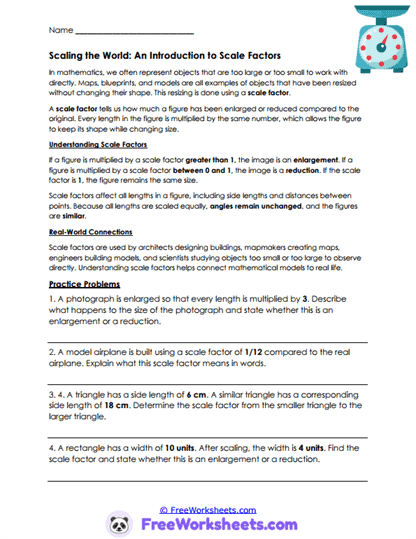
Students analyze real-world scale factor situations involving models, photographs, and maps while deciding whether examples show enlargements or reductions and solving missing measurement problems using proportional reasoning. - Target Skill:
Students develop conceptual understanding of scale factors by connecting ratios, multiplication, and division to geometric similarity while interpreting how proportional relationships affect resized figures.
Size Shift
- What Kids Do:
Students compare original coordinates to image coordinates, identify how points move during dilations, complete missing ordered pairs, and determine whether figures become larger or smaller after scale factor transformations. - Target Skill:
Students practice applying dilation rules on the coordinate plane by multiplying coordinates consistently, interpreting proportional changes visually, and explaining how scale factors preserve similarity while changing figure size in geometry problems.