
About This Worksheet
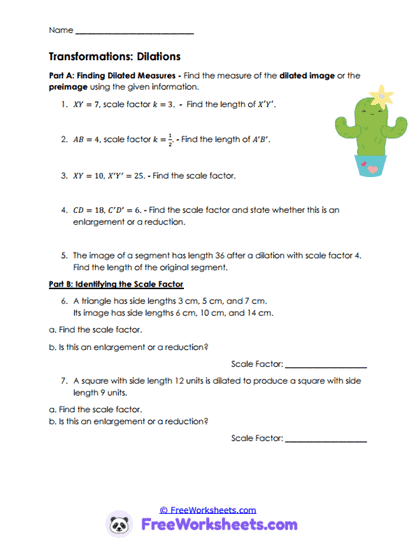
A scale factor compares the size of an original figure to the size of its image after a dilation. This worksheet gives students practice finding missing side lengths, solving for scale factors, and deciding whether a figure was enlarged or reduced. Students use multiplication and division to compare measurements from related figures. For example, a segment with length 9 may become length 36 with a scale factor of 4. The page helps students connect geometric changes to number relationships.
Curriculum and Grade Alignment
This worksheet supports geometry standards related to similarity, proportional reasoning, and transformations. The main goal is to help students use scale factors to solve measurement problems. Students should already understand ratios, multiplication, and division before beginning this activity. The next learning step is applying these relationships to similar triangles and geometric proofs. This aligns with HSG-SRT.A.2 because students use proportional relationships created by dilations.
Student Tasks
On this worksheet, students will solve for missing lengths using given scale factors and side measurements. They will compare original figures to image figures and decide whether each example shows an enlargement or reduction. Students also determine unknown scale factors using side-length ratios. Several problems ask learners to explain how measurements changed during the dilation.
Common Challenges and Misconceptions
Some students may reverse the ratio when calculating the scale factor. Others may confuse the original length with the image length and divide in the wrong direction. A common mistake is forgetting that enlargements use values greater than 1 while reductions use values between 0 and 1. Teachers can help by encouraging students to label each measurement clearly before solving.
Implementation Guidance
This worksheet works well as independent practice after students learn the basics of dilations. Teachers can use it for partner work, review stations, or exit-ticket style assessment. Parents helping at home can guide students by asking whether the figure became bigger or smaller before starting calculations. This simple conversation can help students choose the correct operation more confidently.
Details and Features
The worksheet includes measurement problems, written explanations, and scale factor comparisons. Students practice with triangles, segments, and squares to see how the same rule works across different figures. The layout is clean and printable with enough room for showing work. The progression of problems moves from basic calculations to more thoughtful reasoning tasks.