
About This Worksheet
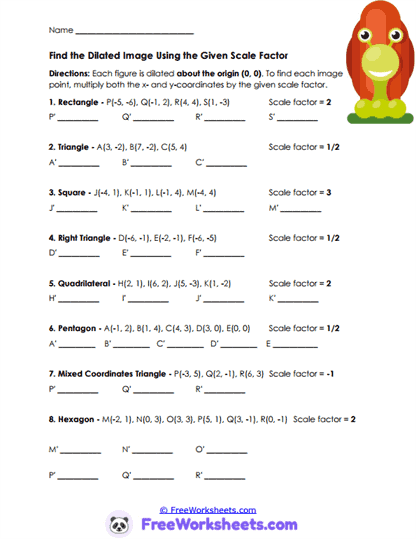
A dilation changes a figure by multiplying each coordinate by the same scale factor. This worksheet helps students practice finding image coordinates after enlargements and reductions on the coordinate plane. Students work with rectangles, triangles, quadrilaterals, and other polygons while applying positive and fractional scale factors. For example, a point at (4, 6) becomes (8, 12) with a scale factor of 2. The activity strengthens both graphing skills and proportional reasoning.
Curriculum and Grade Alignment
This worksheet focuses on transformations and similarity within coordinate geometry. The main learning goal is to apply scale factors correctly to coordinate points during a dilation. Students should already know how to plot points and identify ordered pairs on a graph. After this skill, students are prepared to analyze similar figures and explain geometric relationships. This aligns with HSG-SRT.A.1 because students use dilations to describe similarity transformations.
Student Tasks
On this worksheet, students will calculate new coordinates after applying a given scale factor. They will complete missing ordered pairs for image figures on the coordinate plane. Students also compare original figures with image figures to determine how the shapes changed in size. Some problems involve fractional scale factors, while others require students to work with enlargements and reductions.
Common Challenges and Misconceptions
Some students may multiply only one coordinate instead of both coordinates in an ordered pair. Others may struggle with fractional scale factors and accidentally enlarge the figure instead of reducing it. A common mistake is copying coordinates incorrectly from the original figure. Teachers can help by reminding students to check each point carefully before moving to the next one.
Implementation Guidance
This worksheet works well after students learn the basic dilation rule and need repeated coordinate practice. Teachers can model one problem on the board before students work independently or in small groups. Parents supporting at home can ask students to explain whether the image should become bigger or smaller before calculating. Saying the expected result out loud often helps students catch errors early.
Details and Features
The worksheet includes a variety of polygons, coordinate pairs, and scale factor problems. Students practice using whole-number and fractional scale factors in the same activity. The printable layout gives students space to write image coordinates clearly beside each original point. The organized structure makes the worksheet useful for homework, class review, or skill reinforcement.