
About This Worksheet
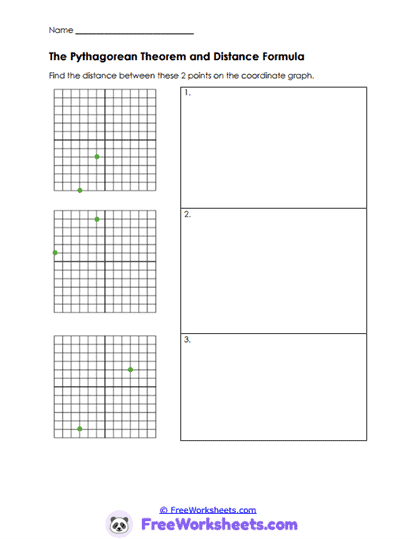
The distance formula is based on the Pythagorean Theorem and helps measure the distance between two points on a coordinate plane. This worksheet gives students practice finding distances by using graph points to create right triangles. Students count horizontal and vertical movement before calculating the diagonal distance. For example, moving 3 units across and 4 units up creates a distance of 5 units. The activity helps students connect graphing skills with right triangle relationships.
Curriculum and Grade Alignment
This worksheet supports geometry standards involving coordinate geometry and right triangle measurement. The main learning goal is to use the Pythagorean Theorem to calculate distances between points on a graph. Students should already understand ordered pairs, graphing, and basic square root operations before beginning. The next learning step is applying the formal distance formula in algebra and geometry settings. This aligns with HSG-GPE.B.7 because students use coordinates and geometric reasoning to solve distance problems.
Student Tasks
On this worksheet, students will study coordinate graphs and calculate the distance between plotted points. They will determine horizontal and vertical leg lengths before applying the Pythagorean Theorem. Students also organize their calculations and simplify answers when needed. Several problems ask learners to explain how the graph connects to the theorem.
Common Challenges and Misconceptions
Some students may count grid units incorrectly when measuring the horizontal and vertical distances. Others may confuse the legs of the triangle with the diagonal distance being solved. A common mistake is forgetting to square the values before adding them together. Teachers can help by encouraging students to draw or trace the right triangle before solving.
Implementation Guidance
This worksheet works well as an introduction to the distance formula or as review practice for coordinate geometry. Teachers can model one graph example together before students complete the remaining problems independently. Parents helping at home can ask students to point out the horizontal, vertical, and diagonal sides before calculating. That visual connection often helps students better understand why the theorem works on graphs.
Details and Features
The worksheet includes coordinate grids with plotted points and open workspace for calculations. Students practice graph reading, right triangle setup, and distance solving in one activity. The printable layout provides large graph spaces for easier counting and organization. The structured format supports classroom instruction, homework, or small-group review.