
Points, Lines, Line Segments, And Planes Worksheets
Points, lines, line segments, and planes give 10th grade math students the vocabulary and visual structure needed to describe nearly every geometric figure they encounter. This free collection of ready-to-print PDF worksheets works well for immediate classroom instruction, homework, review, tutoring, intervention, or independent geometry practice. Through notation, diagram reading, collinearity, coplanarity, and figure construction, students build the precise geometric language and reasoning expected throughout the 10th grade curriculum.
About This Collection of Worksheets
Points, lines, line segments, and planes form the basic language of 10th grade geometry. A point identifies an exact location, a line extends endlessly in two directions, a segment has two fixed endpoints, and a plane represents a flat surface extending without end. Students also use these objects to describe relationships such as collinear points, coplanar figures, intersections, shared endpoints, and points that lie between other points.
This collection moves beyond simple vocabulary review by asking students to recognize, name, draw, compare, and reason about foundational geometric objects. Activities include matching figures with notation, searching larger diagrams for specific objects, drawing figures from written directions, classifying collinear and coplanar relationships, writing alternate names for lines and segments, evaluating geometry claims, correcting mistakes, completing diagrams, matching descriptions with pictures, and answering mixed multiple-choice questions. These varied formats help students connect geometric language with the diagrams and symbols they will use throughout high-school geometry.
Teachers can use these worksheets at the beginning of a 10th grade geometry course or anytime students need reinforcement with foundational notation and diagram interpretation. Individual pages work well for warm-ups, direct instruction, partner practice, independent work, homework, intervention, or formative assessment. Parents, tutors, and homeschool educators can also use the collection to strengthen one concept at a time before students move into angles, constructions, coordinate geometry, transformations, and proof-based reasoning.
Paul’s Teacher Tip
Have students identify the type of geometric object first and write its name or notation second. Small visual details matter: arrows show that a line continues, endpoints show where a segment stops, and a slanted parallelogram is only a model of an infinite plane. When teaching collinear and coplanar relationships, ask students to state the full definition aloud before judging the diagram so they do not rely only on appearance. For three-letter or two-letter naming, encourage students to trace the actual object with a finger or pencil before writing the letters. As students become comfortable, ask them to explain what detail in the diagram proves each answer so the activity begins building habits useful for formal proofs.
Worksheet Collection Skill Spotlights
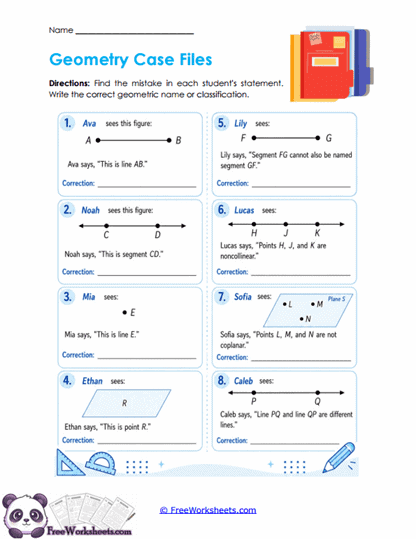
Case Corrections
What Kids Do:
Students examine eight incorrect statements about points, lines, segments, planes, collinear points, and coplanar relationships. They compare each claim with the accompanying figure, identify the specific geometric mistake, and rewrite the statement using the correct name, notation, or classification.
Target Skill:
This activity strengthens precision with foundational geometry language by requiring students to explain why a description is incorrect. Students practice distinguishing objects by endpoints, arrows, placement, and plane membership while developing the careful error-analysis habits needed for 10th grade proof and diagram work.
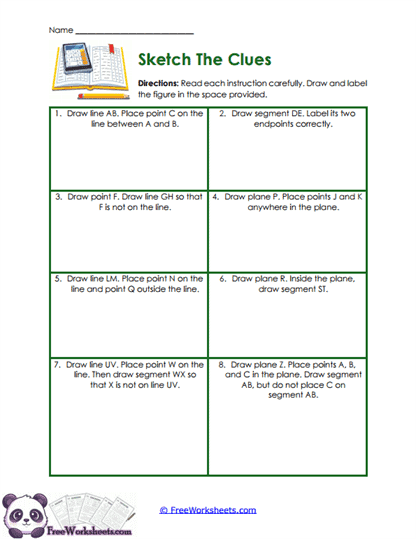
Diagram Drawing
What Kids Do:
Students create eight geometric diagrams from written directions involving points, lines, line segments, and planes. They follow location conditions such as placing a point on a line, between two endpoints, inside a plane, or away from a given object while labeling every part correctly.
Target Skill:
Students strengthen their ability to translate geometric language into visual representations. The worksheet reinforces object definitions, spatial vocabulary, labeling, and notation while helping 10th grade students understand that accurate diagrams depend on carefully following every stated condition.
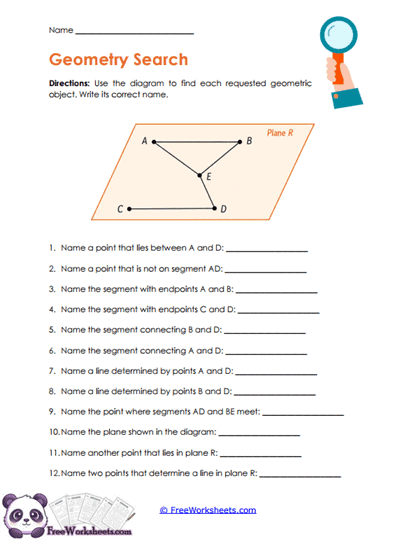
Diagram Search
What Kids Do:
Students study one larger geometric diagram containing a plane and several connected labeled points, then answer twelve questions about the objects shown. They identify points, segments, lines, intersections, points between other points, and objects located within the same plane.
Target Skill:
This worksheet develops diagram-reading skills by requiring students to locate precise geometric information inside a more complex figure. Students reinforce naming, segment-versus-line distinctions, intersections, betweenness, and plane membership while preparing for more involved 10th grade geometry diagrams.
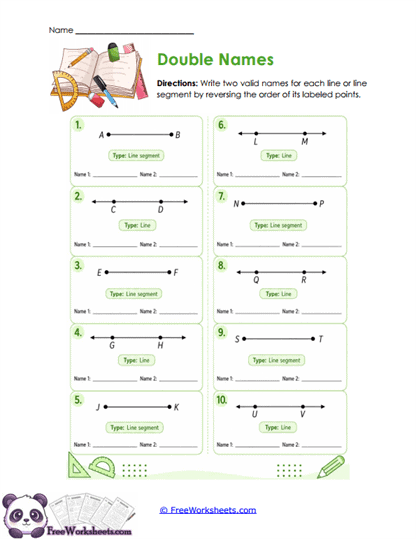
Double Names
What Kids Do:
Students look at ten diagrams of lines and line segments and write two valid names for each figure by reversing the order of its labeled points. Before naming, they determine whether the object has endpoints or arrows so the correct line or segment notation is used.
Target Skill:
Students learn that reversing the two labeled points does not create a different line or segment. The activity strengthens notation fluency, figure recognition, endpoint reasoning, and the ability to recognize equivalent geometric names that may appear in different problems or proofs.
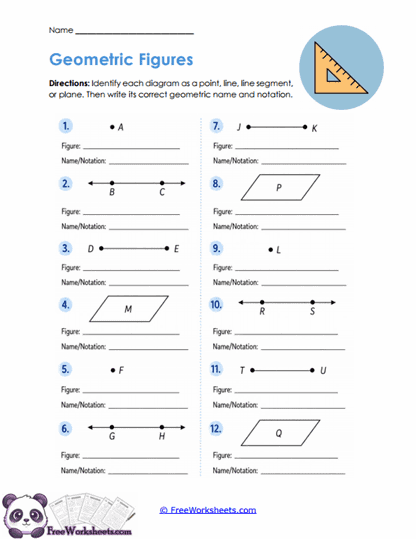
Figure Basics
What Kids Do:
Students examine twelve simple diagrams and classify each as a point, line, line segment, or plane. They then use the labels shown to write the correct geometric name or notation, paying close attention to dots, arrowheads, endpoints, and plane representations.
Target Skill:
This activity establishes the core vocabulary used throughout high-school geometry. Students practice recognizing the defining features of foundational geometric objects and expressing those objects with precise notation, giving them the language needed for later work with angles, constructions, and proofs.
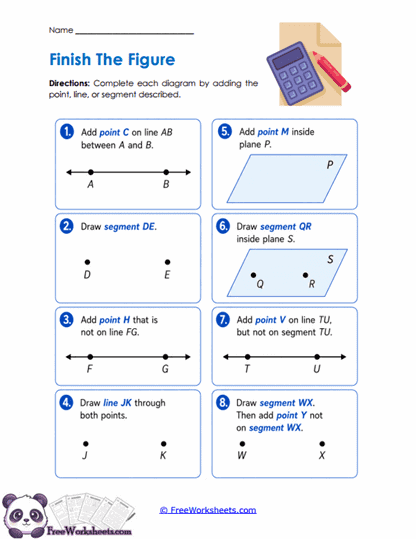
Figure Finish
What Kids Do:
Students complete eight partially drawn geometric figures by adding a requested point, line, or segment in the correct location. They interpret directions involving ideas such as between, inside, on, and not on, then modify the diagram so every stated condition is satisfied.
Target Skill:
Students strengthen the connection between written geometric conditions and visual structure. The worksheet reinforces object construction, spatial relationships, and careful interpretation while helping 10th grade students create diagrams that accurately represent mathematical statements.
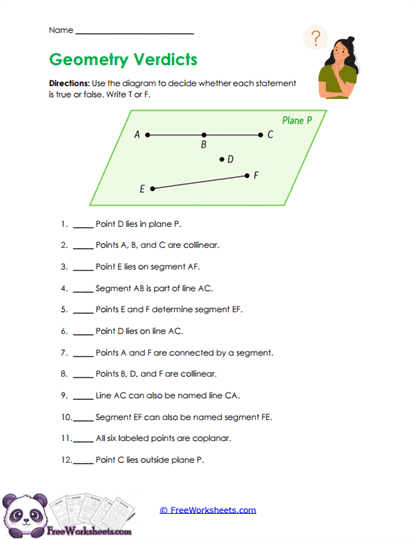
Geometry Claims
What Kids Do:
Students use one labeled diagram in a plane to judge twelve statements as true or false. They evaluate claims involving collinearity, segment membership, plane membership, equivalent segment names, connections among points, and the difference between lying on a segment and lying on a full line.
Target Skill:
This reasoning-focused activity develops the precision needed for geometric proofs. Students learn to base conclusions on what is actually shown or stated in a diagram, strengthening definitions, notation, visual evidence, and logical interpretation in 10th grade geometry.
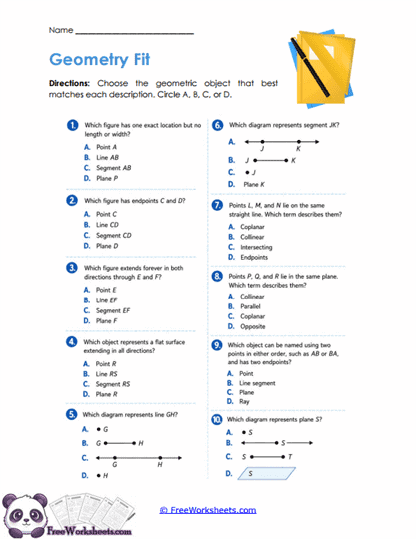
Geometry Fit
What Kids Do:
Students answer ten multiple-choice questions covering definitions, diagrams, notation, endpoints, collinear points, coplanar points, lines, segments, and planes. They compare closely related answer choices and select the one that best matches the complete geometric description.
Target Skill:
This mixed review strengthens students’ ability to distinguish foundational geometry concepts under assessment-style conditions. Students reinforce exact definitions, visual clues, notation, and relationship vocabulary while practicing careful elimination of choices that are only partly correct.
Geometry Links
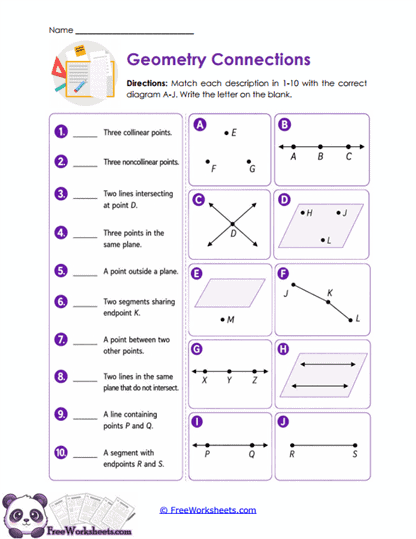
What Kids Do:
Students match ten written geometric descriptions with diagrams showing relationships such as collinear points, noncollinear points, intersecting lines, coplanar objects, shared endpoints, and points located between other points. They compare labels, connections, and placement before making each match.
Target Skill:
Students strengthen their ability to move between verbal geometry and visual representations. The activity reinforces relational vocabulary, diagram interpretation, intersections, shared endpoints, collinearity, and coplanarity while supporting the language skills needed for 10th grade constructions and proofs.
Geometry Pairing
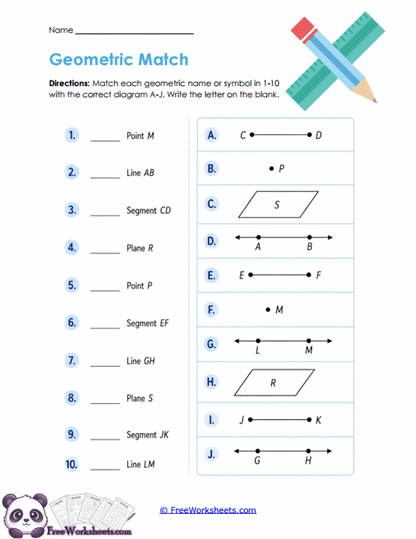
What Kids Do:
Students match ten geometric names or notation examples with the diagrams that correctly represent them. They identify whether each picture shows a point, line, segment, or plane and then confirm that the labels in the drawing match the requested geometric object.
Target Skill:
This worksheet reinforces the connection between terminology, symbols, and diagrams. Students practice distinguishing objects that may share the same labeled points but differ because of endpoints, arrows, or plane representation, strengthening foundational 10th grade notation accuracy.
Line Patterns
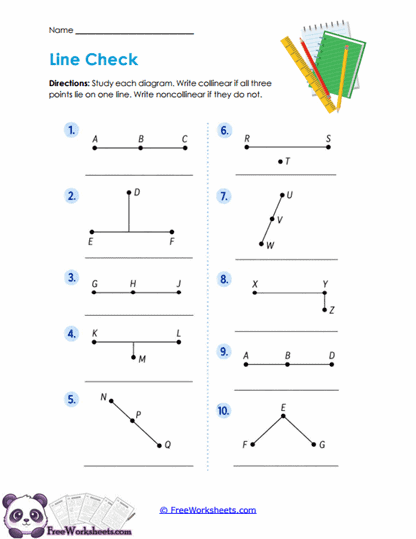
What Kids Do:
Students study ten groups of three labeled points and decide whether each group is collinear or noncollinear. They determine whether one straight line could pass through all three points rather than relying on how close the points appear to one another.
Target Skill:
Students build a clear understanding of collinearity as a precise relationship among points. The worksheet strengthens visual reasoning, definition use, and line structure while preparing 10th grade students for coordinate arguments, proofs, and more complicated geometric diagrams.
Plane Relations
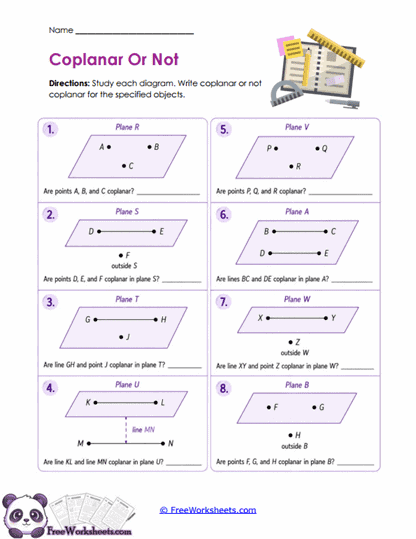
What Kids Do:
Students examine eight diagrams containing planes along with labeled points, lines, or segments and decide whether specified objects are coplanar. They determine whether every named object lies within the same plane and distinguish coplanarity from the separate idea of collinearity.
Target Skill:
This activity develops spatial reasoning with points, lines, and planes. Students reinforce the meaning of a shared geometric plane, learn that coplanar objects do not need to be collinear, and build the conceptual foundation needed for later 10th grade work with three-dimensional figures and proofs.