
About This Worksheet
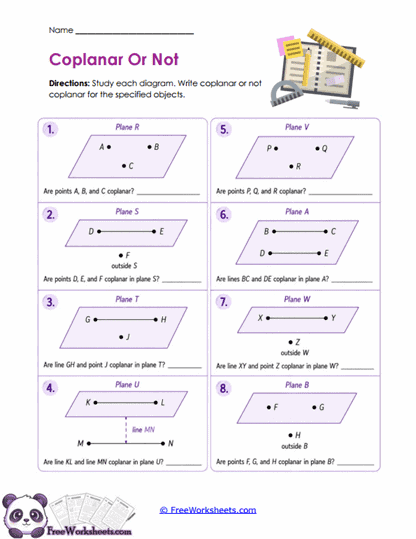
This worksheet helps tenth-grade students decide whether specified points and lines are coplanar or not coplanar. Students study eight diagrams containing a plane and several labeled points or segments, some of which lie inside the plane and some outside it. They then determine whether the named objects all lie in the same plane. This gives students practice with a three-dimensional relationship that is often shown using simple two-dimensional drawings.
For example, three points drawn inside the same plane are coplanar. If one of the points is shown outside the plane, then the set is not coplanar. Students also examine line segments and decide whether the entire object lies within the indicated plane.
What Students Practice
Students practice identifying which objects belong to a particular plane and which do not. They use position and labels to determine whether all requested points or lines share the same flat surface. This strengthens spatial reasoning and geometry vocabulary.
The worksheet also helps students distinguish between being on the same line and being in the same plane. Objects can be coplanar without being collinear, so students begin to see that these relationships describe different kinds of geometric structure.
Why This Skill Matters
Coplanarity is an important idea in geometry because many theorems and proofs depend on objects lying in the same plane. Students need to recognize whether lines, points, and segments belong to one shared flat surface before making conclusions about their relationships.
This skill also supports three-dimensional thinking. Even though the worksheet shows planes as slanted parallelograms, students learn that the actual plane extends infinitely in all directions. That idea prepares them for work with spatial geometry.
Common Challenges
Students may assume that any points drawn close together are coplanar. Remind them to look specifically at whether the points are shown on the same plane. A point drawn outside the plane breaks the relationship.
Another common mistake is confusing coplanar with collinear. Collinear means sharing one line, while coplanar means sharing one plane. Several points can be coplanar without lying on the same line.
How To Use It
Teachers can use this worksheet after introducing planes and basic spatial relationships. It works well for guided practice, independent work, homework, or a bridge into three-dimensional geometry. Asking students to explain why a set is not coplanar can strengthen understanding.
Parents and homeschool teachers can ask, “Are all of these objects inside the same plane?” If yes, they are coplanar. If even one object lies outside, they are not coplanar.
Grade Alignment
This worksheet is intended for Grade 10 geometry and supports CCSS HSG-CO.A.1 by reinforcing the foundational ideas of points, lines, and planes. It also prepares students for more advanced spatial reasoning and proof relationships.
Students should already recognize plane diagrams and basic line relationships. After this practice, they can move into naming geometric objects in multiple ways and evaluating more complex statements.