
SOH-CAH-TOA Right Triangle Trigonometry Worksheets
Right triangle trigonometry gives 10th grade math students a practical way to connect angles, side lengths, and proportional relationships within a triangle. These free, ready-to-print PDF worksheets can be used immediately for classroom lessons, homework, review, intervention, tutoring, or independent practice with SOH-CAH-TOA. By identifying side roles, selecting trig ratios, solving for unknown sides and angles, and interpreting real situations, students build the reasoning expected throughout the 10th grade curriculum.
About This Collection of Worksheets
SOH-CAH-TOA gives 10th grade students a structured way to work with right triangles by connecting an acute angle with ratios of the opposite, adjacent, and hypotenuse sides. Students first need to recognize how those side roles change depending on the reference angle, then determine whether sine, cosine, or tangent connects the information they know with the measurement they need. As their understanding grows, they can also use inverse trigonometric functions to recover missing angle measures from known side lengths.
This collection develops those ideas through a wide range of activities. Students identify side roles, choose appropriate trig functions, match triangle descriptions with equations, solve for missing sides, use inverse trig to find angles, interpret written trig ratios, select correct equations, analyze errors, work through ladder and elevation applications, evaluate true-or-false trig statements, and complete mixed right-triangle problems. The varied formats reinforce setup, calculation, interpretation, and checking rather than treating trigonometry as a single calculator routine.
Teachers can use these worksheets across a 10th grade geometry trigonometry unit, beginning with side identification and ratio selection before moving into equations, inverse functions, and real-world applications. The pages work well for direct instruction, guided practice, independent classwork, homework, review, intervention, partner work, or assessment preparation. Parents, tutors, and homeschool educators can also use individual activities to strengthen one step of the SOH-CAH-TOA process before combining several skills in mixed problems.

Paul’s Teacher Tip
Have students label O, A, and H on every triangle before they touch the calculator, because most trigonometry errors begin with incorrect side identification. Next, ask which two side roles are involved and let that decision choose sine, cosine, or tangent rather than relying on memorization alone. When the unknown is an angle, explicitly point out that students are now working backward and need an inverse trig function. Make calculator mode part of the routine by having students confirm degree mode before beginning a problem set. For a final reasonableness check, remind students that the hypotenuse must be the longest side and that acute angles in a right triangle must fall between 0° and 90°.
Worksheet Collection Skill Spotlights
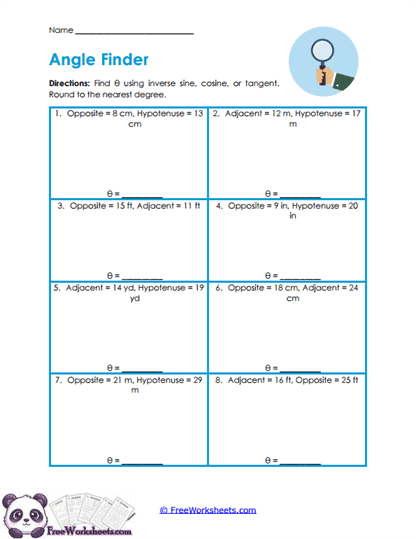
Angle Search
What Kids Do:
Students use pairs of known right-triangle side lengths to determine missing acute angles. They identify whether the known sides form a sine, cosine, or tangent ratio, write the correct fraction, apply the matching inverse trig function, and round each resulting angle to the requested degree.
Target Skill:
This activity develops the reverse use of trigonometric ratios by connecting side relationships back to angle measures. Students strengthen inverse sine, inverse cosine, inverse tangent, calculator use, and 10th grade understanding of how side ratios uniquely determine acute angles in right triangles.
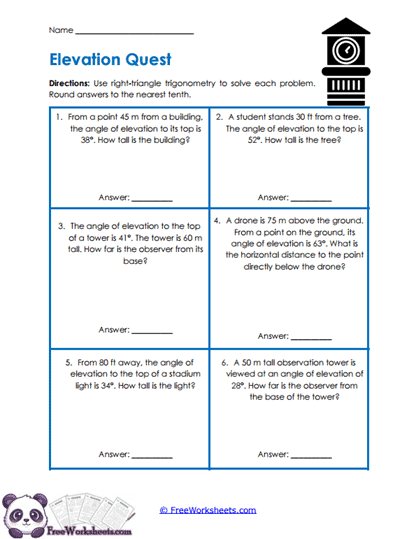
Elevation Problems
What Kids Do:
Students solve six real-world problems involving buildings, trees, towers, drones, lights, and observation points. They translate each situation into a right triangle, identify the angle of elevation, label the horizontal and vertical sides, and use an appropriate trig ratio to find a missing height or distance.
Target Skill:
Students apply right-triangle trigonometry to indirect measurement and mathematical modeling. The worksheet reinforces tangent relationships, diagram creation, algebraic rearranging, and interpretation of horizontal and vertical quantities while showing how 10th grade trig can solve measurements that are difficult to obtain directly.
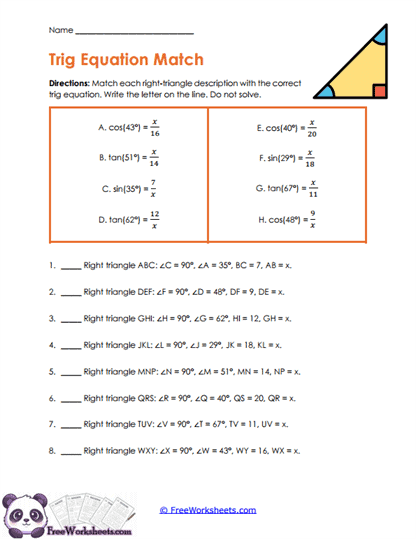
Equation Match
What Kids Do:
Students read eight right-triangle descriptions and match each one to a correct equation from a bank of sine, cosine, and tangent expressions. They identify the reference angle, determine which sides are opposite, adjacent, and hypotenuse, and check both the function and fraction order without solving numerically.
Target Skill:
This worksheet strengthens trigonometric setup before calculator work begins. Students practice translating side relationships into symbolic equations, using SOH-CAH-TOA accurately, and recognizing that the order of the numerator and denominator is just as important as choosing the correct trig function.
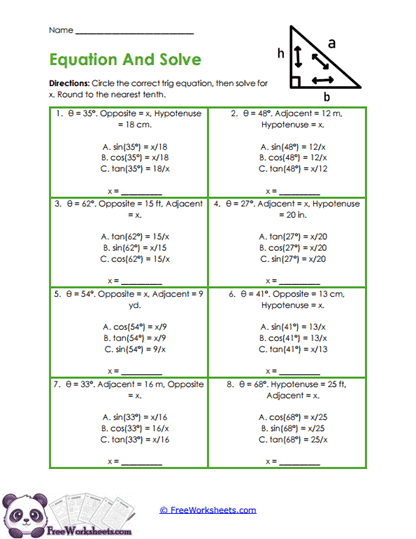
Equation Solve
What Kids Do:
Students examine eight right-triangle problems, choose the correct trigonometric equation from three options, and then solve for the missing side length. They identify side roles, reject incorrect ratios, substitute the known measurements, rearrange the equation when necessary, and calculate the final value.
Target Skill:
Students develop the complete SOH-CAH-TOA solving process while learning to distinguish valid setups from common distractors. The activity reinforces ratio selection, equation interpretation, algebraic isolation, and calculator accuracy in 10th grade right-triangle work.
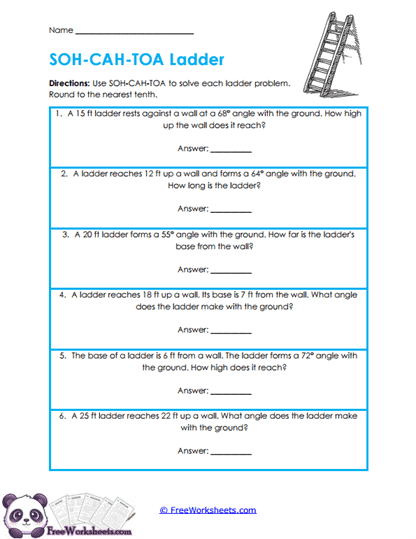
Ladder Trig
What Kids Do:
Students solve six ladder situations involving a ladder leaning against a wall and forming a right triangle with the ground. Depending on the information provided, they calculate a height, base distance, ladder length, or angle by identifying the correct side roles and choosing regular or inverse trigonometry.
Target Skill:
This activity connects SOH-CAH-TOA with a familiar real-world structure. Students strengthen modeling, hypotenuse recognition, side and angle solving, and inverse trig reasoning while seeing how right triangles can be used to calculate measurements in construction, safety, and indirect-measurement settings.
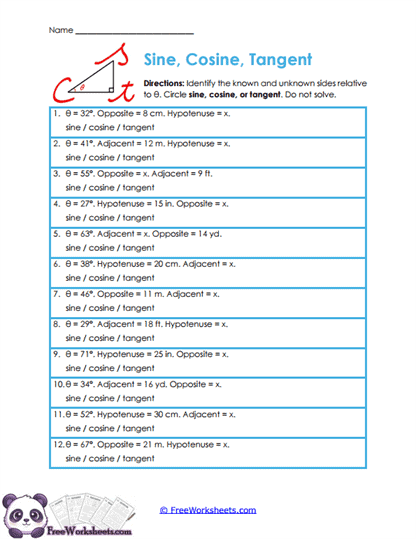
Ratio Choice
What Kids Do:
Students work through twelve situations that identify a reference angle and the two side roles involved in a right triangle. Without solving any numerical problems, they decide whether sine, cosine, or tangent is the ratio that correctly connects those two sides.
Target Skill:
Students build fast, accurate trig-function selection by focusing entirely on SOH, CAH, and TOA. The worksheet reinforces that sine compares opposite and hypotenuse, cosine compares adjacent and hypotenuse, and tangent compares opposite and adjacent before more complicated solving is introduced.
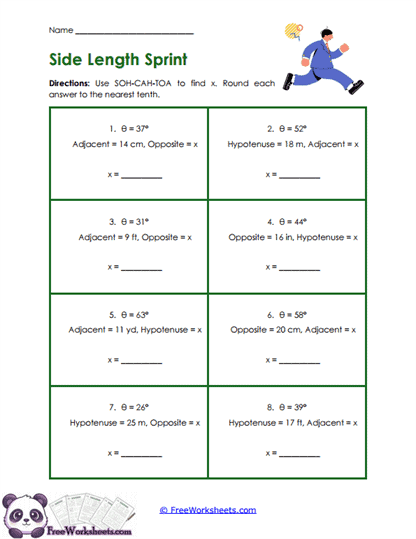
Side Lengths
What Kids Do:
Students solve eight right triangles that provide one acute angle, one known side, and one missing side. They label the side roles, select sine, cosine, or tangent, write the equation, isolate the unknown, use a calculator in degree mode, and round the final length to the nearest tenth.
Target Skill:
This worksheet develops fluency with one of the central uses of right-triangle trigonometry: finding inaccessible side lengths from an angle and another side. Students reinforce function choice, algebraic rearranging, calculator use, and accurate rounding within 10th grade geometry.
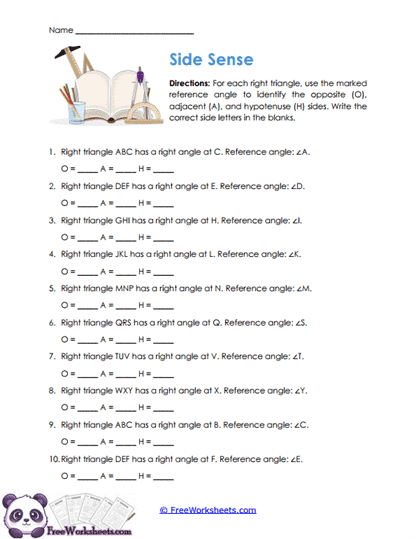
Side Roles
What Kids Do:
Students study ten right-triangle descriptions and label each relevant side as opposite, adjacent, or hypotenuse relative to a named acute reference angle. They locate the right angle first, identify the hypotenuse, and then determine which remaining leg sits across from or beside the reference angle.
Target Skill:
This activity establishes the vocabulary needed for every SOH-CAH-TOA problem. Students learn that the hypotenuse remains fixed while opposite and adjacent depend on perspective, strengthening the 10th grade conceptual foundation behind sine, cosine, and tangent.
Triangle Completion
What Kids Do:
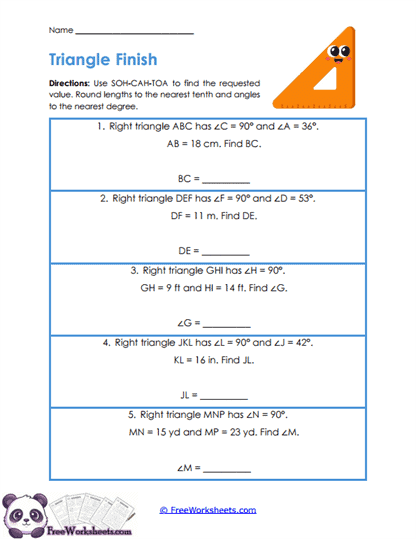
Students complete five mixed right-triangle problems in which different measurements are missing. Some problems require regular sine, cosine, or tangent to find a side, while others require inverse trig to determine an angle, forcing students to decide which kind of problem they are facing before calculating.
Target Skill:
This mixed review develops flexibility with both forward and inverse trigonometric reasoning. Students practice choosing reference angles, labeling sides, selecting functions, solving equations, and deciding whether regular or inverse trig is appropriate for a given 10th grade right-triangle situation.
Trig Errors
What Kids Do:
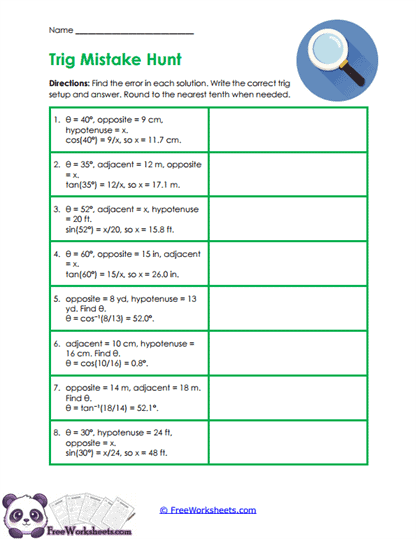
Students analyze eight worked SOH-CAH-TOA solutions that contain mistakes involving side labels, trig-function choice, reversed ratios, inverse functions, algebra, or calculator work. They identify the first incorrect step, explain what went wrong, and rewrite the solution correctly.
Target Skill:
Error analysis strengthens conceptual understanding and self-checking in right-triangle trigonometry. Students learn to inspect setup before arithmetic, verify whether the function matches the side relationship, and judge whether a final side or angle value is reasonable for the triangle.
Trig Sorting
What Kids Do:
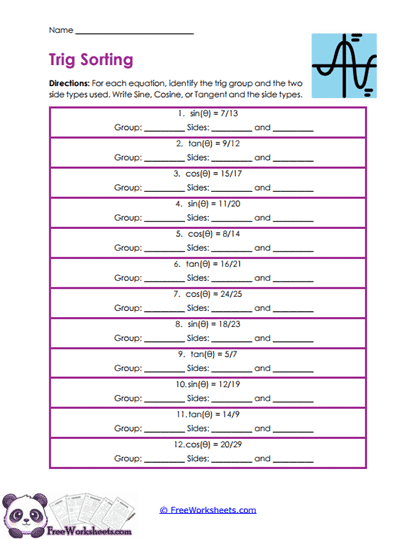
Students interpret twelve written equations such as sin(θ) = 7/13 or tan(θ) = 16/21. For each ratio, they identify whether it represents sine, cosine, or tangent and determine which side role belongs to the numerator and which belongs to the denominator.
Target Skill:
Students strengthen their ability to read trigonometric notation rather than simply produce it. The activity reinforces the structure of SOH-CAH-TOA, fraction order, and side-role recognition while helping students recognize whether a written trig equation makes sense.
Trig Statements
What Kids Do:
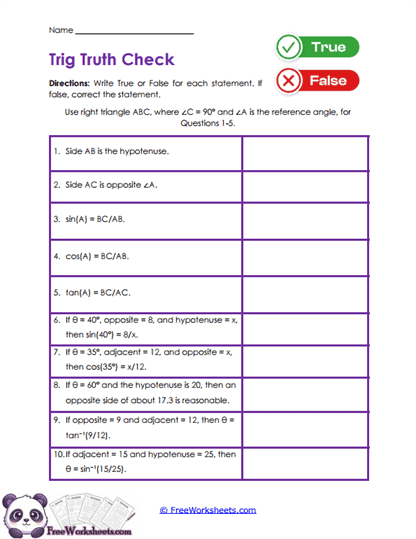
Students study a labeled right triangle and evaluate ten statements involving the hypotenuse, opposite and adjacent sides, sine, cosine, tangent, and numerical trig equations. They mark each statement true or false and correct any statement that misidentifies a side or sets up a ratio incorrectly.
Target Skill:
This reasoning-focused worksheet develops conceptual understanding of right-triangle trigonometry beyond routine calculation. Students reinforce side-role definitions, ratio order, reference-angle thinking, and the ability to verify trig statements before using them in 10th grade problem solving.