
Angles Worksheets
Angles in 10th grade math give students a foundation for reading diagrams, recognizing geometric relationships, and building equations from visual information. These free, ready-to-print PDF worksheets are suited for immediate classroom lessons, homework, review, tutoring, intervention, or independent geometry practice. By classifying angles, interpreting notation, solving for unknown measures, and justifying relationships, students develop the precision and reasoning expected throughout the 10th grade curriculum.
About This Collection of Worksheets
Angle relationships sit at the heart of high-school geometry because they help students make sense of intersecting lines, straight lines, right angles, algebraic expressions, and proof-based diagrams. This collection begins with foundational ideas such as angle types and three-letter notation, then builds into complementary, supplementary, vertical, adjacent, and linear-pair relationships. Students use those ideas to determine missing measures, construct equations, and explain why particular geometric statements are true.
The worksheets offer much more than repeated angle calculations. Students classify measures, name angles precisely, identify relationships from diagrams and descriptions, solve vertical-angle and linear-pair equations, analyze incorrect reasoning, determine which relationship justifies a missing measure, evaluate true-or-false claims, match algebraic expressions to angle conditions, and complete themed geometry challenges. This mix gives students opportunities to work numerically, visually, verbally, and algebraically while reinforcing the same core geometric ideas from different directions.
Teachers can use these pages across a 10th grade geometry unit as prerequisite review, direct instruction, independent practice, partner discussion, homework, intervention, test preparation, or informal assessment. Parents, tutors, and homeschool educators can also select individual worksheets based on whether a student needs support with vocabulary, algebraic setup, diagram interpretation, or geometric reasoning. The progression from basic identification into equations and justification makes the collection useful for both skill building and broader proof preparation.

Paul’s Teacher Tip
Before students calculate anything, ask them to name the angle relationship and state what that relationship guarantees. A short reference such as complementary = 90°, supplementary = 180°, vertical = congruent, linear pair = 180° can help students connect vocabulary with the correct equation. When diagrams contain several rays, have students mark or trace the exact two angles being compared before writing any algebra. If students solve for x, remind them to check whether the question asks for x or the actual angle measure, because those are not always the same answer. For stronger proof readiness, have students justify selected answers with a complete sentence that names the geometric fact being used.
Worksheet Collection Skill Spotlights
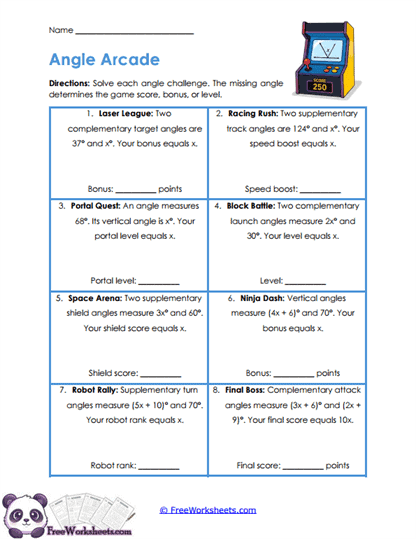
Angle Arcade
What Kids Do:
Students complete eight game-themed angle challenges involving complementary, supplementary, and vertical relationships. They identify the relationship described in each arcade-style situation, write the equation that represents it, solve for x, and use the result as part of the score, level, bonus, or challenge outcome.
Target Skill:
This mixed review strengthens students’ ability to translate angle relationships into equations quickly and accurately. Students reinforce 90° totals, 180° totals, congruent vertical angles, and one- or two-step algebra while applying core 10th grade geometry skills in a more engaging format.
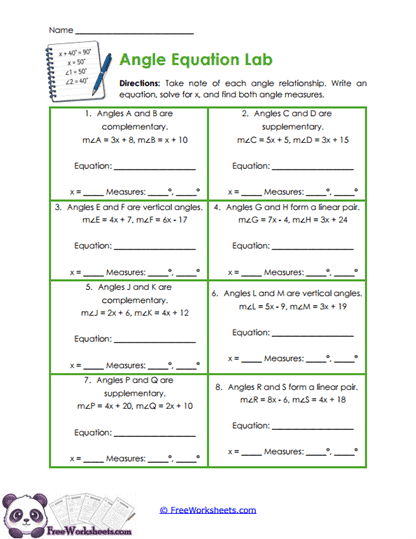
Angle Equations
What Kids Do:
Students solve eight problems in which angle measures are written as algebraic expressions. They determine whether the expressions should be equal, total 90°, or total 180° based on complementary, supplementary, vertical, or linear-pair relationships and then solve the resulting equation.
Target Skill:
Students build the important connection between geometric facts and algebraic structure. The worksheet reinforces equation setup, like-term simplification, coefficient reasoning, and substitution while helping 10th grade students understand why particular angle relationships produce particular equations.
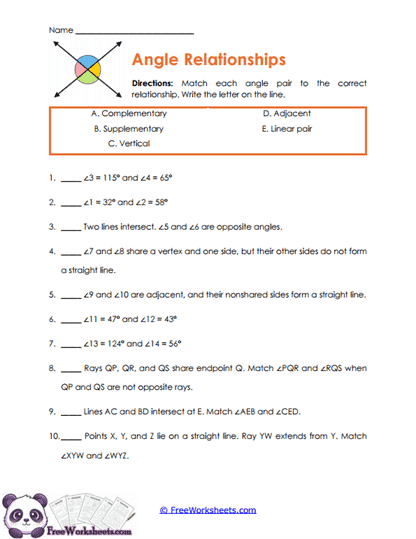
Angle Pairs
What Kids Do:
Students classify ten angle pairs using measures, diagrams, and written descriptions. They distinguish complementary, supplementary, vertical, adjacent, and linear-pair relationships by examining sums, shared sides, opposite positions, and straight-line structures rather than relying on only one visual clue.
Target Skill:
This activity strengthens precise geometry vocabulary and helps students distinguish relationships that are often confused. Students learn which relationships depend on position and which depend on total measure, creating a stronger foundation for 10th grade missing-angle equations and geometric justification.
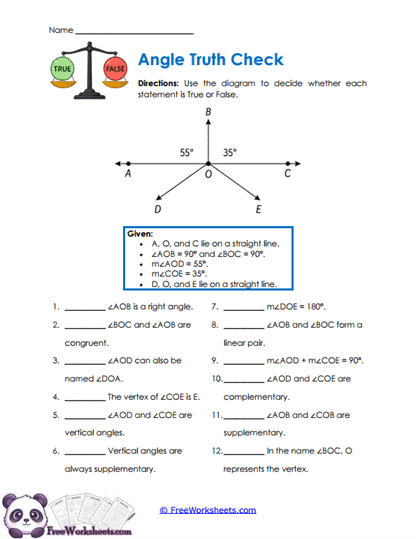
Angle Truth
What Kids Do:
Students study one labeled diagram containing several rays and use the given measures and line relationships to judge twelve angle statements as true or false. They evaluate naming, vertical relationships, complementary and supplementary totals, linear pairs, and other claims without assuming the drawing is to scale.
Target Skill:
Students strengthen evidence-based geometric reasoning by deciding whether each conclusion actually follows from the stated facts. The activity reinforces notation, angle relationships, and logical justification while preparing 10th grade students for the careful reasoning required in formal geometry proofs.
Angle Types
What Kids Do:
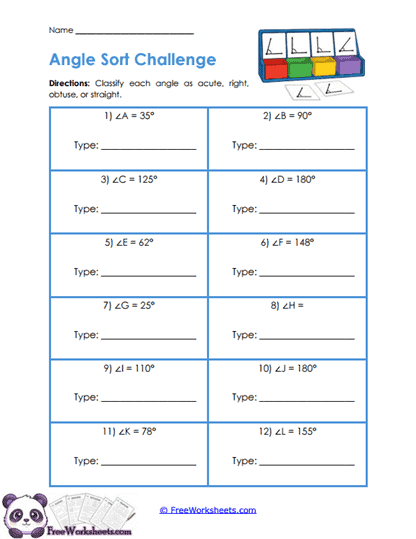
Students examine twelve degree measures and classify each angle as acute, right, obtuse, or straight. They compare every measure with the important 90° and 180° benchmarks and distinguish exact benchmark angles from values that fall above or below them.
Target Skill:
This worksheet reinforces foundational angle vocabulary that students need throughout high-school geometry. Students strengthen benchmark reasoning, degree-measure interpretation, and precise classification so they can recognize angle types quickly when working with triangles, polygons, constructions, and proofs.
Error Angles
What Kids Do:
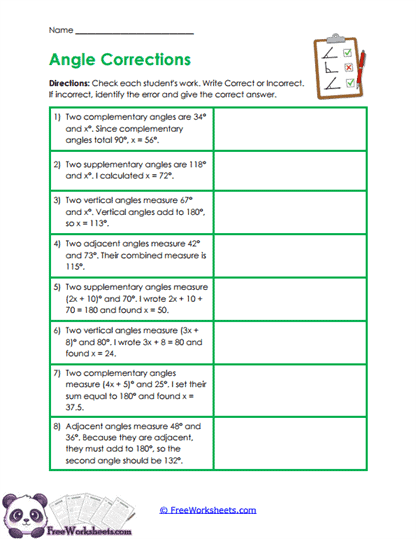
Students review worked angle problems and decide whether the reasoning is correct. When an error appears, they identify whether the mistake came from using the wrong relationship, misreading the diagram, or performing incorrect algebra, then explain the problem and write the corrected result.
Target Skill:
Error analysis develops deeper understanding of angle relationships by requiring students to explain why a solution fails. Students strengthen complementary, supplementary, vertical, adjacent, and linear-pair reasoning while building the self-checking and communication skills expected in 10th grade geometry.
Expression Match
What Kids Do:
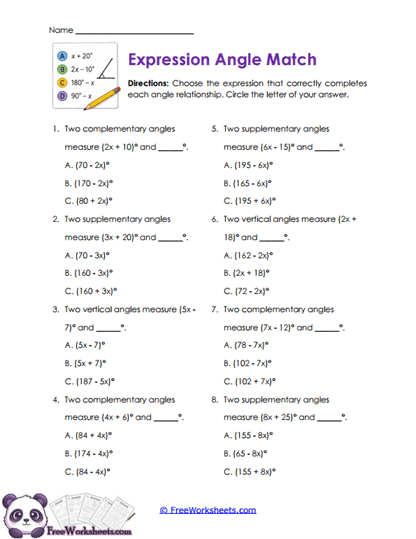
Students examine eight complementary, supplementary, and vertical-angle situations in which one measure is written algebraically. They compare several possible expressions for the second angle and choose the one that creates the required 90° total, 180° total, or congruent relationship.
Target Skill:
Students practice translating geometry conditions into algebraic expression structure before solving full equations. The activity reinforces mental simplification, relationship recognition, and symbolic reasoning, helping 10th grade students connect geometric vocabulary with the algebra used in more advanced diagrams.
Linear Pairs
What Kids Do:
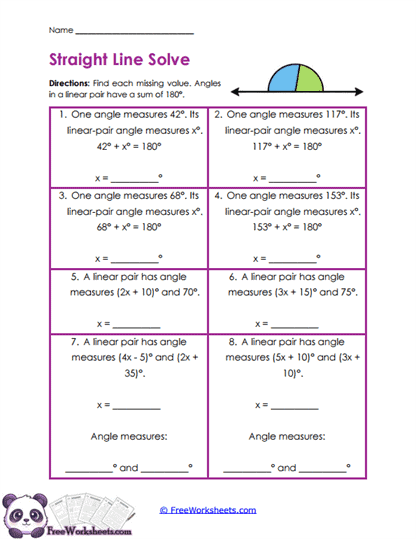
Students solve eight problems involving adjacent angles that form a straight line. They use subtraction for numerical examples and build equations when measures contain expressions, then substitute solved values back into the expressions to determine the actual angle measures.
Target Skill:
This worksheet strengthens understanding that linear-pair angles are supplementary and therefore total 180°. Students combine geometric reasoning with algebra, substitution, and answer checking while preparing for larger intersection diagrams and proof-based work involving straight lines.
Missing Angles
What Kids Do:
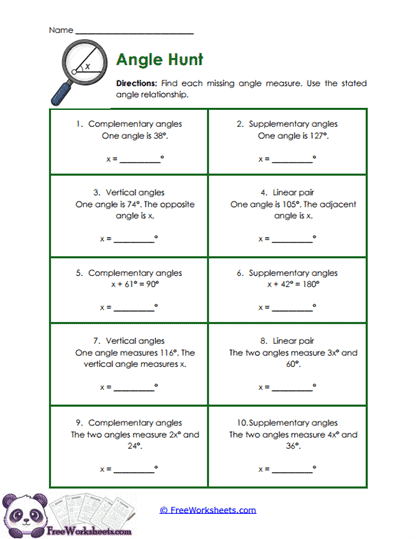
Students determine ten unknown angle measures using complementary, supplementary, vertical, and linear-pair relationships. Some problems require simple arithmetic, while others use algebraic expressions that students must turn into equations before finding the requested measure.
Target Skill:
Students move from recognizing angle vocabulary to using each relationship as a mathematical rule. The activity reinforces equal measures, 90° totals, 180° totals, equation solving, and final substitution while strengthening 10th grade geometric problem-solving fluency.
Relationship Clues
What Kids Do:
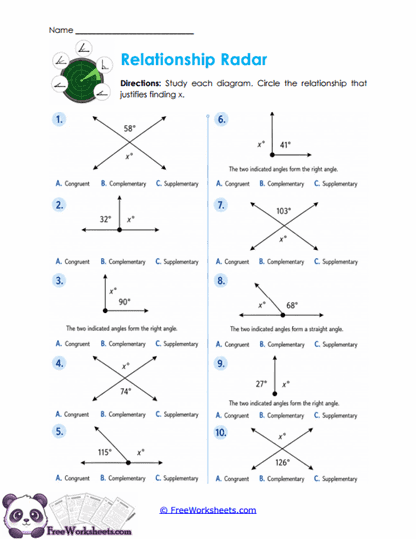
Students study ten small diagrams and decide whether the indicated angles are connected by a congruent, complementary, or supplementary relationship. They interpret visual clues such as intersecting lines, right-angle splits, and straight-line pairs before choosing the rule that justifies the missing measure.
Target Skill:
This activity develops the ability to identify which geometric fact applies without being told directly. Students strengthen diagram interpretation and proof-style justification while learning to rely on markings and structural relationships rather than the apparent size or shape of an angle.
Vertex Names
What Kids Do:
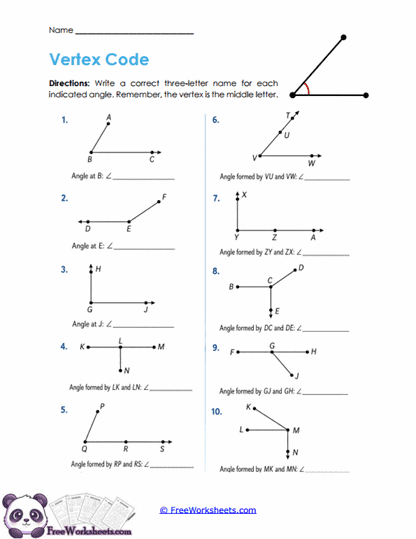
Students examine ten diagrams and write correct three-letter names for indicated angles. They identify the vertex, place that letter in the middle position, and select one point from each ray, including situations where several rays meet at the same location and careful notation is especially important.
Target Skill:
Students build precision with geometric notation and communication. The worksheet reinforces the role of the vertex, ray selection, and valid reversed angle names, giving 10th grade students the notation skills needed for equations, proofs, constructions, and larger labeled diagrams.
Vertical Angles
What Kids Do:
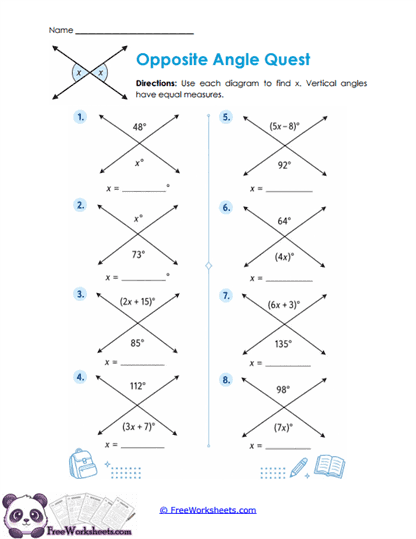
Students work with eight intersection diagrams in which opposite angles are labeled with numbers or algebraic expressions. They identify each vertical pair, set opposite measures equal, solve for x when needed, and determine the actual missing angle measure from the completed equation.
Target Skill:
Students reinforce the theorem that vertical angles are congruent and learn to translate that visual relationship into algebra. The activity combines diagram reading, equation setup, variable isolation, and substitution while preparing students for more complex 10th grade intersection and proof problems.