
About This Worksheet
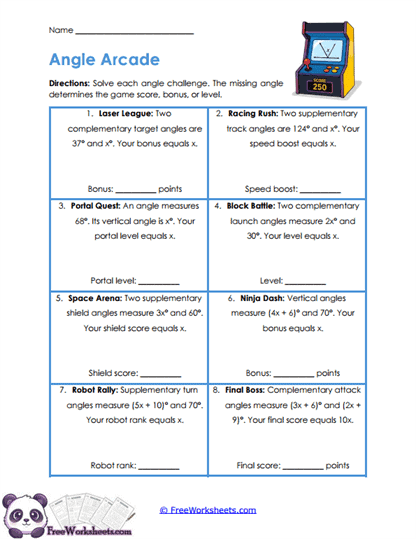
This worksheet helps tenth-grade students solve angle equations through game-themed challenges. Eight problems use arcade-style settings such as laser games, racing, portals, space battles, and final bosses. Each challenge gives a complementary, supplementary, or vertical-angle relationship and asks students to solve for x. The theme makes the practice feel lighter while still requiring solid geometry and algebra skills.
For example, two complementary target angles might be written as 37° and x°, so students use a total of 90°. A supplementary pair may involve an algebraic expression, while vertical angles require equal measures. Each answer becomes part of the game score, level, bonus, or rank.
What Students Practice
Students practice identifying the correct angle relationship and then writing the equation needed to solve for x. They use 90° for complementary angles, 180° for supplementary angles, and equality for vertical angles. This gives them repeated practice with the three most common rules.
The worksheet also reinforces one- and two-step equation solving. Students must isolate x correctly and pay attention to coefficients, constants, and signs. The game format keeps the focus on solving without changing the math itself.
Why This Skill Matters
Angle equations are common in geometry because many figures use algebraic expressions for unknown measures. Students need to know which relationship creates the equation before they can solve it. This worksheet gives them repeated practice making that decision.
The skill also combines algebra and geometry in a practical way. Students see that a geometric fact can become an equation and that solving the equation reveals the missing measure. That connection is important throughout high-school geometry.
Common Challenges
Students may use the wrong total for the relationship. Remind them that complementary angles add to 90°, supplementary angles add to 180°, and vertical angles are equal. Writing the relationship name beside the equation can help.
Another common mistake is solving for x but not checking whether the resulting angle measure makes sense. Encourage students to substitute their answer back into the expression and confirm that the relationship is satisfied.
How To Use It
Teachers can use this worksheet as a review activity, independent practice page, homework, or a more engaging end-of-unit exercise. It works especially well after students have already practiced the relationships in a traditional format. Students can also compare answers with a partner and explain which rule they used.
Parents and homeschool teachers can ask, “What angle rule does this challenge give you?” Once the student identifies the relationship, they can build the equation and solve it step by step.
Grade Alignment
This worksheet is intended for Grade 10 geometry and supports CCSS HSG-CO.C.9 through solving problems with angle relationships. It also reinforces algebraic equation solving within geometry. The activity brings together several core skills in one mixed review.
Students should already know complementary, supplementary, and vertical-angle relationships. After this practice, they are ready for more complex multi-step geometry problems and proof-based reasoning.