
Parallel And Perpendicular Lines Worksheets
Parallel and perpendicular lines in 10th grade math help students connect slope, equations, coordinates, and geometric structure in a precise way. These free, ready-to-print PDF worksheets are designed for immediate classroom use, homework, review, tutoring, intervention, or independent coordinate-geometry practice. Students compare slopes, write related line equations, solve for missing coordinates, and verify relationships while building the analytical reasoning expected throughout the 10th grade curriculum.
About This Collection of Worksheets
Parallel and perpendicular lines give 10th grade students a powerful way to connect algebra with geometry. Equal slopes identify parallel lines, while negative reciprocal slopes identify perpendicular lines, including important special cases involving horizontal and vertical lines. Once students understand those relationships, they can use them to classify line pairs, write new equations, prove geometric properties, and solve coordinate problems involving missing information.
This collection approaches the topic from several different directions. Students classify given slope pairs, calculate slopes from coordinates, extract slopes from equations, find missing slopes, write equations of parallel and perpendicular lines, evaluate true-or-false claims, solve for missing coordinates, graph line pairs, match related equations, and select correct equations from multiple choices. The variety helps students see that the same slope relationships appear in numerical, algebraic, graphical, and coordinate forms.
Teachers can use these worksheets throughout a 10th grade coordinate-geometry unit for direct instruction, guided practice, independent work, homework, intervention, review stations, or assessment preparation. Parents, tutors, and homeschool educators can also target individual skills such as negative reciprocals, equation writing, or slope calculation before moving into more complex applications. The progression from recognition to construction and verification gives students repeated opportunities to explain not only what relationship exists but why it exists.

Paul’s Teacher Tip
Have students write the slope of each line before deciding anything else, because most mistakes happen when they compare equations or coordinates too quickly. For parallel lines, emphasize same slope, while for perpendicular lines, use the phrase flip and change the sign to reinforce the negative reciprocal rule. When equations are not already in slope-intercept form, require students to solve for y before making a comparison so the slope is clearly visible. For coordinate problems, have students simplify both slopes completely before classifying the relationship. A useful final check for nonzero perpendicular slopes is to multiply them together and confirm that the product is -1.
Worksheet Collection Skill Spotlights
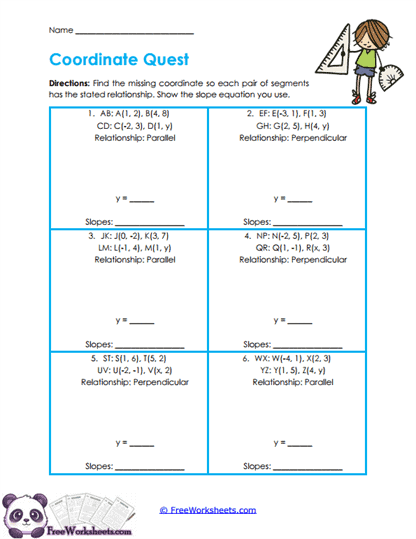
Coordinate Quest
What Kids Do:
Students solve for missing coordinates so that two line segments meet a required parallel or perpendicular condition. They calculate the slope of the fully known segment, determine the target slope for the second segment, substitute the unknown coordinate into the slope formula, and solve the resulting equation.
Target Skill:
This activity develops backward coordinate reasoning by asking students to use a known geometric relationship to determine where a point must be located. Students strengthen slope calculation, negative-reciprocal reasoning, algebraic equation solving, and 10th grade understanding of how coordinate placement controls line direction.
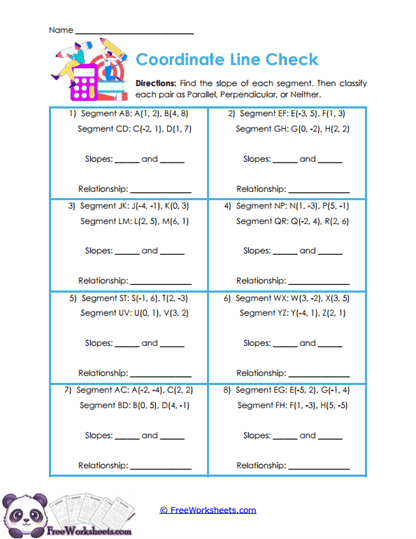
Coordinate Slopes
What Kids Do:
Students calculate the slope of two line segments from pairs of endpoints and then classify the segments as parallel, perpendicular, or neither. They simplify each slope carefully and compare the results using equal-slope and negative-reciprocal rules.
Target Skill:
Students connect the slope formula with geometric classification. The worksheet reinforces consistent coordinate subtraction, fraction simplification, and slope comparison while preparing 10th grade students to use line relationships in coordinate proofs and polygon analysis.
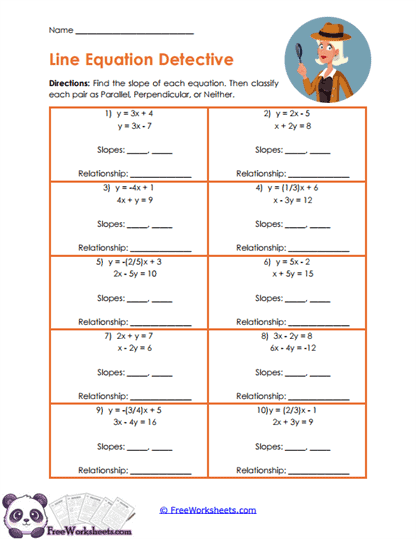
Equation Detective
What Kids Do:
Students examine ten pairs of linear equations written in slope-intercept or standard form. When necessary, they rearrange the equations to identify slope, compare the resulting values, and decide whether each pair represents parallel, perpendicular, or unrelated lines.
Target Skill:
This worksheet strengthens the ability to extract geometric information from algebraic equations. Students practice solving for y, identifying slope accurately, distinguishing slope from intercept, and using slope relationships to analyze line behavior in 10th grade coordinate geometry.
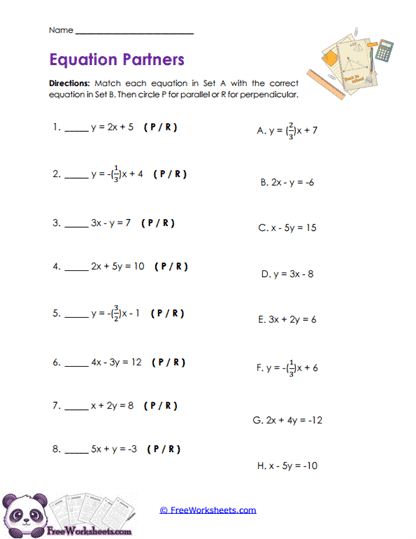
Equation Match
What Kids Do:
Students match equations from one set with equations from another set that create either parallel or perpendicular relationships. They find slopes from different equation forms, simplify the values, and identify whether each successful pairing uses equal slopes or negative reciprocals.
Target Skill:
Students develop efficiency in recognizing related linear equations without graphing them. The activity reinforces equation rearrangement, slope interpretation, negative reciprocals, and algebraic comparison while helping students see that differently written equations can still describe geometrically related lines.
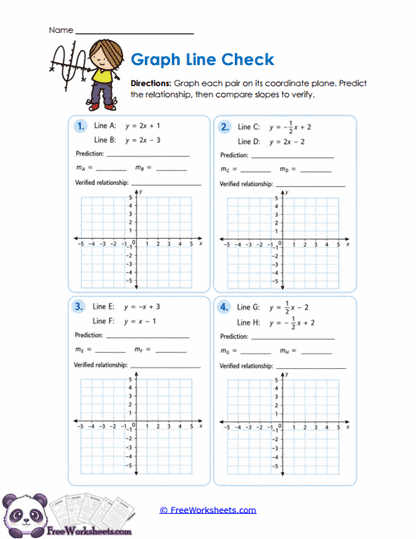
Graph Verification
What Kids Do:
Students graph four pairs of linear equations, predict whether the lines appear parallel or perpendicular, and then calculate the slopes to verify the relationship algebraically. They compare the visual graph with the numerical slope evidence and explain whether both representations agree.
Target Skill:
This activity strengthens the connection among equations, slopes, and graphs. Students learn that a visual picture can suggest a relationship while slope provides the mathematical verification, supporting 10th grade coordinate proofs and more precise geometric reasoning.
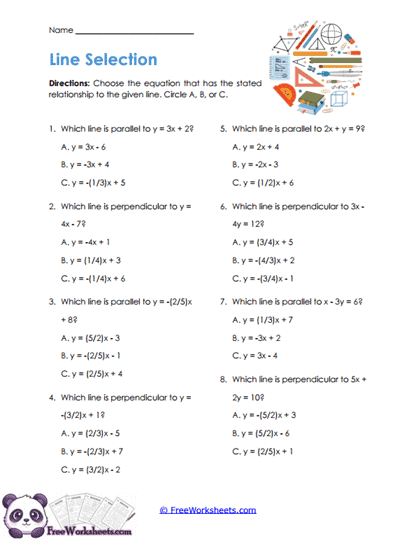
Line Choices
What Kids Do:
Students work through eight multiple-choice problems in which a reference equation is paired with three possible lines. They determine the slope required for a parallel or perpendicular relationship, calculate or identify the slopes of the choices, and select the equation that meets the stated condition.
Target Skill:
Students build speed and accuracy applying slope criteria in a test-style setting. The worksheet reinforces target-slope reasoning, equation manipulation, distractor analysis, and the distinction between true negative reciprocals and common errors such as opposites or unsigned reciprocals.
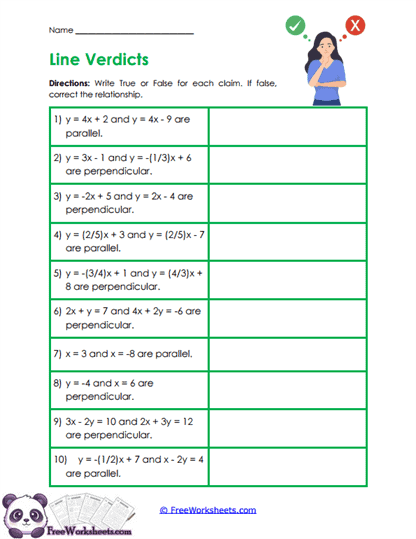
Line Verdicts
What Kids Do:
Students evaluate ten statements about pairs of linear equations and decide whether each claim of parallelism or perpendicularity is true or false. They may need to rearrange standard-form equations, identify special horizontal or vertical cases, and correct any false statements.
Target Skill:
Students strengthen conceptual understanding by judging geometric claims instead of only performing calculations. The activity reinforces slope extraction, negative reciprocals, special slope cases, and the ability to explain why a proposed line relationship is or is not mathematically valid.
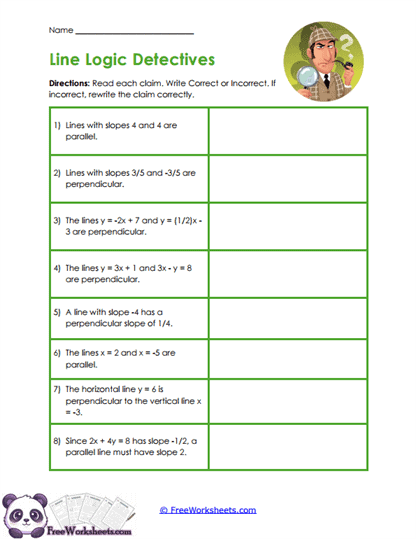
Logic Check
What Kids Do:
Students read eight statements involving slopes, equations, horizontal lines, and vertical lines and determine whether each is correct. When a claim is false, they rewrite it accurately and explain which slope rule or special case should have been used.
Target Skill:
This worksheet develops reasoning about the rules behind parallel and perpendicular lines. Students strengthen vocabulary, slope concepts, error correction, and self-checking while learning to distinguish negative slopes from true negative-reciprocal relationships.
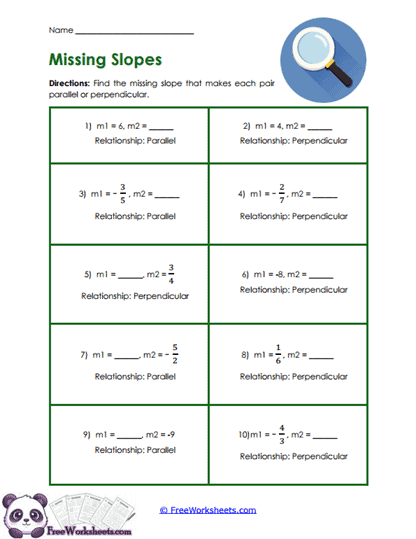
Missing Slopes
What Kids Do:
Students find ten missing slope values based on whether the two lines must be parallel or perpendicular. They keep the slope unchanged for parallel lines and find the negative reciprocal for perpendicular lines, including cases with whole numbers, fractions, and negative values.
Target Skill:
Students build fluency with the two central slope relationships needed throughout coordinate geometry. The activity reinforces fraction manipulation, reciprocal reasoning, sign changes, and the 10th grade skill of determining a required slope before writing or analyzing a line equation.
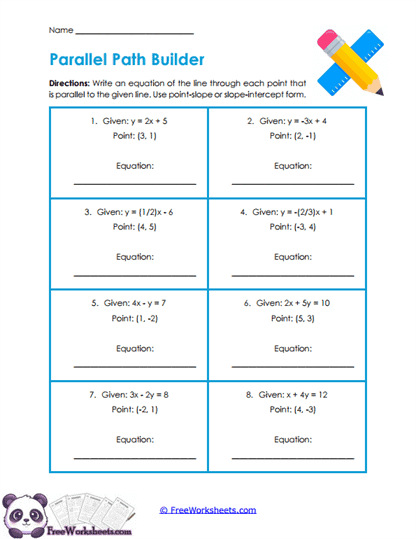
Parallel Lines
What Kids Do:
Students write equations of lines that must be parallel to a given equation and pass through a specified point. They identify the original slope, preserve that slope, and use point-slope form or slope-intercept form to construct the new line and determine any required intercept.
Target Skill:
This activity combines slope relationships with equation writing. Students reinforce that parallel lines share a slope but generally have different intercepts, while practicing point substitution, linear equation forms, and the algebraic reasoning used in 10th grade coordinate constructions.
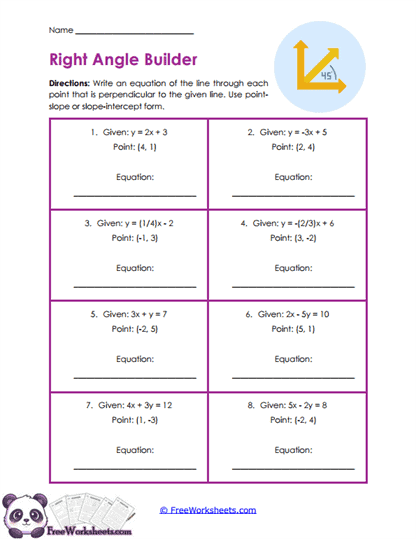
Perpendicular Lines
What Kids Do:
Students write equations of lines perpendicular to given reference equations and passing through specified points. They identify the original slope, calculate its negative reciprocal, and use that new slope with the given coordinate to build the required equation.
Target Skill:
Students apply the negative-reciprocal rule in a complete construction problem rather than in isolation. The worksheet strengthens slope conversion, fraction fluency, point-slope reasoning, and 10th grade understanding of how algebraic slope relationships create right angles.
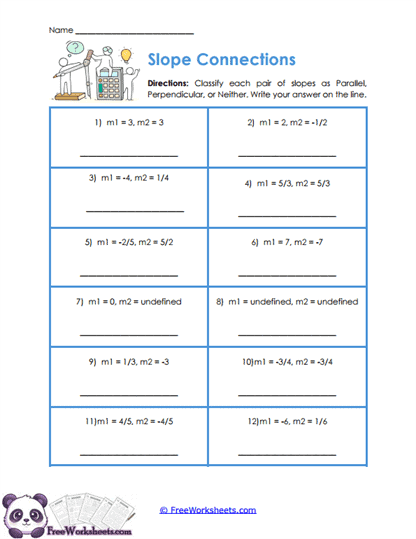
Slope Relationships
What Kids Do:
Students classify twelve slope pairs as parallel, perpendicular, or neither. They compare equal slopes, negative reciprocal fractions, unrelated values, zero slopes, and undefined slopes while accounting for the special perpendicular relationship between horizontal and vertical lines.
Target Skill:
This worksheet establishes the core criteria used throughout the entire topic. Students strengthen recognition of equal slopes, negative reciprocals, special horizontal and vertical cases, and the geometric meaning behind those numerical relationships.