
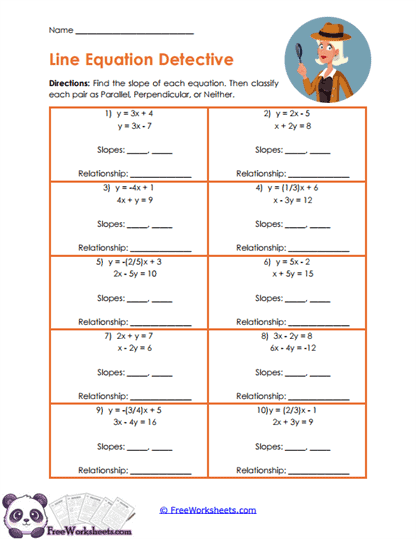
About This Worksheet
This worksheet helps tenth-grade students determine whether pairs of linear equations represent parallel, perpendicular, or unrelated lines. Students work through ten pairs of equations written in different forms. Some equations are already in slope-intercept form, while others must be rearranged before the slope can be identified. Students find both slopes and then classify the relationship.
For example, an equation written as y = 3x + 4 has an obvious slope of 3. A second equation such as x + 3y = 8 must first be rewritten so students can identify its slope. Once both slopes are known, they compare them to see whether they are equal, negative reciprocals, or neither.
What Students Practice
Students practice finding slope from equations written in slope-intercept and standard form. When necessary, they isolate y to rewrite an equation as y = mx + b. They then compare the slope values and classify each pair of lines.
The worksheet also gives students practice with fractions and negative coefficients. This is especially useful when identifying perpendicular relationships because students must recognize negative reciprocals even when the slopes are not written in matching forms.
Why This Skill Matters
Students need to recognize line relationships from equations, not just from graphs or coordinate points. This skill is important when analyzing systems, writing new line equations, and working with coordinate geometry proofs. Being able to find the slope from any common equation form makes students much more flexible.
The activity also reinforces the idea that the y-intercept does not determine whether lines are parallel or perpendicular. The slope is the key feature. Two lines may cross the y-axis in very different places but still be parallel because their slopes match.
Common Challenges
Students may compare equations before rewriting them and miss the actual slopes. Encourage them to isolate y whenever the slope is not immediately visible. Once both equations are in slope-intercept form, the relationship is usually much easier to see.
Another common mistake is comparing y-intercepts instead of slopes. Remind students that parallel and perpendicular relationships are determined by slope. The intercept only tells where the line crosses the y-axis.
How To Use It
Teachers can use this worksheet after students understand slope-intercept form and have practiced rearranging standard-form equations. It works well for guided instruction, independent practice, homework, or review before writing equations of related lines. Having students underline each slope before classifying can make their reasoning easier to check.
Parents and homeschool teachers can ask, “Can you see the slope right away?” If not, have the student rearrange the equation until y is alone. Then compare the two slopes using the parallel and perpendicular rules.
Grade Alignment
This worksheet is intended for Grade 10 geometry and supports CCSS HSG-GPE.B.5, which asks students to use slope criteria for parallel and perpendicular lines. It also reinforces algebraic manipulation of linear equations, making it a useful bridge between Algebra 1 and geometry.
Students should already know slope-intercept form and how to solve an equation for y. After this practice, they can move into finding missing slopes and writing equations of parallel or perpendicular lines.