
About This Worksheet
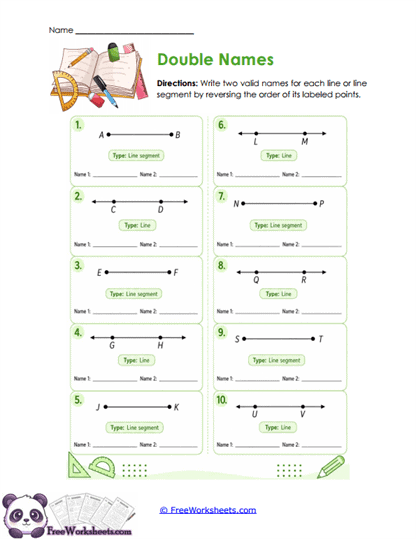
This worksheet helps tenth-grade students practice naming the same line or line segment in two valid ways. Students look at ten simple diagrams with labeled endpoints and write two correct names for each figure by reversing the order of the letters. This reinforces the idea that a segment with endpoints A and B can be named segment AB or segment BA, and a line through G and H can be named line GH or line HG.
The activity mixes both lines and line segments, so students must first identify which type of figure they are working with before writing the names. This keeps the practice focused on both notation and figure recognition.
What Students Practice
Students practice reading endpoint labels and writing equivalent geometric names in both directions. They also distinguish lines from line segments by checking whether the figure has arrowheads or fixed endpoints. This strengthens notation accuracy.
The worksheet also reinforces that the order of two endpoint letters does not change the geometric object for a line or segment. Students become more comfortable seeing different names for the same figure in textbooks, diagrams, and proofs.
Why This Skill Matters
Geometry often uses multiple valid names for the same object. Students need to recognize that segment AB and segment BA refer to the same segment, just as line GH and line HG refer to the same line. This prevents confusion when notation changes from one problem to another.
The skill also supports proof writing and diagram interpretation. Students may see one name in the diagram and another in the directions, so understanding equivalent naming helps them follow the reasoning more easily.
Common Challenges
Students may think reversing the letters creates a different figure. Remind them that the same two endpoints still define the same segment or line. Only the order of the written name has changed.
Another common mistake is using line notation for a segment or segment notation for a line. Encourage students to look for arrows before naming the object. Arrows indicate a line, while two endpoints indicate a segment.
How To Use It
Teachers can use this worksheet as a quick notation review, warm-up, homework page, or short assessment. It works especially well after students already understand the difference between lines and line segments.
Parents and homeschool teachers can ask, “What are the two endpoint letters?” Once the student names the figure one way, simply reverse the letters for the second valid name.
Grade Alignment
This worksheet is designed for Grade 10 geometry and supports CCSS HSG-CO.A.1 by reinforcing precise geometric notation for points, lines, and segments. It helps students recognize equivalent names for the same geometric object.
Students should already know how to distinguish lines from segments. After this practice, they can move into true-or-false geometry statements and more complex naming tasks.