
About This Worksheet
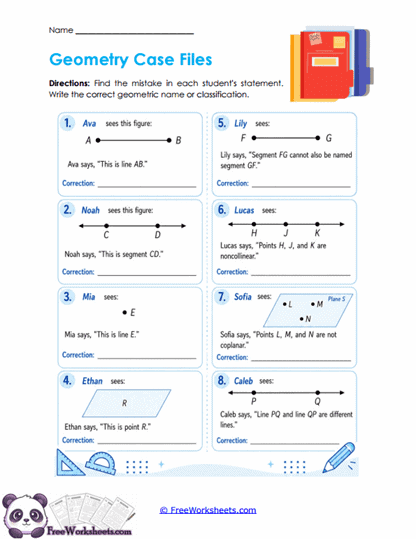
This worksheet helps tenth-grade students find and correct mistakes in basic geometry naming and classification. Each of the eight cases shows a student looking at a figure and making a statement about it. Students must decide what is wrong and write the correct geometric description. The examples include confusing lines with segments, points with lines, planes with points, and collinear or coplanar relationships.
For example, a student may look at a segment with endpoints A and B and incorrectly call it a line. Another may see a single labeled dot and call it a line. These simple mistakes help students practice paying attention to the exact features that define each geometric object.
What Students Practice
Students practice comparing a student’s claim with the actual diagram and identifying the specific error. They then replace the incorrect description with the correct name, notation, or relationship. This strengthens both vocabulary and visual reasoning.
The worksheet also reviews several ideas at once, including points, lines, segments, planes, collinear points, and coplanar points. That makes it a strong cumulative check of foundational geometry language.
Why This Skill Matters
Students need to be able to recognize when geometric language is being used incorrectly. A small naming mistake can change the meaning of an entire problem. Error analysis helps students become more careful and precise.
The skill also supports self-checking. If students can explain why someone else’s statement is wrong, they are more likely to notice the same mistake in their own work. This is especially valuable before moving into formal proofs.
Common Challenges
Students may correct the final word without explaining what feature of the diagram caused the mistake. Encourage them to use specific language such as “this has two endpoints, so it is a segment” or “this is one dot, so it is a point.” That makes the correction more meaningful.
Another common mistake is overlooking whether arrows are present. Arrowheads are one of the clearest clues that a figure is a line rather than a segment. Students should check those details first.
How To Use It
Teachers can use this worksheet for partner discussion, small-group review, homework, or an error-analysis lesson. It works especially well after students have practiced identifying each object separately and are ready to explain mistakes.
Parents and homeschool teachers can treat each example like a quick detective problem. Ask, “What feature of the picture tells us what this object really is?” Then have the student correct the statement.
Grade Alignment
This worksheet is intended for Grade 10 geometry and supports CCSS HSG-CO.A.1 through accurate use of geometric definitions and notation. The error-analysis format also strengthens reasoning and mathematical communication.
Students should already recognize basic points, lines, segments, and planes. After this practice, they can move into construction tasks and larger geometry relationship problems.