
About This Worksheet
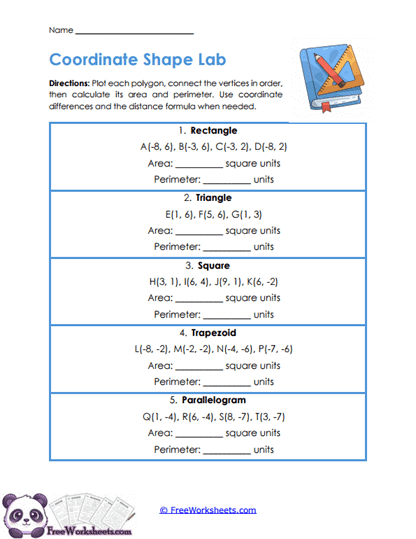
This worksheet helps tenth-grade students practice finding the area and perimeter of polygons drawn from coordinates on the coordinate plane. Students are given the ordered pairs for five different figures, including a rectangle, triangle, square, trapezoid, and parallelogram. They plot the vertices in order, connect the points to form each shape, and then calculate both its area and perimeter. This gives students practice combining coordinate geometry with familiar measurement formulas.
Some side lengths can be found by looking at horizontal or vertical changes between coordinates, while diagonal sides may require the distance formula. Students must first understand the shape they created and then choose the correct method for each measurement. This makes the activity more involved than simply plugging numbers into an area formula.
What Students Practice
Students practice plotting ordered pairs accurately and connecting vertices in the correct order. Once the polygon is formed, they determine side lengths using coordinate differences or the distance formula. They then use the appropriate area formula for the shape and add all side lengths to calculate perimeter.
The worksheet also reinforces the differences between area and perimeter. Area measures the space inside a polygon and is reported in square units, while perimeter measures the total distance around the outside and is reported in units. Finding both for the same figures helps students keep these ideas separate.
Why This Skill Matters
Coordinate geometry allows students to combine algebra and geometry in one problem. Instead of receiving side lengths directly, they learn how coordinates can provide the information needed to measure a figure. This is an important step toward more advanced work with geometric figures on a coordinate plane.
The skill also develops flexible problem solving. A rectangle may have simple horizontal and vertical sides, while another polygon may include a diagonal side that requires a different strategy. Students learn to inspect the figure before deciding which formula or method to use.
Common Challenges
Students may subtract coordinate values without considering whether the side is horizontal, vertical, or diagonal. For horizontal sides, they should compare x-values, while vertical sides come from differences in y-values. Diagonal sides generally require the distance formula.
Another common mistake is using perimeter measurements inside an area formula or forgetting square units on an area answer. Encourage students to label each calculation as either side length, perimeter, or area before writing the final result.
How To Use It
Teachers can use this worksheet after students have reviewed plotting coordinates, polygon area formulas, and the distance formula. It works well for guided practice, independent classwork, homework, or a coordinate-geometry review. Having students sketch each polygon before calculating can make the measurements much easier to understand.
Parents and homeschool teachers can guide students one step at a time. First plot and connect the vertices, then identify the shape, find its side lengths, and finally calculate the area and perimeter. Breaking the work into those smaller steps makes the problems much easier to manage.
Grade Alignment
This worksheet is designed for Grade 10 geometry and supports coordinate-based geometric measurement. It connects well with CCSS HSG-GPE.B.7, which asks students to use coordinates to compute perimeters of polygons and areas of triangles and rectangles. It also reinforces the distance formula and familiar polygon formulas.
Students should already understand ordered pairs, basic area formulas, and coordinate differences. After this practice, they can move into irregular polygons and figures that require decomposition or enclosing methods.