
About This Worksheet
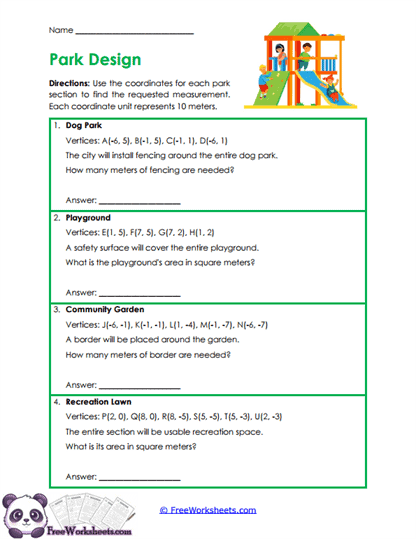
This worksheet helps tenth-grade students apply coordinate-plane area and perimeter skills to real-world park design situations. Students work with four different sections of a park, including a dog park, playground, community garden, and recreation lawn. Each problem gives the coordinates of the section and asks students to determine either fencing, border length, or area. Since each coordinate unit represents 10 meters, students must also convert their coordinate measurements into real distances or square measurements.
For example, a polygon representing a dog park may require students to find its perimeter and then multiply each coordinate-unit measurement by 10 meters. A playground problem may ask for area, which means students must remember that square units scale differently from linear units. This adds an important real-world layer to the coordinate work.
What Students Practice
Students practice plotting or interpreting coordinate polygons, finding side lengths, calculating perimeter or area, and then converting the result into meters or square meters. Depending on the figure, they may use coordinate differences, the distance formula, or decomposition.
The worksheet also reinforces the difference between linear and square scaling. One coordinate unit represents 10 meters, but one square coordinate unit represents 100 square meters. This helps students connect scale with area more carefully.
Why This Skill Matters
Coordinate geometry is often used in planning, mapping, landscaping, and design. A set of coordinates can describe the boundary of a real space, while area and perimeter help determine how much fencing, border material, or surface space is needed. This worksheet gives students a practical reason to use the math.
The skill also connects geometry with scale. Students must understand that real-world measurements depend on what each coordinate unit represents. This prepares them for maps, blueprints, and scale drawings.
Common Challenges
Students may forget to convert the final answer from coordinate units to meters. Encourage them to identify the scale before solving and write it beside the problem. This keeps the real-world unit in mind throughout the calculation.
Another common mistake is multiplying area by 10 instead of 100. Remind students that area is two-dimensional, so both length and width are being scaled by 10. That makes one square unit equal to 10 × 10, or 100 square meters.
How To Use It
Teachers can use this worksheet as a real-world application after students are comfortable finding area and perimeter from coordinates. It works well for independent practice, partner work, homework, or a STEM-style lesson. You might ask students to sketch one park section before calculating so they can see what the measurement represents.
Parents and homeschool teachers can ask, “Are we finding a distance around the outside or space inside the shape?” Once that is clear, help the student choose perimeter or area and then apply the 10-meter scale correctly.
Grade Alignment
This Grade 10 worksheet supports CCSS HSG-GPE.B.7 through coordinate-based area and perimeter calculations and also connects with geometric modeling. The scale component reinforces students’ understanding of how coordinate units represent actual measurements.
Students should already know basic area, perimeter, coordinate differences, and scale. After this practice, they can move into more advanced design and comparison problems on the coordinate plane.