
About This Worksheet
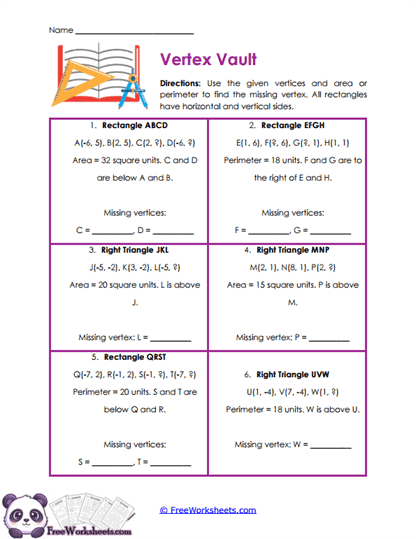
This worksheet helps tenth-grade students use area or perimeter information to determine missing coordinates in rectangles and right triangles. Students are given some vertices and one measurement, then use the horizontal or vertical structure of the figure to find the unknown vertex or vertices. This turns coordinate geometry into a reverse problem: instead of finding area or perimeter from the coordinates, students use the measurement to recover the missing coordinates.
For example, if a rectangle has two known vertices and a given area, students can use the known side length to find the missing dimension. Once that dimension is known, they can place the missing vertices so the sides remain horizontal and vertical. Similar reasoning is used with right triangles where a base, height, area, or perimeter helps determine the missing point.
What Students Practice
Students practice working backward from area and perimeter formulas. They identify known horizontal or vertical side lengths from the coordinates, solve for a missing length, and then use that length to locate the unknown vertex. This combines algebra, measurement, and coordinate reasoning.
The worksheet also reinforces the structure of rectangles and right triangles. Students must recognize which coordinates should share the same x-value or y-value. This helps them see how geometric properties control coordinate placement.
Why This Skill Matters
Finding a missing coordinate requires more reasoning than simply measuring a completed figure. Students must connect shape properties, formulas, and coordinate relationships all at once. This makes the activity a strong higher-level geometry exercise.
The skill also prepares students for proof and construction work. They learn that coordinates are not random; they must fit the geometric conditions of the figure. That kind of reasoning is important throughout analytic geometry.
Common Challenges
Students may find the missing side length correctly but place the point in the wrong direction. Remind them to check whether the point is supposed to lie above, below, left, or right of a known vertex. The directions in the problem matter just as much as the length.
Another common mistake is forgetting that horizontal sides share y-values and vertical sides share x-values. Encourage students to use that fact before trying to invent a coordinate. It often narrows the possibilities immediately.
How To Use It
Teachers can use this worksheet after students are comfortable finding area and perimeter from coordinates. It works well for guided practice, independent work, homework, or an extension activity because students must reason backward. Modeling one rectangle example can help students see how to turn the given measurement into a missing coordinate.
Parents and homeschool teachers can ask, “What side length do we already know?” and then, “What length must the missing side have?” Once the length is found, use the shape’s horizontal or vertical sides to determine the correct coordinate.
Grade Alignment
This worksheet is intended for Grade 10 geometry and supports CCSS HSG-GPE.B.4-7 through coordinate reasoning, distance, and polygon measurement. It also reinforces algebraic problem solving by using area or perimeter formulas to find unknown dimensions. The reverse-solving format makes the worksheet more challenging than standard coordinate measurement.
Students should already understand area, perimeter, coordinate differences, and basic polygon properties. After this practice, they can move into method selection and more complex coordinate design problems.