
About This Worksheet
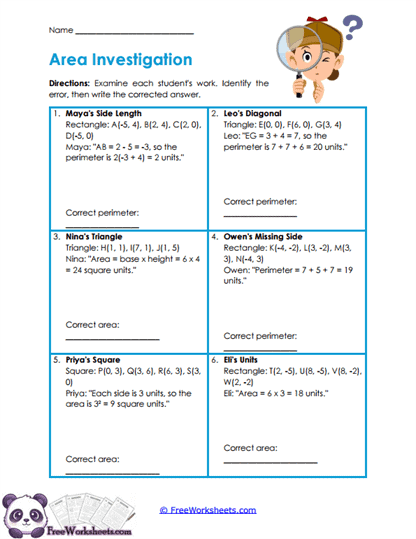
This worksheet helps tenth-grade students analyze mistakes in area and perimeter work on the coordinate plane. Six worked examples show a student’s attempted solution, and students must identify what went wrong before writing the correct answer. The errors include side-length mistakes, missing diagonal distances, incorrect triangle area, skipped sides, and wrong use of units. This makes the activity more about mathematical reasoning than simple calculation.
For example, a student may find the side of a square correctly but then multiply side by side incorrectly, or may add coordinate differences for a diagonal instead of using the distance formula. Another student may calculate a rectangle’s area but forget that the result should be in square units. These examples help students notice the kinds of errors that often happen in coordinate geometry.
What Students Practice
Students practice reading someone else’s work carefully and checking whether the method matches the geometry of the figure. They must decide whether the mistake comes from distance, area, perimeter, or unit reasoning. This strengthens both computation and error analysis.
The worksheet also reinforces the idea that different measurements require different formulas. A horizontal side may use coordinate subtraction, a diagonal may need the distance formula, and area may require a base-height relationship. Students must understand the structure of the figure before judging the work.
Why This Skill Matters
Students often make small coordinate mistakes that cause an entire area or perimeter calculation to be wrong. Error analysis helps them become better at checking their own work and understanding why a method fails. This is especially useful when several formulas are involved in one problem.
The skill also builds mathematical communication. Students need to explain the mistake, not just replace the final answer. Being able to describe why a solution is incorrect shows stronger understanding.
Common Challenges
Students may notice the final answer is wrong but struggle to identify the first bad step. Encourage them to start with the coordinates and verify each side length before checking the area or perimeter. This makes the error easier to isolate.
Another common mistake is correcting the number without correcting the method. Ask students to state whether the problem came from using the wrong formula, missing a side, or misreading the coordinates. This makes the correction more meaningful.
How To Use It
Teachers can use this worksheet for partner work, small-group review, test preparation, or a whole-class error-analysis lesson. It works especially well after students have practiced both area and perimeter on the coordinate plane. Asking students to defend one correction aloud can lead to strong geometry discussion.
Parents and homeschool teachers can treat each problem like a detective case. Ask, “What did this student assume?” and then, “Does that match the shape and coordinates?” This keeps the focus on reasoning instead of just recalculating.
Grade Alignment
This Grade 10 worksheet supports CCSS HSG-GPE.B.7 by reinforcing coordinate-based area and perimeter calculations. It also strengthens mathematical reasoning and self-checking through error analysis. The activity helps students use distance, area, and perimeter formulas more accurately.
Students should already understand coordinate distances and common polygon formulas. After this practice, they are better prepared to check complex coordinate-geometry solutions independently.