
One-variable Inequalities Worksheets
8th grade math one-variable inequalities worksheets help students solve, graph, test, and interpret ranges of possible values in algebraic situations. Free, ready-to-print worksheets in PDF format are designed for immediate classroom use, guided practice, homework, intervention, or homeschool lessons. Students strengthen inequality solving, number-line graphing, and algebraic reasoning while developing skills that support 8th grade curriculum expectations.
About This Collection of Worksheets
One-variable inequalities help 8th grade students describe situations where more than one value can make a mathematical statement true. Students build on equation-solving skills while learning how symbols such as <, >, ≤, and ≥ represent limits, minimums, maximums, and ranges of possible solutions. They also learn the important rule that multiplying or dividing both sides by a negative number reverses the inequality symbol, giving them a stronger understanding of how inequalities differ from equations.
This collection gives students many ways to practice the topic. Activities include solving one-step and multi-step inequalities, working with negative coefficients, testing possible values, matching inequalities with number-line graphs, writing inequalities from graphs, completing missing solution steps, analyzing incorrect work, comparing two proposed solutions, and translating real-world constraints into algebra. Students also work with budgets, quantities, time limits, scores, and other practical situations that show why inequalities are useful outside the classroom.
Teachers can use these worksheets throughout an 8th grade algebra unit for modeling, guided practice, independent work, math centers, homework, intervention, review, or formative assessment. Parents, tutors, and homeschool educators can focus on one skill at a time before combining symbolic solving, graphing, and interpretation. The variety of formats also helps students practice explaining why a solution works instead of depending only on memorized steps.

Paul’s Teacher Tip
Have students read every inequality aloud before solving so they connect the symbol with words such as greater than, less than, at least, and no more than. When negative multiplication or division appears, ask students to mark that exact step and write flip the sign beside it rather than reversing the symbol simply because they see a negative number somewhere in the problem. For number-line graphs, use two questions every time: “Is the boundary included?” and “Do the solutions go toward larger or smaller numbers?” When students solve word problems, have them decide whether the situation describes a minimum or maximum before choosing the inequality symbol. For extra checking, ask students to substitute one value from their final solution set back into the original inequality and explain why it works.
Worksheet Collection Skill Spotlights
Boundary Graphs
What Kids Do:
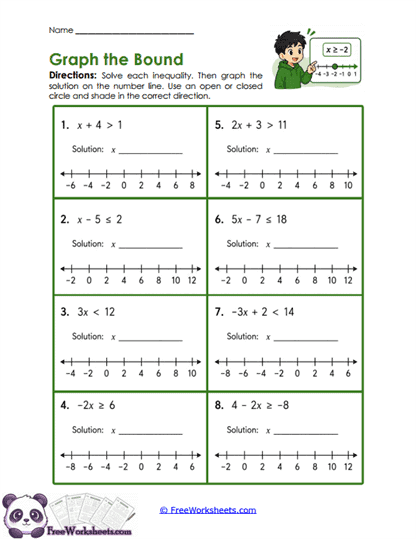
Students solve eight inequalities and then graph each solution on a number line. They identify the boundary value, choose an open or closed circle depending on whether the endpoint is included, and shade toward larger or smaller numbers based on the meaning of the final inequality.
Target Skill:
This activity strengthens the connection between symbolic inequalities and visual solution sets. Students practice solving inequalities accurately while interpreting <, >, ≤, and ≥ through boundary points and shading, supporting 8th grade understanding that an inequality represents many possible values rather than one answer.
Boundary Match
What Kids Do:
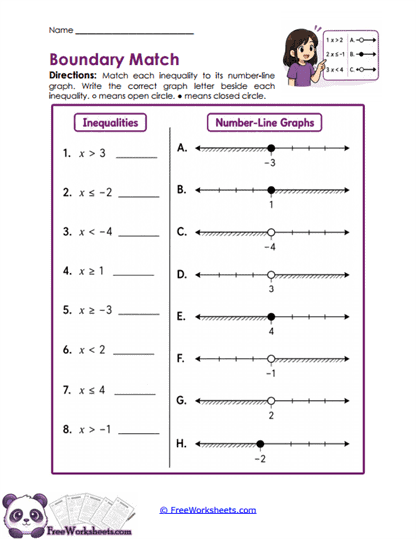
Students match eight inequalities with number-line graphs that use different boundary values, open and closed circles, and left- or right-facing shading. They must examine both the inequality symbol and graph details to determine which visual representation shows exactly the same solution set.
Target Skill:
Students build fluency translating between algebraic notation and number-line models. The worksheet reinforces how strict and inclusive inequality symbols control endpoint markings while greater-than and less-than language determines direction, strengthening 8th grade reasoning with ordered numbers and solution sets.
Budget Bounds
What Kids Do:
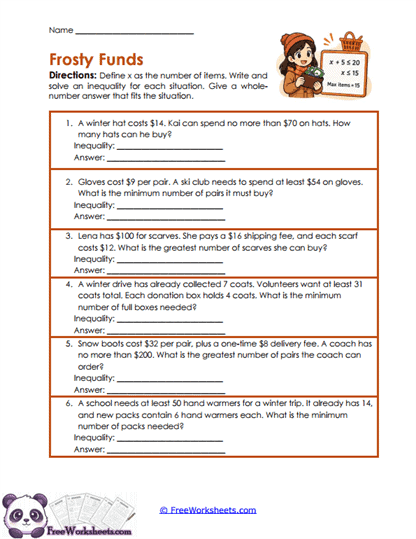
Students solve six real-world shopping problems involving hats, gloves, scarves, coats, boots, and hand warmers. They define the unknown quantity, identify language such as “at least” or “no more than,” write an inequality for the budget or requirement, solve it, and interpret the practical number of items allowed.
Target Skill:
This activity develops mathematical modeling with inequalities by teaching students to translate maximums, minimums, fixed costs, and quantity limits into algebraic statements. Students also practice deciding when whole-number answers are necessary, connecting 8th grade inequality skills with realistic decision-making.
Error Patrol
What Kids Do:
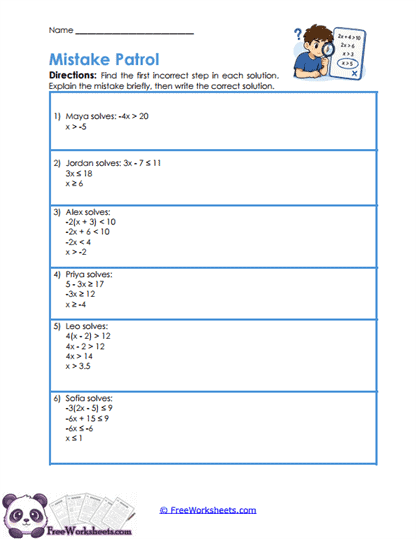
Students examine incorrect inequality solutions and locate the first step where the reasoning fails. They analyze arithmetic, inverse operations, sign changes, and symbol direction, explain what the student did wrong, and then repair the work to produce a correct final solution.
Target Skill:
Error analysis strengthens procedural accuracy and deeper algebraic understanding. Students learn to distinguish arithmetic mistakes from inequality-rule mistakes, especially failures to reverse a symbol after multiplying or dividing by a negative number, while building the 8th grade skill of explaining mathematical reasoning clearly.
Escape Limits
What Kids Do:
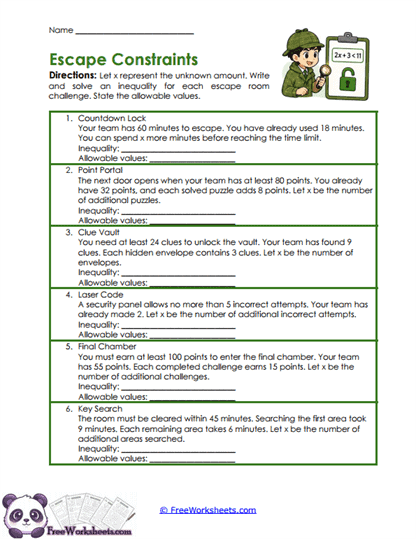
Students solve six escape-room themed situations involving time, points, clues, attempts, scores, and search limits. They translate phrases describing minimums or maximums into inequalities, solve for the unknown quantity, and then list allowable values that make sense within each challenge.
Target Skill:
Students strengthen their ability to model real-world constraints with one-variable inequalities. The activity connects symbolic solutions with practical ranges of values and helps students interpret phrases such as “at least,” “no more than,” and “within,” supporting 8th grade algebra and problem-solving goals.
Inequality Climb
What Kids Do:
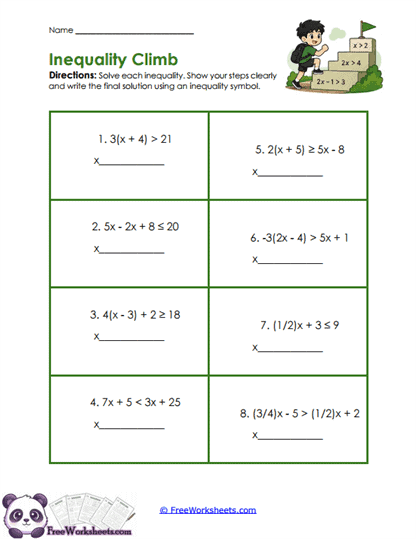
Students work through eight multi-step inequalities containing parentheses, like terms, variables on both sides, fractions, and negative coefficients. They distribute, simplify, move terms, apply inverse operations, and carefully determine whether a multiplication or division step requires the inequality symbol to reverse.
Target Skill:
This worksheet strengthens advanced one-variable inequality solving by combining several algebra skills within each problem. Students practice organizing multi-step work, maintaining equivalent statements, and applying the negative sign-switching rule accurately, preparing them for more complex algebraic constraints.
Inequality Sprint
What Kids Do:
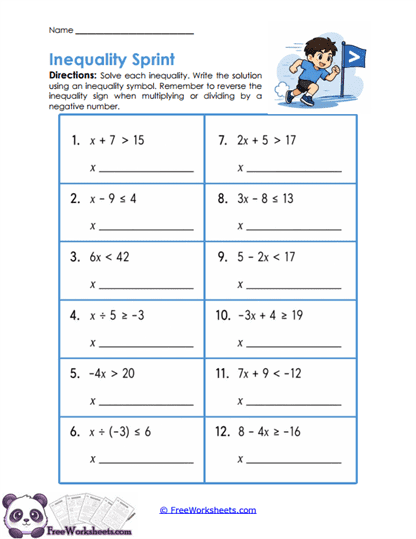
Students solve twelve one-step and two-step inequalities using addition, subtraction, multiplication, and division. They isolate x with inverse operations, work with positive and negative coefficients, and decide when the inequality symbol remains unchanged or must reverse because of multiplication or division by a negative value.
Target Skill:
Students build core fluency with solving one-variable inequalities while connecting the process to familiar equation-solving strategies. The activity emphasizes balance, inverse operations, symbol accuracy, and the idea that a final inequality describes an entire set of possible values.
Number Rays
What Kids Do:
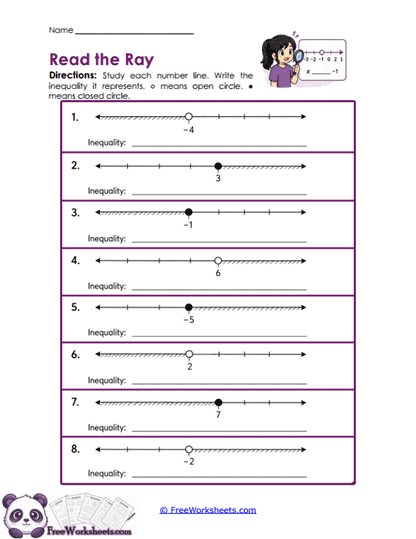
Students study eight number-line graphs and write the inequality represented by each one. They identify the boundary point, determine whether an open or closed circle includes that value, follow the shaded ray toward greater or lesser numbers, and choose the matching inequality symbol.
Target Skill:
Students strengthen their ability to translate visual solution sets back into algebraic notation. The activity reinforces boundary inclusion, numerical order, and the meanings of <, >, ≤, and ≥, helping 8th grade students move confidently between number-line models and symbolic inequalities.
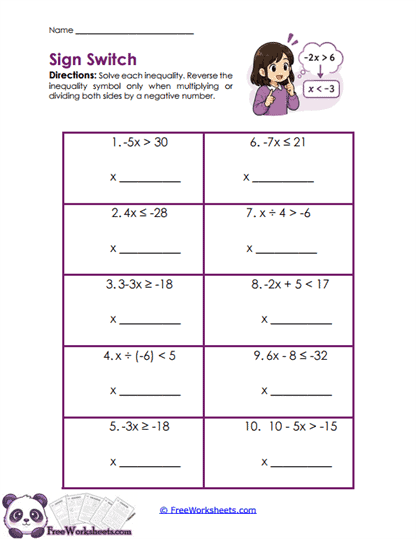
Sign Switch
What Kids Do:
Students solve ten inequalities designed specifically around negative coefficients and divisors. They work through one-step and multi-step expressions, identify the exact operation that requires a sign reversal, and preserve the correct form of symbols such as ≥ and ≤ when changing their direction.
Target Skill:
This focused practice develops mastery of the rule that an inequality reverses only when both sides are multiplied or divided by a negative number. Students learn not to flip symbols merely because a negative value appears, improving accuracy and confidence with 8th grade inequality solving.
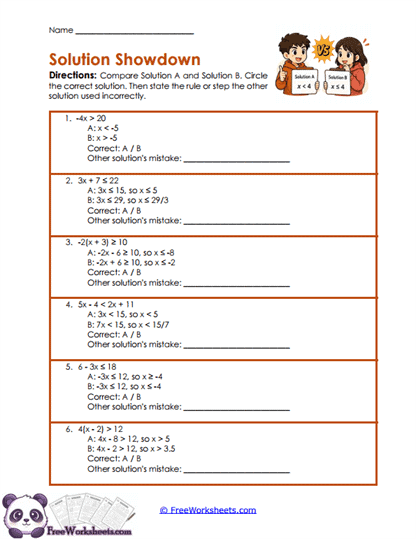
Solution Duel
What Kids Do:
Students compare Solution A and Solution B for six inequalities and decide which student’s reasoning is correct. They inspect each line for valid operations, distribution, simplification, and sign changes, then explain the exact mistake made in the incorrect solution instead of simply choosing an answer.
Target Skill:
Students develop the ability to critique and defend algebraic reasoning. By comparing two plausible solution paths, they reinforce negative-number rules, distribution, like-term combination, inverse operations, and symbol changes while becoming more careful about checking their own inequality work.
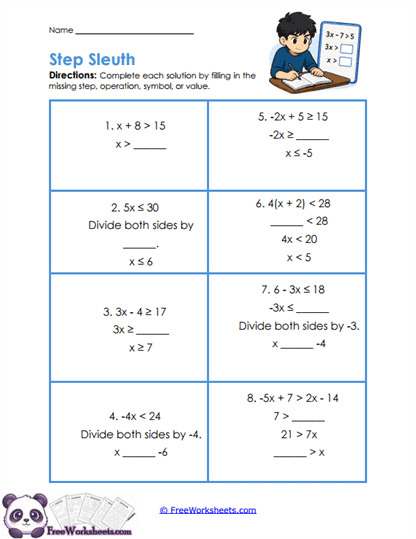
Step Sleuth
What Kids Do:
Students complete eight partially solved inequalities by filling in missing numbers, operations, inequality symbols, or boundary values. They compare one line of work with the next and determine what mathematical step must have occurred, including recognizing when division by a negative value causes the symbol to reverse.
Target Skill:
This activity strengthens understanding of the structure behind inequality-solving procedures. Rather than solving every problem from the beginning, students analyze how equivalent steps connect, reinforcing inverse operations, symbol accuracy, negative-number reasoning, and organized 8th grade algebraic thinking.
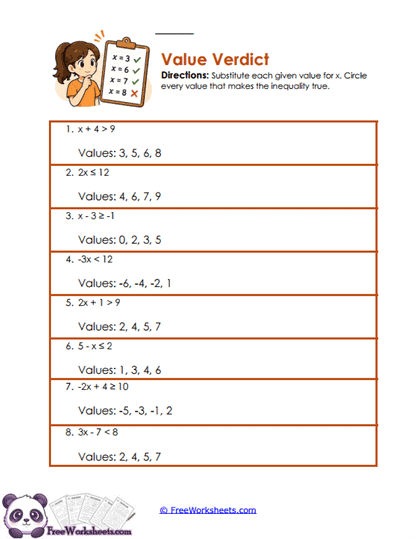
Value Check
What Kids Do:
Students are given inequalities along with several possible values for x and substitute each number into the original statement. They simplify both sides, decide whether the resulting comparison is true or false, and determine which tested numbers belong to the inequality’s solution set.
Target Skill:
Students develop a concrete understanding of what it means for a number to satisfy an inequality. The activity strengthens substitution, integer operations, comparison skills, and solution-set reasoning while showing 8th grade students that many different values can make the same inequality true.