
About This Worksheet
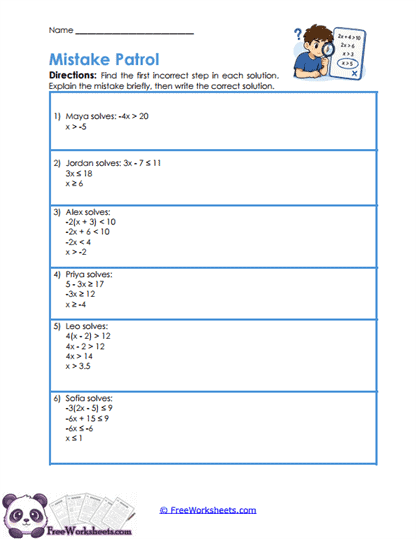
This worksheet helps eighth-grade students analyze incorrect inequality solutions and find the first mistake. Each problem shows a student’s work, and the task is to explain where the reasoning went wrong before writing the correct solution. The examples include sign errors, arithmetic mistakes, incorrect inverse operations, and failures to reverse the inequality symbol when needed. This makes the activity more about mathematical thinking than simply producing an answer.
For example, a student may divide both sides of -4x > 20 by -4 but forget to reverse the inequality symbol. Another may subtract or divide incorrectly in a multi-step problem. By finding the exact mistake, students learn to recognize the errors they are most likely to make themselves.
What Students Practice
Students practice reading another person’s work step by step and checking whether each move is valid. They identify the first incorrect step, explain the mistake, and then repair the solution. This encourages careful reasoning rather than rushing through procedures.
The worksheet also reviews several types of inequalities at once. Students work with one-step and multi-step problems, positive and negative coefficients, and different inequality symbols. That makes the page a broad review of common solving skills.
Why This Skill Matters
Error analysis helps students become more independent problem solvers. When they understand why a step is wrong, they are more likely to catch the same issue in their own work. This is especially important with inequalities because one small sign mistake can completely change the solution set.
The activity also builds mathematical communication. Students must explain the mistake clearly instead of only giving a corrected answer. That strengthens their ability to describe reasoning, which becomes increasingly important in higher-level math.
Common Challenges
Students may notice that the final answer is wrong but struggle to find the first step where the work went off track. Encourage them to check one line at a time instead of jumping straight to the end. This makes it easier to see the exact error.
Another common difficulty is correcting the arithmetic without correcting the inequality rule. Have students state the rule first, such as “divide by a negative, so reverse the sign,” before fixing the work. This keeps the reasoning clear.
How To Use It
Teachers can use this worksheet for partner work, small-group instruction, test review, or a whole-class discussion. It is especially useful after students have practiced solving inequalities and are ready to think more deeply about mistakes. Asking students to defend their corrections aloud can lead to strong mathematical conversations.
Parents and homeschool teachers can make the page feel like a puzzle. Ask, “Where did this student first go wrong?” and then, “What should have happened instead?” This keeps the focus on reasoning before calculation.
Grade Alignment
This Grade 8 worksheet supports algebraic reasoning with one-variable inequalities and builds on the skills connected to CCSS 8.EE.C.7. It also reinforces mathematical practice standards involving checking work and explaining reasoning. The activity is especially useful for strengthening accuracy with negative numbers and inverse operations.
Students should already know how to solve basic inequalities. After this practice, they are better prepared for more complex inequalities and formal assessments.