
Square and Cube Roots Worksheets
These worksheets help students strengthen radical notation, estimation strategies, and numerical reasoning skills. These free, ready-to-print worksheets come in PDF format for immediate classroom use during review, intervention, homework, or algebra practice. Students develop curriculum aligned skills including evaluating square roots, solving cube roots, and estimating irrational values accurately.
About This Collection of Worksheets
This collection of Square and Cube Roots worksheets gives students meaningful practice working with radicals, perfect squares, perfect cubes, and irrational-number estimation. Learners evaluate square roots and cube roots, solve equations involving radicals, compare and order root values, and apply roots to geometry and measurement situations. The worksheets gradually build fluency by combining conceptual understanding with repeated practice using roots and exponents together.
Teachers can use these printable worksheets during algebra instruction, geometry connections, guided review, math stations, intervention groups, or assessment preparation. Puzzle-style activities, estimation tasks, ordering problems, and real-world applications help students stay engaged while strengthening number sense and algebra reasoning. Activities involving area, volume, and irrational numbers encourage learners to connect radicals to practical mathematical situations and visual models.
These worksheets align closely with Common Core standards 8.EE.A.2 and 8.NS.A.2 while supporting foundational algebra and numerical reasoning skills. Students practice simplifying roots, estimating irrational square roots, comparing radical expressions, and solving equations involving square and cube roots. The printable format makes this collection useful for classrooms, tutoring sessions, homeschool instruction, and independent math reinforcement.

Paul’s Teacher Tip
Students often memorize square roots and cube roots more successfully when they connect them to repeated multiplication patterns and visual models. Encourage learners to build perfect-square and perfect-cube reference charts they can revisit during estimation and comparison activities. Number lines are also extremely helpful when teaching irrational square roots because students can visualize where values belong between whole numbers. Many errors happen because students confuse square roots and cube roots, so repeated side-by-side comparisons can strengthen understanding. Geometry examples involving area and volume make roots feel much more meaningful and practical for students. Frequent mixed review helps learners become more flexible when switching between evaluating, estimating, comparing, and solving radical expressions.
Worksheet Collection Skill Spotlights
Cube Foundations
- What Kids Do:
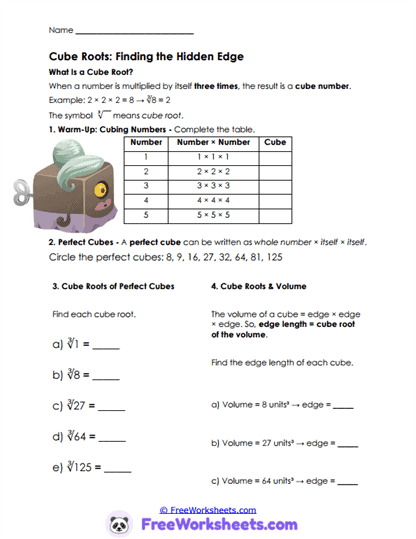
Students explore perfect cubes and cube roots through repeated multiplication, tables, and geometry connections involving volume. Learners identify cube numbers, evaluate cube roots, and connect radicals to finding edge lengths of cubes while strengthening understanding of repeated multiplication patterns. - Target Skill:
This worksheet strengthens cube-root fluency, exponent reasoning, and numerical pattern recognition aligned to Common Core radical standards. Students improve understanding of perfect cubes, repeated multiplication, and inverse operations while building readiness for algebra and geometry applications involving volume.
Mixed Roots
- What Kids Do:
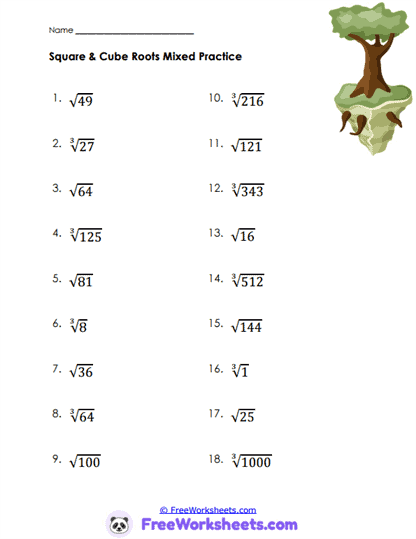
Students simplify square roots and cube roots of perfect powers while working through mixed radical problems involving both operations. Learners evaluate radical expressions, recognize benchmark roots quickly, and compare how square roots and cube roots behave differently across multiple examples. - Target Skill:
This activity reinforces radical notation understanding, perfect-square recognition, and cube-root fluency aligned to algebra readiness standards. Students strengthen procedural accuracy and numerical reasoning while building long-term confidence evaluating radicals and interpreting exponent relationships correctly.
Root Applications
- What Kids Do:
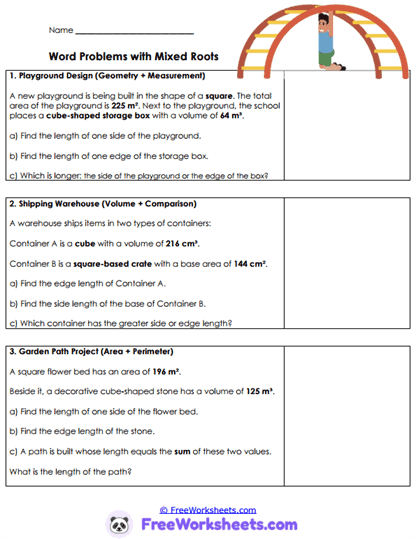
Students solve geometry and measurement problems involving square roots and cube roots connected to area and volume situations. Learners determine side lengths, edge lengths, and dimensions using radicals while applying algebraic reasoning to practical real-world measurement scenarios. - Target Skill:
This worksheet strengthens mathematical modeling, geometry reasoning, and radical application skills aligned to Common Core standards for roots and exponents. Students improve their ability to connect square roots and cube roots to contextual problem solving involving dimensions, area, and volume.
Root Comparisons
- What Kids Do:
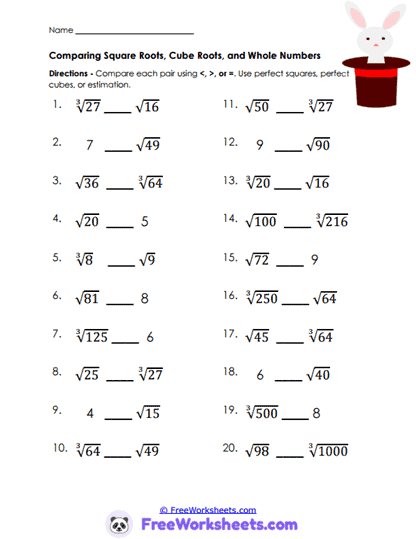
Students compare square roots, cube roots, and whole numbers using inequality symbols while evaluating and estimating radical values. Learners determine which values are greater or smaller and practice interpreting benchmark roots quickly during comparison activities. - Target Skill:
This worksheet develops number sense, irrational-number reasoning, and comparison fluency aligned to standards involving real-number relationships. Students strengthen their ability to evaluate radicals accurately while improving confidence comparing rational and irrational numerical values logically.
Root Estimates
- What Kids Do:
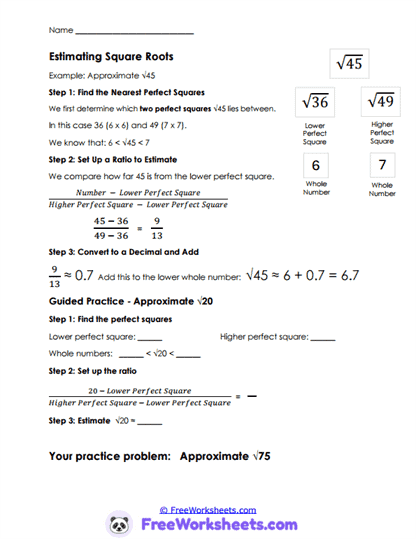
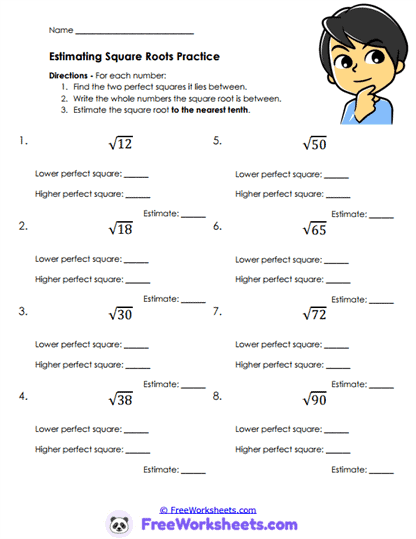
Students estimate square roots that are not perfect squares by identifying nearby benchmark perfect squares and approximating values to the nearest tenth. Learners compare distances between perfect squares and use decimal reasoning to estimate irrational roots accurately. - Target Skill:
This activity strengthens estimation strategies, irrational-number understanding, and numerical reasoning aligned to Common Core expectations for approximating square roots. Students improve number-line reasoning and benchmark comparison skills while building stronger conceptual understanding of irrational values.
Root Foundations
- What Kids Do:
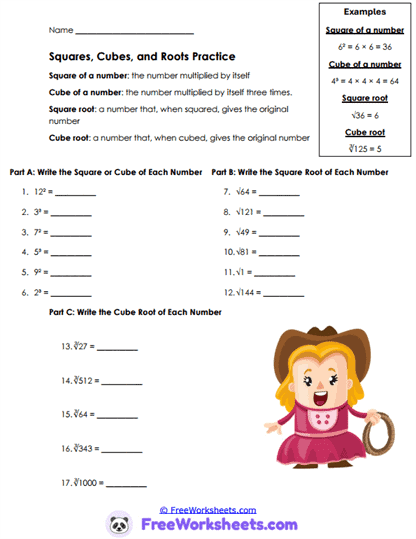
Students practice evaluating squares, cubes, square roots, and cube roots while exploring how roots reverse exponent operations. Learners solve repeated multiplication problems, simplify radicals, and recognize relationships between powers and roots through organized mixed practice. - Target Skill:
This worksheet reinforces exponent fluency, radical notation understanding, and inverse-operation reasoning aligned to algebra readiness standards. Students strengthen recognition of perfect squares and perfect cubes while developing stronger procedural confidence with roots and powers together.
Root Mysteries
- What Kids Do:
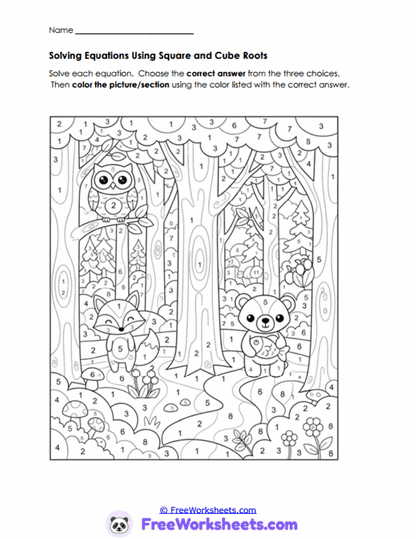
Students solve equations involving square roots and cube roots and use their answers to complete a color-by-number puzzle activity. Learners evaluate radicals, check solutions, and connect equation solving with visual engagement while practicing perfect-square and perfect-cube recognition. - Target Skill:
This worksheet strengthens equation-solving fluency, radical reasoning, and algebraic problem-solving skills aligned to Common Core root standards. Students practice using inverse operations and evaluating roots accurately while building confidence solving equations involving radicals.
Root Ordering
- What Kids Do:
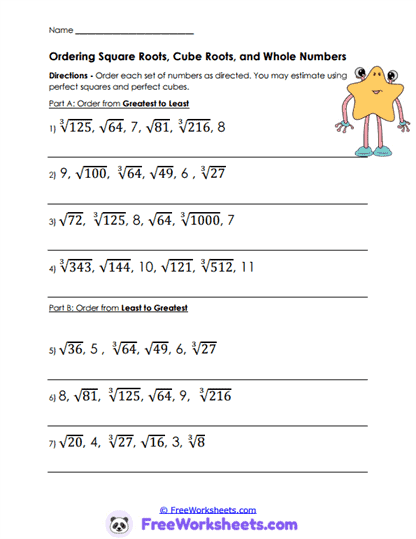
Students arrange square roots, cube roots, and whole numbers from least to greatest or greatest to least by evaluating and estimating radicals carefully. Learners compare irrational and rational values while organizing numerical sequences accurately using benchmark strategies. - Target Skill:
This activity strengthens ordering skills, estimation reasoning, and numerical comparison fluency aligned to standards involving irrational numbers. Students improve their ability to interpret radicals, estimate root values, and compare numbers logically using benchmark perfect squares and cubes.
Root Practice
- What Kids Do:
Students complete additional square-root estimation practice by identifying benchmark perfect squares and approximating irrational roots to the nearest tenth. Learners compare nearby values, place irrational numbers between whole numbers, and explain estimation reasoning step by step. - Target Skill:
This worksheet reinforces irrational-number estimation, benchmark reasoning, and decimal approximation aligned to Common Core standards for square-root estimation. Students strengthen number sense and estimation confidence while improving understanding of how irrational roots behave between integers.
Root Review
- What Kids Do:
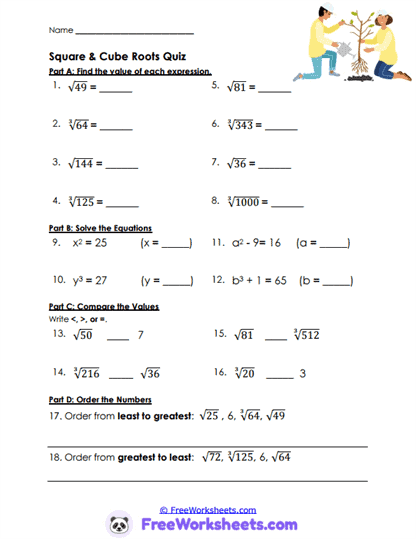
Students complete a mixed review involving evaluating roots, solving radical equations, comparing values, and ordering numbers. Learners switch between multiple radical skills while applying estimation, algebraic reasoning, and procedural fluency across varied practice activities. - Target Skill:
This worksheet strengthens cumulative radical fluency and algebra readiness aligned to standards involving square roots, cube roots, and irrational-number reasoning. Students improve flexibility with equations, comparisons, ordering, and estimation while reinforcing long-term retention of root concepts.
Smart Estimates
- What Kids Do:
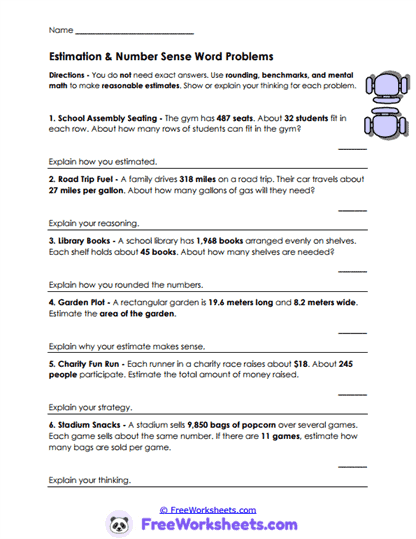
Students solve real-world estimation problems involving rounding, benchmark values, and mental math strategies connected to practical situations such as seating, fuel, books, and money. Learners explain why their estimates are reasonable and compare different approximation methods. - Target Skill:
This worksheet strengthens number sense, approximation reasoning, and contextual problem-solving skills aligned to mathematical reasoning standards. Students improve estimation fluency and numerical flexibility while learning how mental math and benchmark strategies support efficient decision making.
Square Foundations
- What Kids Do:
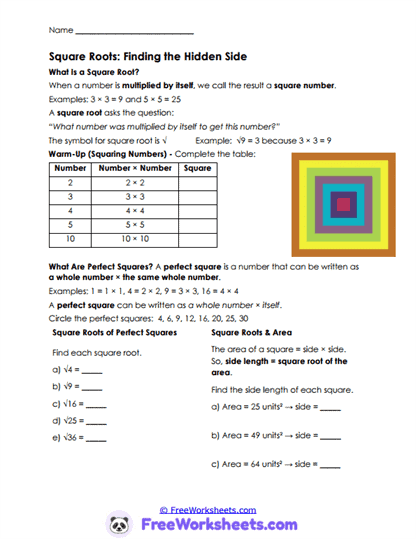
Students explore perfect squares and square roots through multiplication tables, radical notation practice, and geometry connections involving area. Learners evaluate square roots, recognize square-number patterns, and connect roots to finding missing side lengths in squares. - Target Skill:
This worksheet develops foundational square-root understanding, repeated multiplication fluency, and numerical reasoning aligned to Common Core radical standards. Students strengthen perfect-square recognition and inverse-operation understanding while preparing for irrational-number estimation and algebra applications.