
Learn Cube Roots
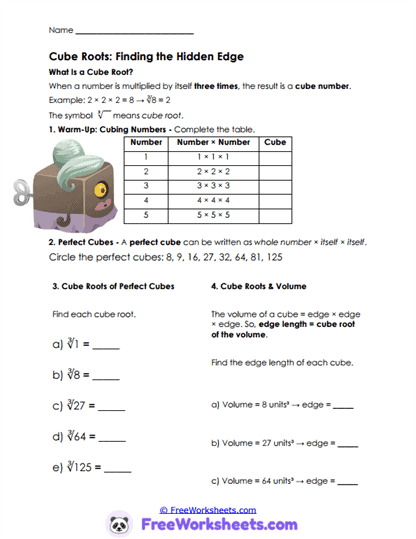
This worksheet introduces students to cube roots and explains how they connect to perfect cubes and volume relationships. Learners study how multiplying a number by itself three times creates a cube number. The activity strengthens number sense by helping students recognize perfect cubes and evaluate cube roots accurately. For example, 2 × 2 × 2 = 8, so ∛8 = 2. Students also explore how cube roots connect to finding the edge length of cubes from volume measurements.
Standards Connection
This worksheet supports Grade 8 math concepts involving cube roots, exponents, and perfect cubes. Students strengthen numerical reasoning skills that prepare them for algebra, geometry, and volume applications. Learners should already understand multiplication patterns and exponent basics before beginning this activity. The worksheet aligns with Common Core standard 8.EE.A.2 through evaluating cube roots of perfect cubes. It also supports TEKS 8.2A by applying roots and exponents to represent numerical relationships.
Explore Perfect Cubes
On this worksheet, students will identify perfect cubes and calculate cube roots of whole numbers. Learners complete tables showing repeated multiplication patterns that form cube numbers. Some problems ask students to evaluate cube roots directly, while others connect cube roots to geometric volume situations. Students also practice identifying which numbers belong in a list of perfect cubes. The activity strengthens understanding of how cube roots reverse repeated multiplication.
Frequent Errors
Many students confuse square roots with cube roots because both use similar symbols. Some learners forget that cube roots involve three equal factors instead of two. Others struggle to recognize perfect cubes larger than 27 because they are less familiar with the patterns. Students may also misunderstand how cube roots relate to finding cube edge lengths from volume. Teachers can improve understanding by modeling cube models and repeated multiplication examples visually.
Teaching Strategies
Teachers can use this worksheet during root-introduction lessons, geometry connections, or guided algebra review activities. Parents and homeschool educators may support learning by discussing real-world cube examples such as boxes, dice, or storage containers. The activity also works well for partner discussions where students explain why a number is or is not a perfect cube. Learners benefit from repeated multiplication practice because it strengthens cube-number recognition. Visual and geometric examples help students connect roots to real measurements.
Worksheet Features
The worksheet includes warm-up multiplication tables, perfect cube identification, and cube-root practice problems for balanced learning. Organized answer spaces support neat written work and careful calculations. Problems gradually increase in difficulty to support confidence and skill development. Student-friendly directions encourage independent completion and classroom use. The printable design works well for middle school classrooms, tutoring programs, and homeschool mathematics lessons.