
Scientific Notation Worksheets
These worksheets help students strengthen exponent reasoning, decimal movement, and powers of 10 understanding. These free, ready-to-print worksheets come in PDF format for immediate classroom use during lessons, homework, intervention, or independent review. Students develop curriculum aligned skills including converting scientific notation, comparing numerical values, and solving real-world scientific notation problems.
About This Collection of Worksheets
This collection of scientific notation worksheets gives students meaningful practice working with very large and very small numbers using powers of 10. Learners convert numbers between standard form and scientific notation, compare and order scientific notation values, and apply exponent reasoning to practical science and technology situations. The worksheets gradually increase in complexity so students can strengthen both conceptual understanding and procedural fluency while building confidence with decimal movement and exponent relationships.
Teachers can use these printable worksheets during direct instruction, review lessons, intervention groups, math stations, science integration activities, or assessment preparation. Mixed review pages, conversion tables, comparison tasks, and real-world application problems provide students with varied opportunities to practice scientific notation skills in engaging formats. Real-life examples involving astronomy, digital storage, environmental science, and measurements help students understand why scientific notation is important outside the classroom.
These worksheets align closely with Common Core standards 8.EE.A.3 and 8.EE.A.4 while supporting important Grade 8 numerical reasoning and algebra readiness skills. Students practice converting numbers accurately, comparing values written in scientific notation, solving operations with powers of 10, and interpreting scientific quantities logically. The printable format makes this collection useful for classrooms, tutoring sessions, homeschool instruction, and additional math reinforcement at home.

Paul’s Teacher Tip
Scientific notation becomes much easier for students when they connect decimal movement directly to powers of 10. Encourage learners to physically track decimal shifts with arrows or place-value charts before writing exponents. Many mistakes happen because students rush through exponent signs, so frequent verbal explanations about why an exponent is positive or negative can improve accuracy. Comparing large and small scientific values visually also helps students understand magnitude more clearly. Real-world science examples involving planets, microscopic organisms, or computer storage make scientific notation feel practical and meaningful. Consistent mixed review practice helps students build flexibility when switching between conversions, comparisons, and operations.
Worksheet Collection Skill Spotlights
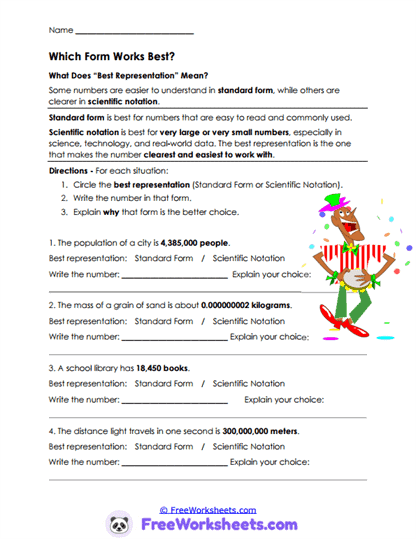
Best Formats
- What Kids Do:
Students examine real-world numbers and decide whether standard form or scientific notation is the clearer and more practical representation. Learners rewrite values into the selected format, explain their reasoning, and compare how different representations improve readability and communication in science and mathematics contexts. - Target Skill:
This worksheet strengthens mathematical communication, numerical reasoning, and scientific notation interpretation aligned to Common Core Grade 8 standards. Students practice evaluating representations critically while improving conversion fluency, exponent understanding, and real-world application of powers of 10 in meaningful contexts.
Decimal Moves
- What Kids Do:
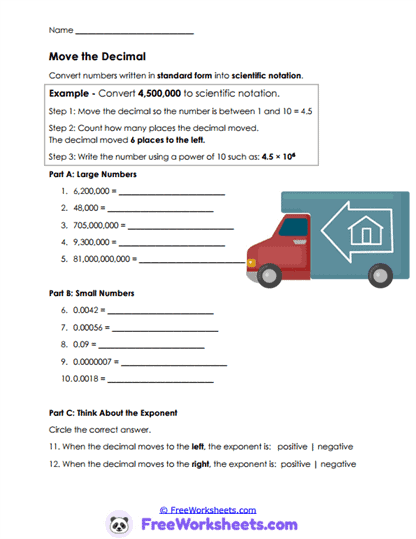
Students convert large and small standard-form numbers into scientific notation by moving decimals and identifying appropriate powers of 10. Learners determine decimal direction, count movement accurately, and rewrite values using proper coefficients and positive or negative exponents. - Target Skill:
This activity strengthens decimal place-value understanding, exponent reasoning, and conversion fluency aligned to Grade 8 scientific notation standards. Students build confidence representing numbers efficiently while improving accuracy with decimal movement, coefficient structure, and powers of 10 relationships.
Expand Exponents
- What Kids Do:
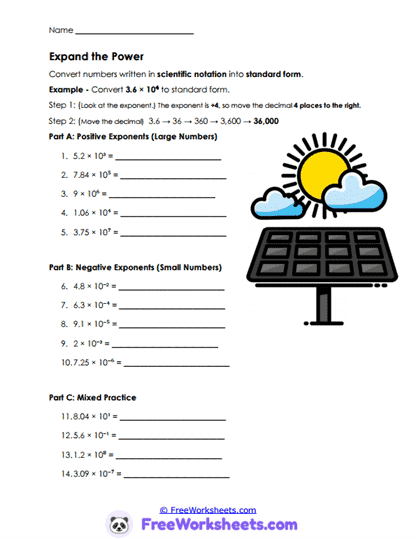
Students convert numbers written in scientific notation back into standard form by moving decimals according to exponent values. Learners rewrite values involving both positive and negative exponents while carefully tracking zeros, decimal placement, and overall numerical magnitude. - Target Skill:
This worksheet reinforces scientific notation expansion skills, decimal accuracy, and exponent interpretation aligned to Common Core numerical reasoning standards. Students strengthen place-value understanding, procedural fluency, and conceptual connections between powers of 10 and numerical size relationships.
Exponent Mastery
- What Kids Do:
Students complete mixed scientific notation practice involving conversions, comparisons, ordering, and operations with powers of 10. Learners switch between multiple scientific notation skills while interpreting exponent effects, rewriting answers correctly, and analyzing large and small numerical values. - Target Skill:
This worksheet strengthens overall scientific notation fluency and numerical reasoning aligned to Grade 8 standards 8.EE.A.3-4. Students improve flexibility with conversions, comparisons, and operations while building long-term confidence using powers of 10 across varied mathematical situations.
Notation Review
- What Kids Do:
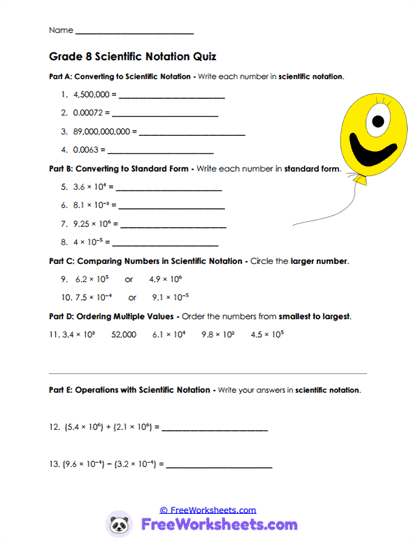
Students complete a comprehensive review involving scientific notation conversions, comparisons, ordering tasks, and operations. Learners solve mixed problems using positive and negative exponents while practicing decimal movement, notation structure, and powers of 10 reasoning across multiple activities. - Target Skill:
This activity reinforces cumulative scientific notation understanding aligned to Common Core Grade 8 expectations. Students strengthen conversion accuracy, comparison reasoning, operational fluency, and procedural consistency while reviewing several connected powers of 10 concepts within one assignment.
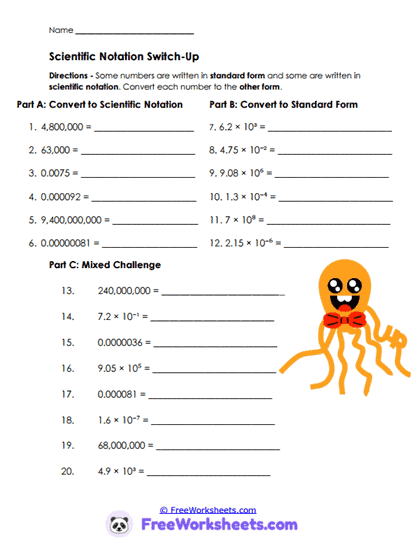
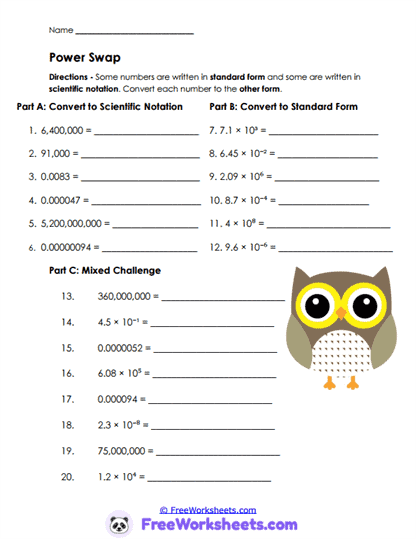
Notation Switch
- What Kids Do:
Students convert numbers between scientific notation and standard form in both directions using decimal movement and exponent reasoning. Learners identify coefficient structure, determine exponent signs, and solve mixed conversion problems involving extremely large and very small numerical values. - Target Skill:
This worksheet develops conversion flexibility, decimal fluency, and exponent interpretation aligned to Grade 8 scientific notation standards. Students strengthen understanding of powers of 10 relationships while building accuracy converting between multiple numerical representations efficiently and correctly.
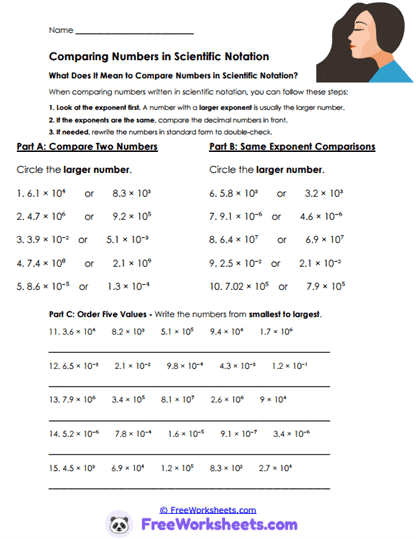
Number Comparisons
- What Kids Do:
Students compare and order scientific notation values by analyzing coefficients and exponents carefully. Learners determine which quantities are larger or smaller, rewrite values when needed, and organize scientific notation numbers from least to greatest using logical comparison strategies. - Target Skill:
This worksheet strengthens numerical magnitude reasoning, comparison fluency, and exponent interpretation aligned to Common Core standard 8.EE.A.4. Students improve their ability to analyze scientific notation values accurately while reinforcing place-value understanding and powers of 10 relationships.
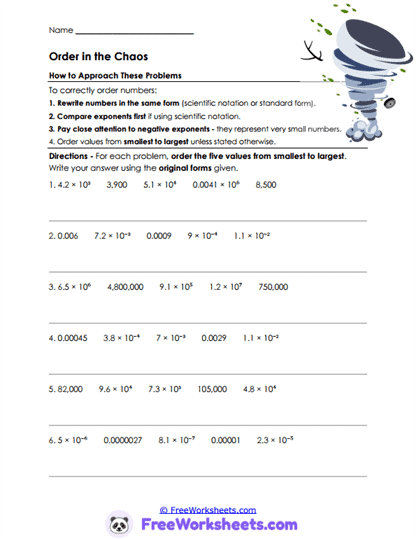
Ordered Powers
- What Kids Do:
Students compare groups of numbers written in both standard form and scientific notation before arranging them from smallest to largest. Learners rewrite values into matching formats, analyze exponent effects carefully, and organize numbers using logical place-value reasoning. - Target Skill:
This worksheet reinforces ordering skills, scientific notation interpretation, and numerical reasoning aligned to Grade 8 comparison standards. Students strengthen flexibility comparing values across multiple representations while improving decimal accuracy, exponent analysis, and mathematical organization skills.
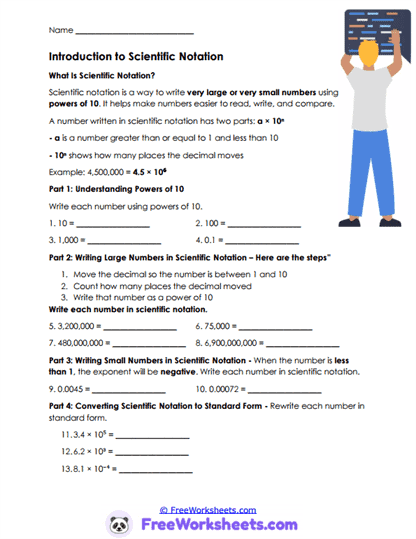
Power Basics
- What Kids Do:
Students learn how scientific notation represents very large and very small numbers using powers of 10 and decimal movement. Learners identify coefficients, determine exponent values, and convert numbers between scientific notation and standard form through introductory guided practice activities. - Target Skill:
This worksheet develops foundational scientific notation understanding aligned to Common Core Grade 8 standards. Students strengthen exponent reasoning, decimal place-value knowledge, and conversion fluency while building readiness for scientific notation comparisons, operations, and advanced algebra applications.
Power Operations
- What Kids Do:
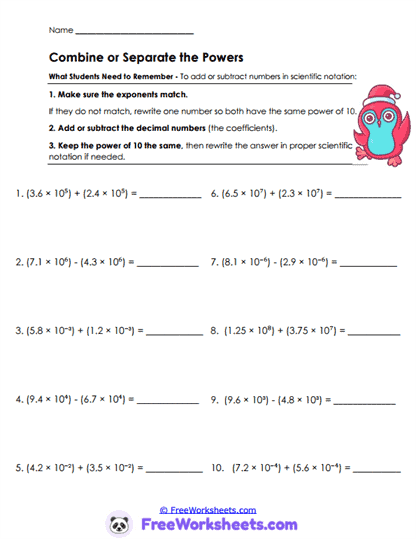
Students add and subtract numbers written in scientific notation by matching powers of 10 and combining coefficients carefully. Learners rewrite answers into proper scientific notation form while solving operations involving both positive and negative exponents. - Target Skill:
This worksheet strengthens operational fluency, exponent reasoning, and scientific notation structure aligned to Grade 8 standards for powers of 10 operations. Students practice combining scientific notation values accurately while improving decimal placement, coefficient adjustments, and procedural mathematical precision.
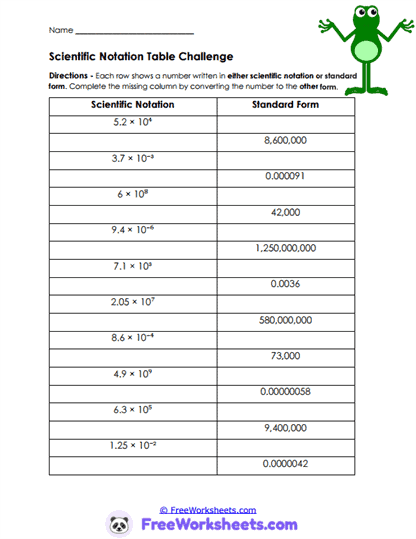
Power Tables
- What Kids Do:
Students complete conversion tables by rewriting values between standard form and scientific notation. Learners analyze decimal movement, determine correct exponents, and organize large and small numbers visually while strengthening recognition of powers of 10 patterns and relationships. - Target Skill:
This worksheet reinforces conversion accuracy, visual organization, and exponent reasoning aligned to Common Core scientific notation standards. Students strengthen place-value understanding, decimal fluency, and scientific notation interpretation while building confidence comparing and rewriting quantities efficiently.
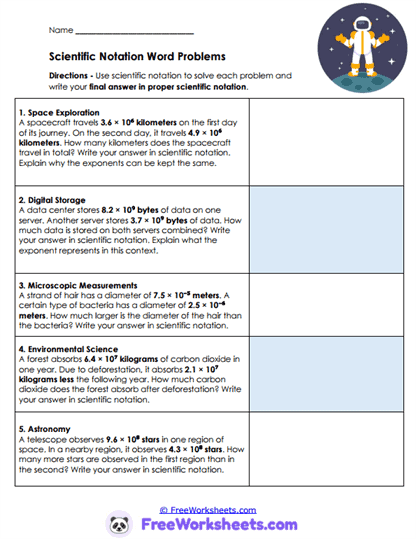
Science Stories
- What Kids Do:
Students solve real-world scientific notation word problems involving astronomy, technology, environmental science, and measurements. Learners apply operations with powers of 10, interpret scientific quantities carefully, and explain how scientific notation simplifies difficult calculations and comparisons. - Target Skill:
This activity strengthens real-world problem solving, scientific notation operations, and quantitative reasoning aligned to Grade 8 standards 8.EE.A.3-4. Students improve their ability to apply powers of 10 meaningfully while strengthening algebra readiness and scientific mathematical communication skills.