
Solving Systems Of Equations Worksheets
8th grade math solving systems of equations worksheets help students identify, solve, compare, and verify shared solutions between linear relationships. Free, ready-to-print worksheets in PDF format are designed for immediate classroom use, guided practice, homework, intervention, or homeschool lessons. Students strengthen graphing, substitution, and elimination skills while developing algebraic reasoning that supports 8th grade curriculum expectations.
About This Collection of Worksheets
Solving systems of equations helps 8th grade students understand how two linear relationships can be true at the same time. A system’s solution is the ordered pair that satisfies both equations, which can be seen as the point where two lines intersect on a graph. Students also learn that systems may have one solution, no solution, or infinitely many solutions depending on how the two lines relate.
This collection gives students practice with systems in several forms. Activities include checking ordered pairs, graphing pairs of lines, identifying intersection points, classifying solution types, solving with substitution, solving with elimination, matching systems to ordered pairs, finding shared values in tables, analyzing errors, and verifying final answers in both original equations. Students move among equations, graphs, tables, and point banks so they learn to recognize the same system idea across different representations.
Teachers can use these worksheets throughout an 8th grade systems unit for direct instruction, guided practice, independent work, partner activities, homework, intervention, review, or formative assessment. Parents, tutors, and homeschool educators can also use the collection to introduce one solving method at a time before asking students to compare strategies. The repeated emphasis on checking both equations helps students build a dependable habit of verifying that a final ordered pair truly solves the system.

Paul’s Teacher Tip
Before students solve a system, ask them what the solution should represent: one ordered pair that makes both equations true. When graphing, remind them that the solution is where the two lines cross, not where either line crosses an axis. For substitution, have students clearly box the isolated variable before replacing it in the second equation, and for elimination, have them mark the terms they expect to cancel before combining the equations. When students find only x or only y, prompt them with “Do we have a full ordered pair yet?” For stronger understanding, require students to verify selected answers by substituting the ordered pair back into both original equations.
Worksheet Collection Skill Spotlights
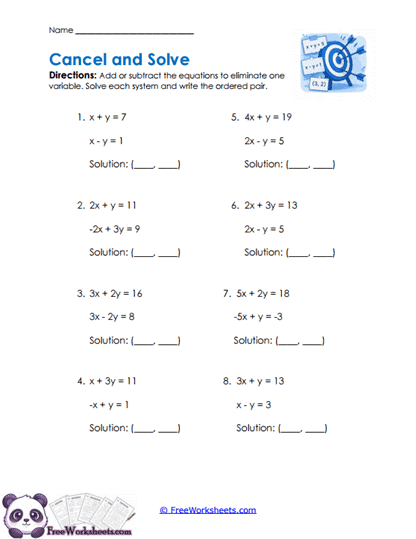
Elimination Moves
What Kids Do:
Students solve systems of two linear equations by adding or subtracting the equations so one variable cancels. They identify which terms can be eliminated, combine corresponding expressions, solve the resulting one-variable equation, substitute back to find the second value, and write the final solution as an ordered pair.
Target Skill:
This activity strengthens algebraic system solving through elimination. Students practice recognizing opposite coefficients, combining like terms accurately, handling signs, and completing the second substitution step, supporting 8th grade understanding of how two equations can be combined without changing their shared solution.
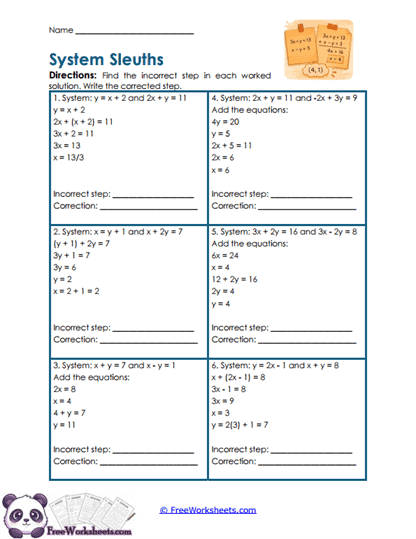
Error Systems
What Kids Do:
Students analyze six worked system solutions containing mistakes in substitution, elimination, combining terms, sign handling, or back-substitution. They locate the first incorrect step, explain the exact problem, and then correct the reasoning so the system can be solved accurately.
Target Skill:
Error analysis develops deeper understanding of system-solving procedures because students must judge whether each algebraic step is valid. The activity strengthens substitution, elimination, equation solving, sign accuracy, and mathematical explanation while helping 8th grade students become better at checking their own work.
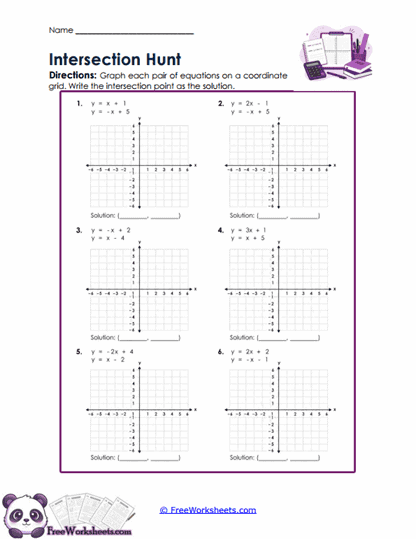
Graph Intersections
What Kids Do:
Students graph two linear equations on the same coordinate plane for each of six systems. They identify slope and y-intercept, draw both lines carefully, locate the point where they intersect, and write that shared location as an ordered-pair solution.
Target Skill:
Students build a visual understanding of systems by connecting the intersection of two lines with the point that satisfies both equations. The worksheet reinforces slope-intercept graphing, ordered pairs, and 8th grade reasoning about why intersecting lines represent one shared solution.
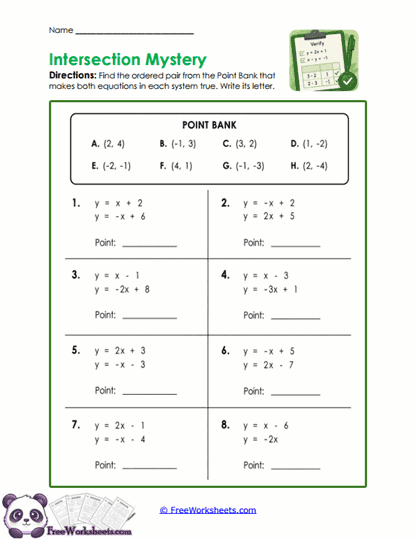
Intersection Match
What Kids Do:
Students work with eight systems written in slope-intercept form and match each one to an ordered pair from a point bank. They may solve the equations algebraically or test candidate points, but each final choice must make both equations true at the same time.
Target Skill:
This activity strengthens the connection between symbolic equations and shared ordered-pair solutions. Students practice substitution, comparison of linear expressions, and solution verification while reinforcing the 8th grade idea that every correct solving method should lead to the same intersection point.
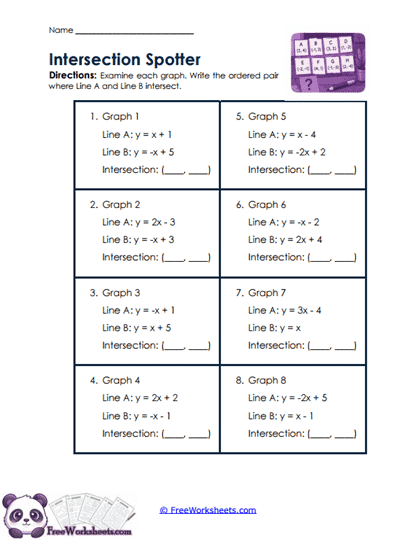
Intersection Points
What Kids Do:
Students examine pairs of linear equations and find the common ordered pair where the two relationships agree. Depending on the equation forms, they may graph the lines, compare expressions, or use substitution to determine the shared x- and y-values.
Target Skill:
Students strengthen flexible system-solving skills and learn that algebraic and graphical methods describe the same mathematical idea. The activity reinforces slope-intercept form, ordered-pair meaning, and the 8th grade connection between a system solution and the intersection of two linear relationships.
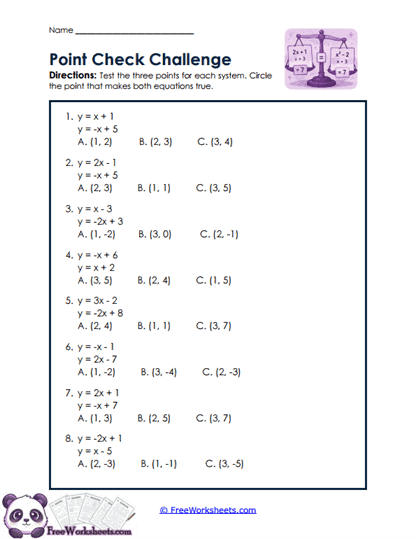
Point Test
What Kids Do:
Students are given a system and three possible ordered pairs, then test each candidate by substituting its x- and y-values into both equations. They reject any point that makes even one equation false and identify the one point that satisfies both statements.
Target Skill:
This worksheet develops a concrete understanding of what it means to solve a system. Students strengthen substitution, ordered-pair interpretation, and verification skills while learning that a system solution must satisfy two conditions simultaneously rather than simply work in one equation.
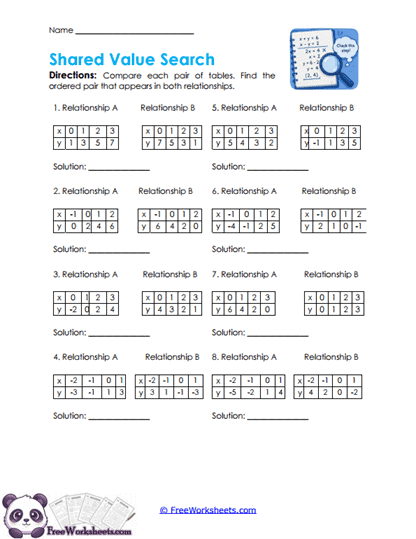
Shared Values
What Kids Do:
Students compare two tables representing different linear relationships and identify the exact ordered pair that appears in both. They read each x-and-y column as a complete pair and locate the shared input-output combination without first graphing or solving equations algebraically.
Target Skill:
Students learn to recognize system solutions from tabular representations. The activity reinforces that a shared ordered pair in two tables means the same thing as an intersection on a graph, strengthening 8th grade connections among functions, tables, systems, and common values.
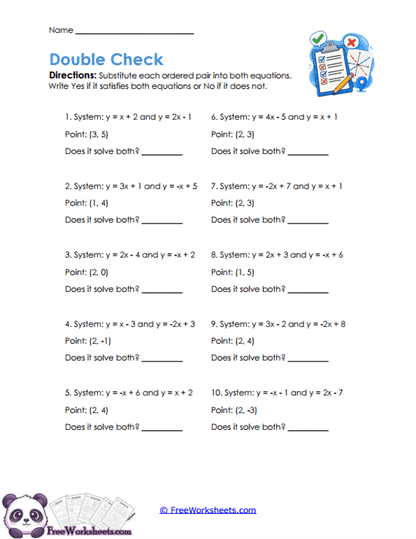
Solution Check
What Kids Do:
Students receive ten systems paired with proposed ordered-pair solutions. For each one, they substitute the x- and y-values into both equations, evaluate whether each statement is true, and decide whether the point really solves the system.
Target Skill:
Students strengthen the foundational idea that a system solution must satisfy both equations at once. Repeated verification builds substitution fluency, ordered-pair accuracy, and a useful checking routine that students can apply after solving systems by graphing, substitution, or elimination.
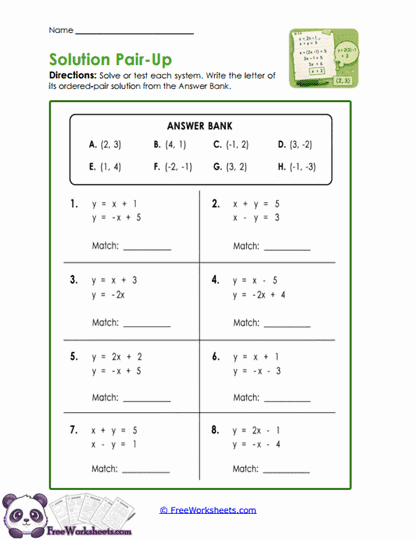
Solution Match
What Kids Do:
Students solve or test eight systems and connect each one to the correct ordered pair in an answer bank. They choose an efficient strategy for each system, verify that the selected point works in both equations, and use the remaining choices as a built-in check on their work.
Target Skill:
This activity develops strategy flexibility and solution verification. Students practice deciding when substitution, direct solving, or testing points is most efficient while reinforcing the 8th grade expectation that a system’s ordered-pair solution must satisfy both linear relationships.
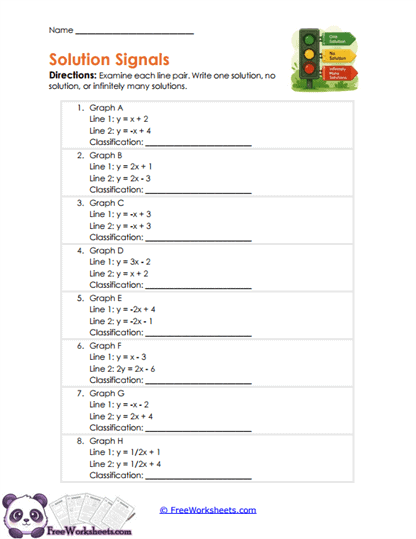
Solution Types
What Kids Do:
Students examine eight pairs of linear equations and compare their slopes and y-intercepts. They classify each system as having one solution, no solution, or infinitely many solutions based on whether the lines intersect, remain parallel, or represent the exact same line.
Target Skill:
Students strengthen conceptual understanding of system behavior without always solving for an exact point. The activity connects algebraic features with graphical relationships and helps 8th grade students recognize how slope and intercept information determines the number of solutions.
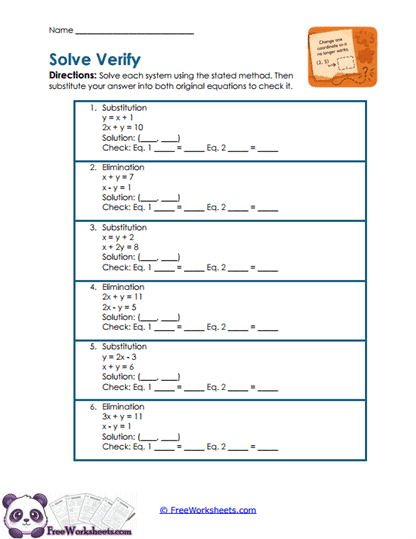
Solve Check
What Kids Do:
Students solve six systems using the method named in each problem, either substitution or elimination. After finding the ordered pair, they substitute both values into Equation 1 and Equation 2 and confirm that each original equation becomes true.
Target Skill:
This activity develops a complete solve-and-verify routine. Students strengthen both major algebraic system methods while learning that verification is part of the solution process, reinforcing 8th grade understanding that a valid ordered pair must satisfy both equations simultaneously.
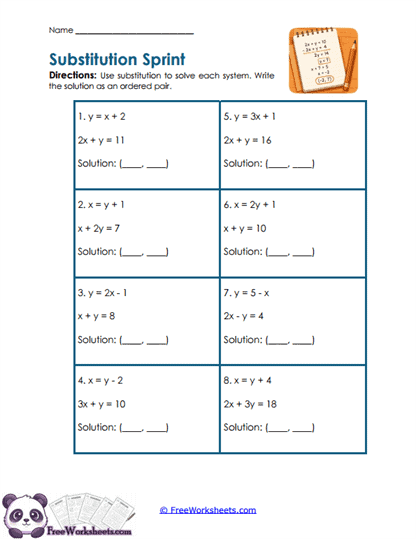
Substitute Systems
What Kids Do:
Students solve eight systems in which one variable is already isolated. They replace that variable in the second equation with an equivalent expression, simplify to solve for the remaining variable, substitute back to find the second value, and write the answer as an ordered pair.
Target Skill:
Students build fluency with substitution as a system-solving method. The worksheet reinforces equivalent expressions, one-variable equation solving, careful use of parentheses, and back-substitution while supporting the 8th grade goal of solving simultaneous linear equations algebraically.