
Proportions Worksheets
8th grade math proportions worksheets help students solve equivalent ratios, identify proportional relationships, and apply proportional reasoning in real-world situations. Free, ready-to-print worksheets in PDF format are designed for immediate classroom use, guided practice, homework, intervention, or homeschool lessons. Students strengthen ratio reasoning, unit-rate fluency, and proportional modeling while developing skills that support 8th grade curriculum expectations.
About This Collection of Worksheets
Proportions help 8th grade students understand how two ratios can describe the same relationship. Students use proportional reasoning to find missing values, compare rates, identify constants of proportionality, complete tables, and connect ratios with equations such as y = kx. These skills also provide an important bridge into 8th grade topics such as slope, similar figures, linear relationships, and scale reasoning.
This collection gives students many ways to practice proportions instead of repeating one type of problem. Activities include solving missing-value proportions, deciding whether two ratios are equivalent, testing tables for proportionality, finding constants of proportionality, choosing efficient solving strategies, correcting errors, matching answers, finding missing sides in similar figures, comparing unit rates, completing proportional tables, and solving real-world applications. Students move among numerical ratios, tables, equations, geometric figures, and everyday situations so they learn to recognize proportional relationships in different forms.
Teachers can use these worksheets for direct instruction, guided practice, partner work, math centers, homework, intervention, review, or formative assessment. Parents, tutors, and homeschool educators can also use individual pages to focus on one proportional reasoning skill before combining several representations. The collection gives students repeated opportunities to explain how quantities correspond, choose an efficient method, and check whether their answers preserve the original relationship.

Paul’s Teacher Tip
Before students cross multiply, ask them to look for an easy scale factor because many proportions can be solved more quickly by recognizing how one ratio was multiplied or divided. When students work with tables, have them calculate y ÷ x in more than one column so they confirm that the same constant works throughout the relationship. For word problems, require students to label the quantities in each ratio before writing a proportion so corresponding units stay in the same positions. When introducing y = kx, connect k directly to the language “how much y for one x” so students see the constant as a unit rate rather than another formula to memorize. For extension, ask students to solve one proportion two different ways and explain which strategy was more efficient.
Worksheet Collection Skill Spotlights
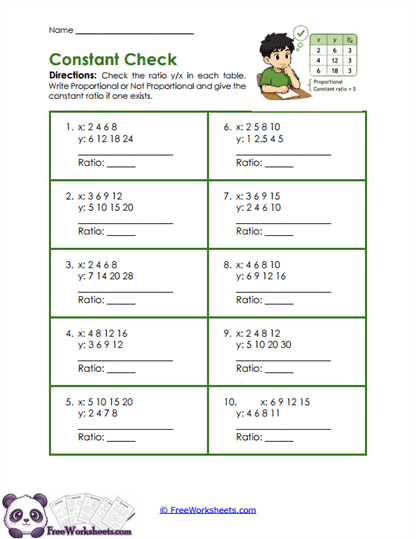
Constant Check
What Kids Do:
Students examine ten x-and-y tables and decide whether each one represents a proportional relationship. They calculate y divided by x for several corresponding pairs, check whether that ratio remains constant throughout the table, and identify the constant ratio when the relationship is proportional.
Target Skill:
Students strengthen their ability to recognize proportional relationships from tables by focusing on constant multiplicative change rather than equal differences. The activity also connects the constant ratio with the structure of y = kx, preparing 8th grade students to relate proportional reasoning to slope and linear functions.
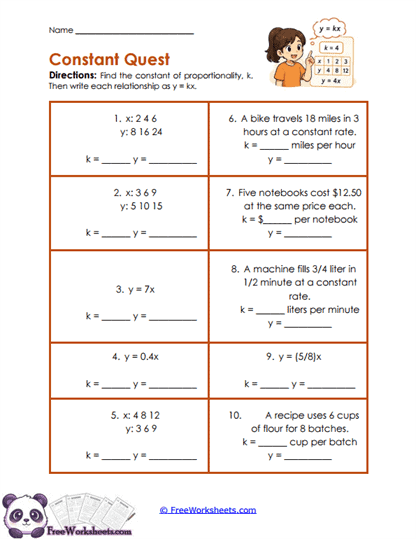
Constant Quest
What Kids Do:
Students work with ten tables, equations, and real-world situations to determine the constant of proportionality. After finding k by using y divided by x or recognizing the multiplier directly, they write the matching proportional equation in the form y = kx and check that it fits the given relationship.
Target Skill:
This activity develops the connection among ratios, unit rates, constants of proportionality, and equations. Students learn that k describes how much y changes for each unit of x, strengthening the 8th grade transition from proportional reasoning into slope and linear relationships.
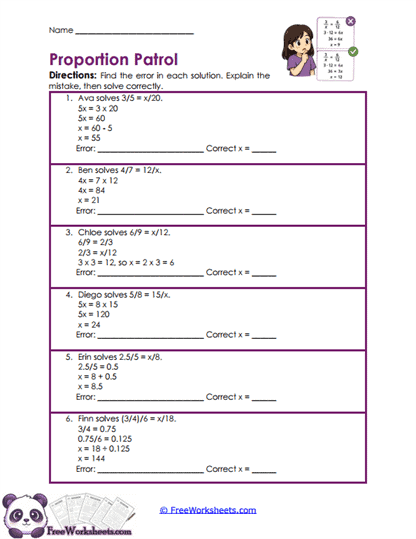
Error Patrol
What Kids Do:
Students investigate six incorrect proportion solutions involving cross products, equivalent ratios, fractions, decimals, and arithmetic. They locate the first incorrect step, explain what went wrong, rewrite the setup or calculation correctly, and solve for the missing value using valid proportional reasoning.
Target Skill:
Error analysis helps students understand why proportion-solving methods work instead of simply repeating procedures. They strengthen cross-product setup, fraction equivalence, arithmetic accuracy, and mathematical communication while developing the 8th grade habit of checking whether each step preserves an equivalent ratio.
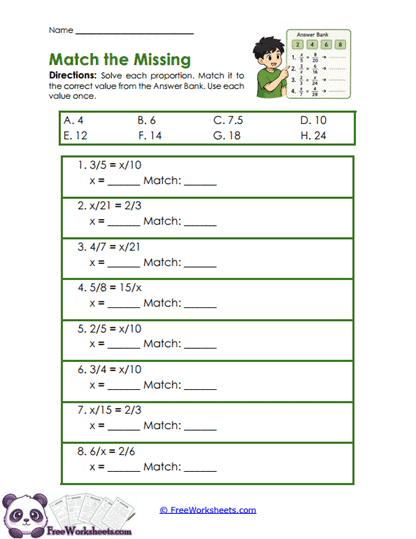
Missing Match
What Kids Do:
Students solve eight missing-value proportions and match each result to an answer bank in which every value is used once. They may use scale factors, equivalent fractions, or cross multiplication, then use the available choices as a final check rather than guessing before completing the proportion.
Target Skill:
Students build fluency solving proportions while practicing efficient strategy selection and self-checking. The activity reinforces corresponding positions, equivalent ratios, multiplication, and division, helping 8th grade students apply dependable proportional reasoning before moving into more involved applications.
Rate Links
What Kids Do:
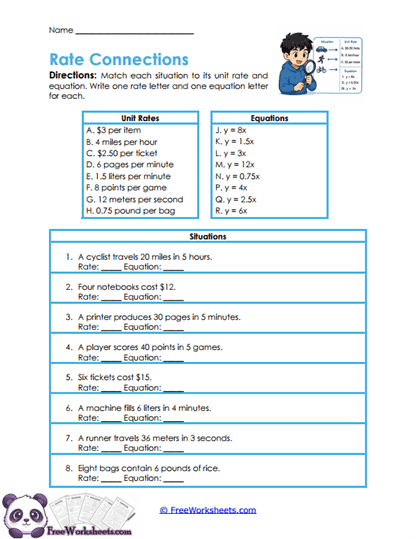
Students read eight real-world situations involving cycling, notebook costs, printing, game points, tickets, filling rates, running, and weights. They calculate the unit rate for each relationship and then connect that value with a proportional equation written in the form y = kx.
Target Skill:
Students strengthen the connection between verbal situations, unit rates, constants of proportionality, and symbolic equations. By recognizing that the unit rate becomes the value of k, students build an important 8th grade bridge from proportional relationships to slope and linear functions.
Rate Rivalry
What Kids Do:
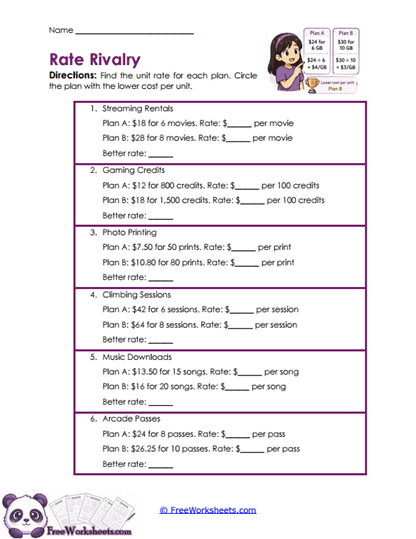
Students compare two plans in six real-world situations involving streaming rentals, gaming credits, photo printing, climbing sessions, music downloads, and arcade passes. They calculate the cost per unit for both options, label the rates correctly, and determine which plan gives the lower cost and better value.
Target Skill:
The worksheet develops practical unit-rate reasoning by requiring students to put two different choices on equal terms before comparing them. Students strengthen decimal division, money calculations, units, and proportional comparison while applying 8th grade mathematical reasoning to everyday purchasing decisions.
Ratio Match
What Kids Do:
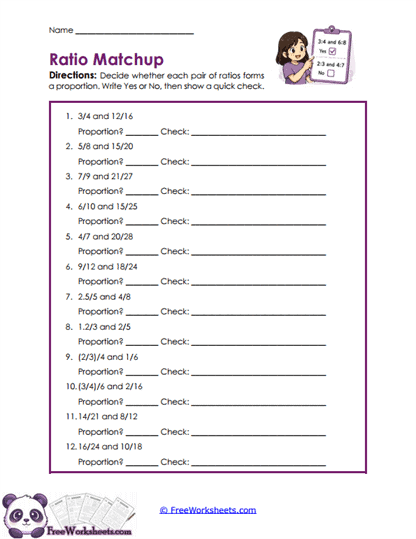
Students inspect twelve pairs of ratios and decide whether each pair forms a true proportion. They justify each yes-or-no decision by simplifying the ratios, finding a common scale factor, or checking cross products, including examples with whole numbers, decimals, and fractional values.
Target Skill:
Students develop a stronger understanding that proportional relationships depend on equivalent multiplicative relationships rather than similar-looking numbers or equal differences. This practice reinforces ratio equivalence and gives 8th grade students a solid foundation for solving proportions and recognizing proportional models.
Ratio Reality
What Kids Do:
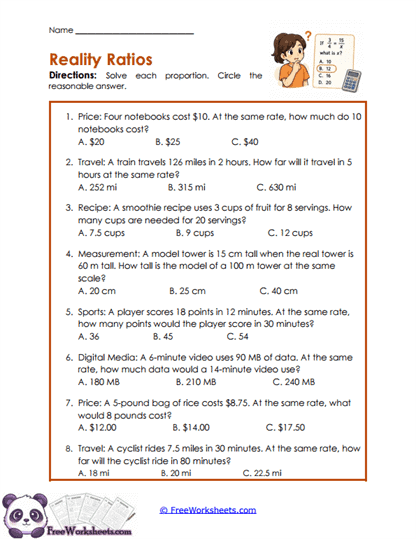
Students solve eight multiple-choice proportion problems involving prices, travel, recipes, scale models, sports, data use, and distance. They identify the quantities being compared, choose an appropriate strategy such as a unit rate, scale factor, or cross product, and select the answer that fits the relationship.
Target Skill:
Students apply proportional reasoning to practical situations and learn to organize corresponding quantities before calculating. The activity strengthens flexible strategy use, reasonableness checking, and real-world modeling while supporting 8th grade connections among proportions, scale, similarity, rates, and linear relationships.
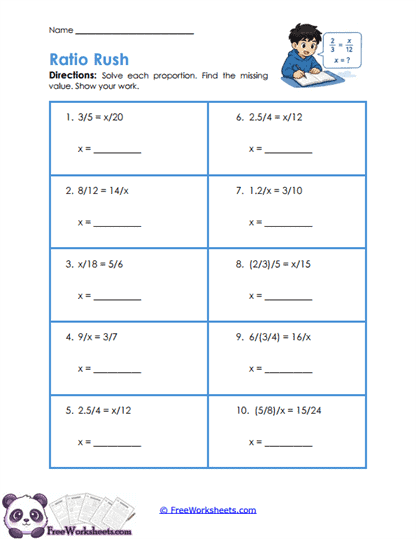
Ratio Rush
What Kids Do:
Students solve ten proportions containing an unknown value represented by x. They determine which values correspond across the two ratios and use scale factors, equivalent fractions, cross products, or another valid strategy to find the missing term while keeping the ratios equivalent.
Target Skill:
This worksheet builds core fluency with solving proportions and reinforces the multiplicative structure behind equivalent ratios. Students practice multiplication, division, fraction reasoning, and equation solving while developing the proportional thinking needed for 8th grade applications in geometry, rates, and linear relationships.
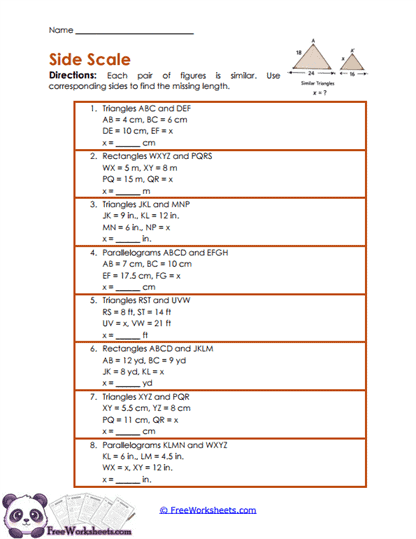
Scale Sides
What Kids Do:
Students work with eight pairs of similar triangles, rectangles, parallelograms, and other figures containing a missing side length. They identify corresponding sides, organize those measurements into a proportion, solve for x, and include the appropriate unit in the final measurement.
Target Skill:
Students connect proportional reasoning directly with geometry by recognizing that corresponding sides of similar figures share a constant scale relationship. The activity strengthens 8th grade understanding of similarity, scale factors, measurement, and the careful setup of proportions using matching parts.
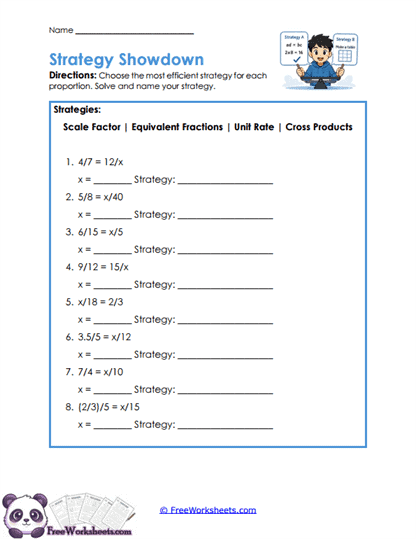
Strategy Choice
What Kids Do:
Students solve eight proportions and identify which method they used from choices such as scale factor, equivalent fractions, unit rate, or cross products. They examine the numbers before calculating and select an approach that makes the missing value easier to find rather than automatically using the same procedure every time.
Target Skill:
This activity develops mathematical flexibility and number sense by showing students that several correct methods can solve a proportion. Students learn to recognize friendly factors and convenient rates, strengthening efficient 8th grade problem solving and preparing them to choose strategies independently in unfamiliar situations.
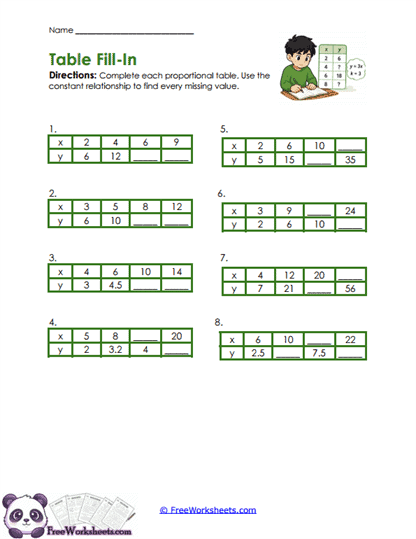
Table Patterns
What Kids Do:
Students complete eight proportional x-and-y tables containing missing values. They use known pairs to determine the constant multiplier or ratio, apply that same rule to every column, and use multiplication or division to fill in unknown entries while checking that the proportional relationship remains consistent.
Target Skill:
Students strengthen their understanding that proportional tables follow one constant multiplicative rule rather than an additive pattern. The activity reinforces constants of proportionality, table interpretation, and the structure of y = kx, supporting the transition into 8th grade slope and linear-function work.