
Lines And Angles Worksheets
8th grade math lines and angles worksheets help students identify, compare, calculate, and explain angle relationships in geometric situations. Free, ready-to-print worksheets in PDF format are designed for immediate classroom use, guided practice, homework, intervention, or homeschool lessons. Students strengthen angle reasoning, equation solving, and geometric vocabulary while developing skills that support 8th grade curriculum expectations.
About This Collection of Worksheets
Lines and angles are a major part of 8th grade geometry because students use them to explain how figures are connected and to determine unknown measurements. This collection helps students understand relationships involving vertical, adjacent, complementary, supplementary, corresponding, alternate interior, alternate exterior, same-side interior, and linear-pair angles. Students also work with triangle angle sums, exterior angles, parallel lines, transversals, and equations that connect algebra with geometry.
The worksheets include a wide variety of activities so students practice the topic in more than one way. They classify angle pairs, find missing measures, analyze parallel-line diagrams, solve algebraic angle equations, choose correct equations, correct mistakes, follow multi-step angle chains, prove lines are parallel, and apply geometry to street maps and structural settings. Several activities require students to explain why a particular relationship applies, helping them move beyond memorizing angle rules.
Teachers can use these pages throughout an 8th grade geometry unit for direct instruction, guided practice, partner work, math centers, homework, intervention, review, or formative assessment. Parents, tutors, and homeschool educators can also use the collection to focus on one angle relationship at a time before combining several ideas in larger diagrams. The mix of vocabulary, computation, algebra, and reasoning gives students repeated opportunities to build confidence with both the visual and mathematical sides of geometry.

Paul’s Teacher Tip
Before students solve any angle problem, have them name the relationship they see and say what that relationship tells them mathematically. A simple reference such as vertical = equal, complementary = 90°, supplementary = 180°, and linear pair = 180° can help students organize the most common rules. When working with parallel lines and transversals, have students first decide whether the angles are inside or outside the parallel lines and then whether they are on the same or opposite sides of the transversal. For algebraic angle problems, require students to write the geometry rule before creating the equation so they do not automatically set every pair of expressions equal. As an extension, ask students to justify each answer in one sentence using the specific angle relationship rather than giving only the numerical measure.
Worksheet Collection Skill Spotlights
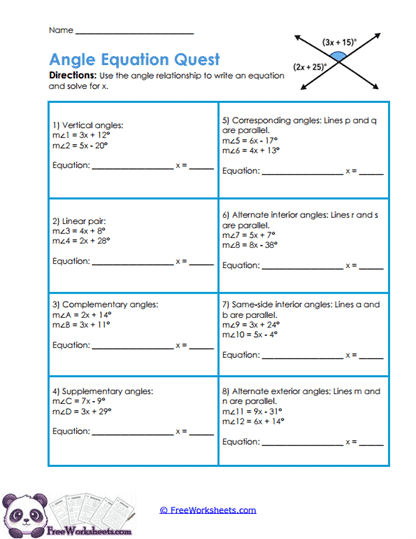
Angle Equations
What Kids Do:
Students work with algebraic expressions representing vertical, linear-pair, complementary, corresponding, alternate interior, same-side interior, and alternate exterior angles. They determine whether the expressions should be equal or add to 90° or 180°, write the correct equation, and then solve for x.
Target Skill:
This activity strengthens the connection between geometry and algebra by requiring students to translate angle relationships into equations. Students practice recognizing congruent and supplementary relationships, building correct algebraic models, and solving linear equations in support of 8th grade geometric reasoning.
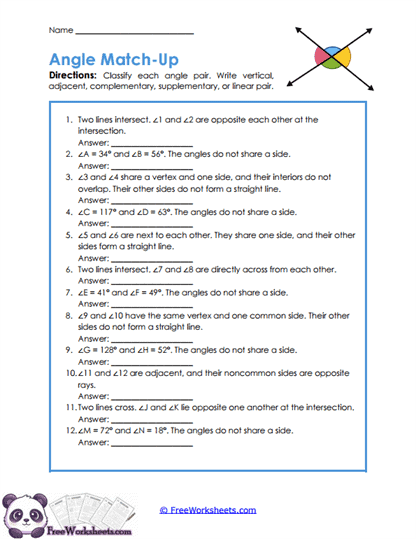
Angle Pairs
What Kids Do:
Students read twelve short descriptions of angle relationships and classify each pair as vertical, adjacent, complementary, supplementary, or a linear pair. They use clues involving shared sides, opposite positions, straight lines, and total angle measures rather than depending only on a diagram.
Target Skill:
Students build precise geometry vocabulary and learn to distinguish relationships that are often confused. The activity reinforces that some angle names depend on position while others depend on total measure, creating an important 8th grade foundation for missing-angle problems and transversal reasoning.
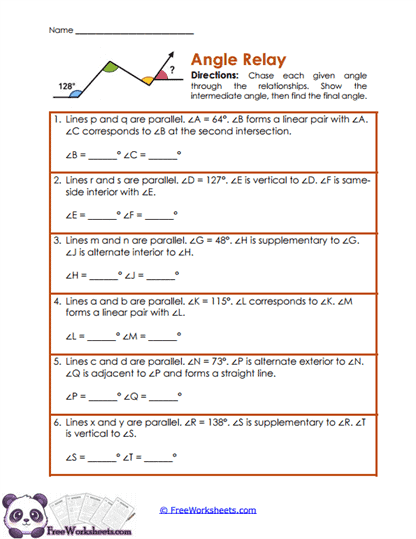
Angle Relay
What Kids Do:
Students solve linked angle problems in which one missing measure must be found before the next can be determined. They move through sequences involving linear pairs, corresponding angles, vertical angles, same-side interior angles, supplementary relationships, and alternate angle relationships.
Target Skill:
The worksheet develops multi-step geometric reasoning by showing students how one angle fact can lead directly to another. Students practice organizing connected information, choosing the correct relationship at each stage, and using earlier results accurately within more complex 8th grade angle problems.
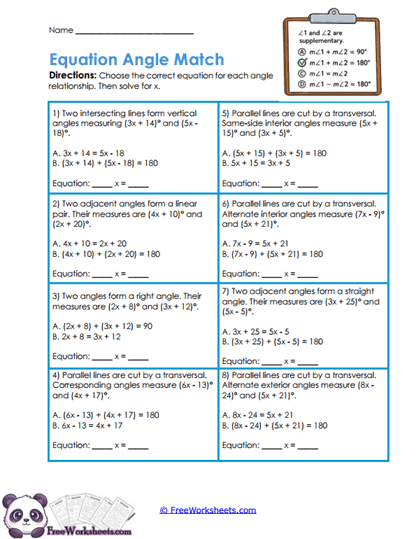
Equation Matching
What Kids Do:
Students examine geometry situations and choose between two possible equations before solving for x. The problems include vertical, complementary, supplementary, corresponding, and other parallel-line angle relationships, so students must decide whether expressions should be equal or add to a known total.
Target Skill:
Students strengthen equation setup, which is often the most difficult part of algebraic geometry. The activity teaches them to connect the angle relationship with the correct mathematical structure before solving, supporting 8th grade skills in geometric reasoning and linear equation solving.
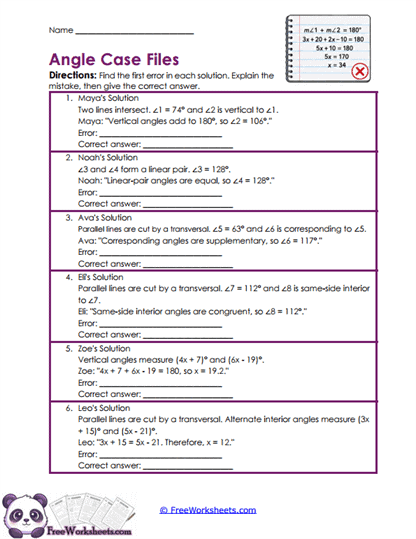
Error Angles
What Kids Do:
Students analyze six examples of incorrect angle reasoning involving vertical angles, linear pairs, corresponding angles, same-side interior angles, algebraic expressions, and alternate interior angles. They locate the first mistake, explain which geometry rule was used incorrectly, and then provide the corrected reasoning and answer.
Target Skill:
This error-analysis practice develops deeper conceptual understanding because students must identify why a solution fails rather than simply recalculate it. They strengthen mathematical communication, angle vocabulary, equation setup, and the ability to check reasoning in 8th grade geometry problems.
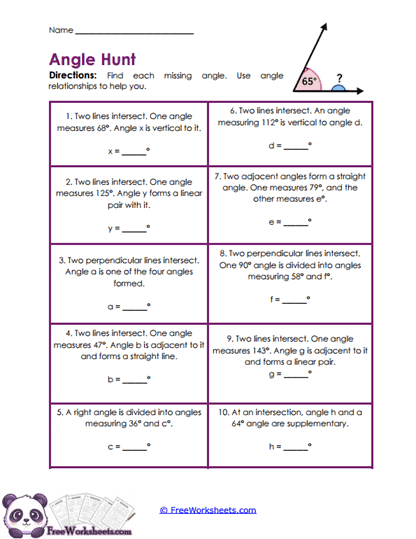
Missing Angles
What Kids Do:
Students solve ten problems involving vertical angles, linear pairs, right angles, straight angles, perpendicular lines, adjacent angles, and supplementary relationships. They identify whether the unknown angle should be equal to another angle or found by subtracting from 90° or 180°.
Target Skill:
Students strengthen their ability to choose the correct angle rule before calculating a missing measure. This practice reinforces equality, complementary totals, supplementary totals, and straight- and right-angle reasoning while preparing students for more advanced 8th grade geometry diagrams and equations.
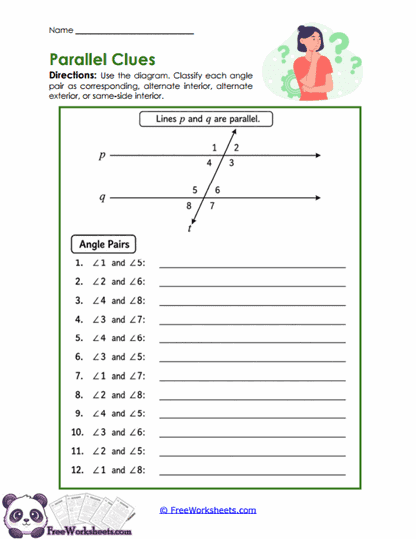
Parallel Clues
What Kids Do:
Students study a labeled diagram of two parallel lines crossed by a transversal and classify twelve angle pairs. They determine whether each pair is corresponding, alternate interior, alternate exterior, or same-side interior by comparing position, interior or exterior placement, and side of the transversal.
Target Skill:
Students develop the visual and vocabulary skills needed to recognize angle relationships formed by parallel lines and a transversal. This classification practice gives them the 8th grade foundation needed to explain why certain angles are congruent or supplementary and to solve later missing-angle problems.
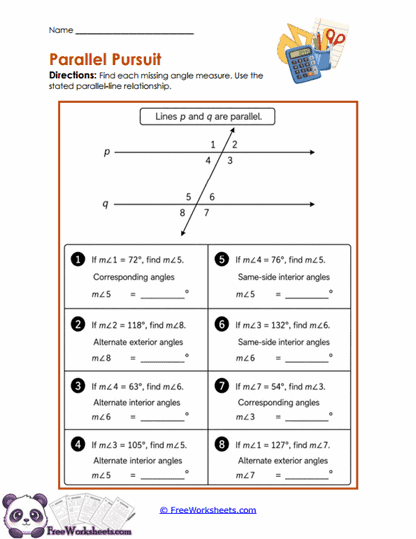
Parallel Measures
What Kids Do:
Students use a numbered parallel-line and transversal diagram to find unknown angle measures. They identify whether each requested pair is corresponding, alternate interior, alternate exterior, or same-side interior and then decide whether the angles are congruent or supplementary before calculating.
Target Skill:
This activity moves students from naming angle relationships to using them mathematically. Students reinforce which parallel-line angle pairs have equal measures and which add to 180°, strengthening the reasoning required for 8th grade transversal problems and multi-step geometry work.
Parallel Proofs
What Kids Do:
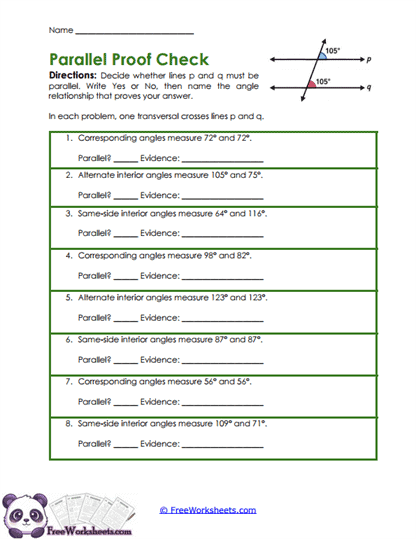
Students examine eight sets of angle information and decide whether the measurements are enough to prove that two lines are parallel. They use corresponding, alternate interior, and same-side interior relationships and state which converse angle fact supports or fails to support the conclusion.
Target Skill:
Students develop informal proof reasoning by using angle measurements as evidence rather than beginning with lines that are already known to be parallel. The activity strengthens understanding of converse relationships and supports 8th grade geometric arguments involving parallel lines and transversals.
Street Angles
What Kids Do:
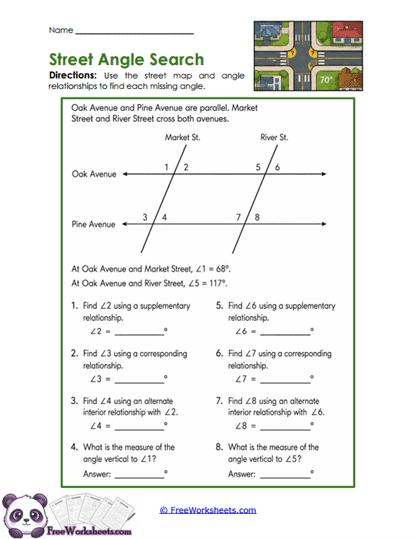
Students analyze a street-map style diagram containing parallel streets and crossing roads. They use vertical, supplementary, corresponding, and alternate interior relationships to determine missing measures, often transferring an angle value from one intersection to another through a chain of geometric facts.
Target Skill:
Students apply familiar angle relationships within a larger real-world diagram rather than isolated textbook figures. This strengthens their ability to recognize relevant geometry structures independently and combine several 8th grade angle rules in practical, multi-step situations.
Structure Angles
What Kids Do:
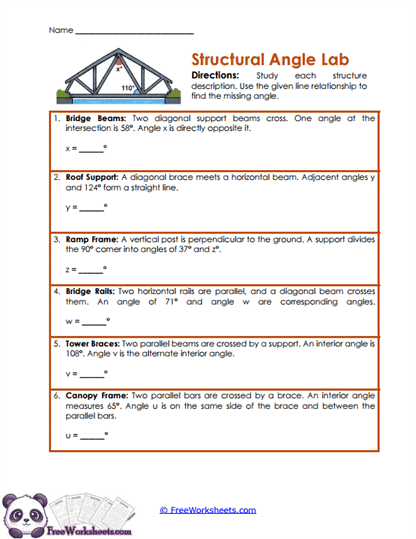
Students solve six building- and structure-themed problems involving bridge beams, roof supports, ramps, rails, braces, and canopy frames. They identify vertical, linear-pair, complementary, corresponding, alternate interior, or same-side interior relationships and use the appropriate rule to find each missing angle.
Target Skill:
The worksheet develops transfer of geometric reasoning into applied situations. Students learn to simplify a structural description into intersecting, perpendicular, or parallel lines and then use established angle facts, strengthening both reading comprehension and 8th grade geometry problem solving.
Triangle Sums
What Kids Do:
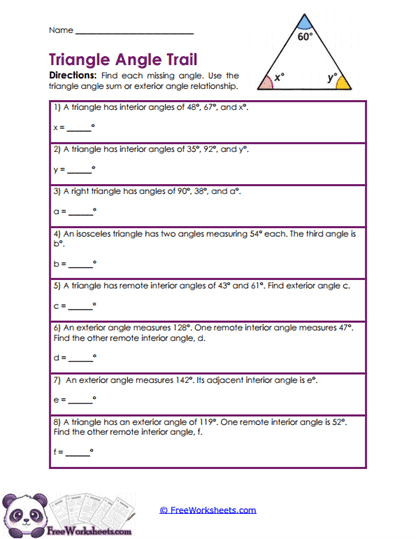
Students solve eight problems involving ordinary, right, and isosceles triangles along with exterior-angle situations. They use the 180° interior-angle sum, equal-angle properties, right-angle information, and exterior-angle relationships to calculate unknown interior or exterior measures.
Target Skill:
Students strengthen their understanding of triangle angle relationships and learn to choose between interior-sum and exterior-angle reasoning. The activity also encourages them to combine multiple geometric facts, supporting 8th grade work with triangle properties and more advanced multi-step figures.