
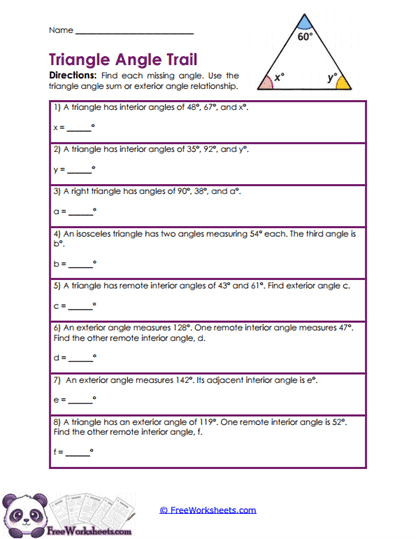
About This Worksheet
This worksheet helps eighth-grade students find missing interior and exterior angles in triangles. Students work through eight problems involving ordinary triangles, right triangles, isosceles triangles, and exterior-angle situations. Some questions use the fact that the three interior angles of a triangle add to 180°, while others require students to use an exterior-angle relationship. This gives students practice choosing the right rule based on the information they are given.
For example, if a triangle has interior angles of 48° and 67°, students subtract their sum from 180° to find the third angle. If an exterior angle is given along with one remote interior angle, students use the exterior-angle relationship to determine the missing remote interior angle. These different problem types help students see how triangle angle facts connect.
What Students Practice
Students practice using the triangle angle-sum rule, which says that the interior angles of a triangle total 180°. They also apply the exterior-angle idea that an exterior angle equals the sum of the two remote interior angles. This requires students to recognize whether the missing angle is inside or outside the triangle.
The worksheet also includes special triangle types. A right triangle gives students a known 90° angle, while an isosceles triangle gives them two equal angles. These clues help students practice using more than one geometry fact in the same problem.
Why This Skill Matters
Triangle angle relationships are a major part of geometry because triangles appear inside many larger figures. Students who understand how interior and exterior angles work can use that knowledge in polygons, proofs, and more complicated diagrams. This worksheet builds that foundation in a clear and focused way.
The problems also strengthen reasoning skills. Students must decide which angle fact applies before doing any arithmetic. That habit of identifying the relationship first is useful throughout geometry.
Common Challenges
Students may forget whether to add or subtract when working with exterior angles. Remind them that an exterior angle equals the sum of the two remote interior angles, while the three interior angles together equal 180°. Writing the rule before solving can prevent confusion.
Another challenge is identifying the remote interior angles. Students sometimes choose the interior angle beside the exterior angle instead. Encourage them to look for the two interior angles that are not adjacent to the exterior angle.
How To Use It
Teachers can use this worksheet after introducing triangle angle sums and exterior angles. It works well for guided practice, independent work, homework, or a geometry review station. Modeling one interior-angle problem and one exterior-angle problem can help students see the difference between the two approaches.
Parents and homeschool teachers can help by asking, “Is the missing angle inside the triangle or outside it?” Then ask which rule matches that situation. Keeping those two cases separate makes the problems much easier for students to organize.
Grade Alignment
This worksheet is designed for Grade 8 math and supports CCSS 8.G.A.5, which includes establishing and using facts about the sum of the angles in a triangle and relationships involving exterior angles. The page gives students repeated practice applying those facts in several triangle types.
Students should already understand basic angle measures and supplementary relationships. After this practice, they can move into more complex polygon angle problems and multi-step geometry reasoning.