
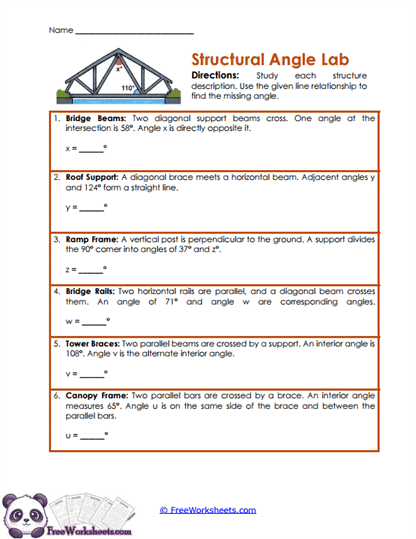
About This Worksheet
This worksheet helps eighth-grade students apply angle relationships to structural and building-style situations. Six problems use contexts such as bridge beams, roof supports, ramp frames, bridge rails, tower braces, and canopy frames. Students study each description and use vertical, linear-pair, complementary, corresponding, alternate interior, or same-side interior relationships to find a missing angle. This makes the geometry feel connected to real structures instead of only abstract diagrams.
For example, two crossing bridge beams create vertical angles, so opposite angles have equal measures. Parallel bridge rails crossed by a diagonal brace can create corresponding or alternate interior angles. These situations help students recognize the same geometry rules in different settings.
What Students Practice
Students practice identifying the angle relationship hidden inside a written structural description. They then use equality, 90°, or 180° relationships to determine the missing measure. This requires both reading comprehension and geometry reasoning.
The worksheet also mixes several relationship types on one page. Students work with intersecting lines, perpendicular situations, and parallel lines crossed by supports or braces. This variety helps them decide which rule fits instead of relying on one repeated pattern.
Why This Skill Matters
Students benefit from seeing that geometry describes real objects and structures. Beams, supports, rails, and braces often form the same kinds of angle relationships studied in class. Applying those relationships to realistic contexts helps students understand why the rules matter.
This skill also prepares students for more complex applications of geometry. Later, students may need to analyze diagrams involving construction, design, engineering, or coordinate geometry. Strong angle reasoning gives them a useful starting point.
Common Challenges
Students may focus so much on the building context that they miss the actual angle relationship. Encourage them to simplify each problem by identifying the lines and asking whether they intersect, form a right angle, or are parallel. Once the structure is translated into a basic geometry picture, the solution is usually easier.
Another common mistake is mixing up alternate interior and corresponding angles. Have students picture where the two angles sit relative to the parallel lines and transversal before calculating. A quick sketch can help when the words feel confusing.
How To Use It
Teachers can use this worksheet as an application activity after students have practiced angle relationships in standard diagrams. It works well for independent work, partner discussion, homework, or a STEM-themed geometry lesson. Asking students to draw a small sketch beside each description can strengthen the connection between the words and the math.
Parents and homeschool teachers can help by stripping the problem down to its basic geometry. Ask, “What kind of lines are described here?” and then, “What relationship do those lines create?” This makes the structural setting easier to understand.
Grade Alignment
This worksheet is written for Grade 8 math and supports CCSS 8.G.A.5 through applied reasoning with angle relationships. Students use facts about intersecting lines, parallel lines, transversals, right angles, and straight angles to solve realistic problems.
Students should already know the main angle-pair relationships and basic angle arithmetic. After completing this page, they are ready for more complex real-world geometry diagrams and multi-step applications.