
About This Worksheet
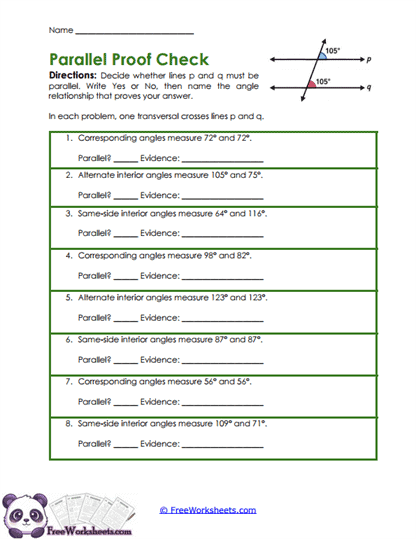
This worksheet helps eighth-grade students decide whether given angle relationships are enough to prove that two lines are parallel. Each of the eight problems describes a pair of angle measures involving corresponding, alternate interior, or same-side interior angles. Students decide whether lines p and q must be parallel and then write the relationship that supports their answer. This moves students beyond solving for angle measures and into geometric reasoning.
For example, if corresponding angles both measure 72°, that is evidence that the two lines are parallel. If same-side interior angles add to 180°, that also supports the conclusion that the lines are parallel. Students must check whether the given measurements satisfy the correct converse relationship.
What Students Practice
Students practice using the converses of familiar parallel-line angle theorems. Instead of starting with parallel lines and finding angle measures, they start with angle measures and decide whether the lines must be parallel. This reversal is an important step in developing deeper geometry understanding.
The worksheet includes corresponding angles, alternate interior angles, and same-side interior angles. Students must determine whether the measures are congruent or supplementary in the correct way. This helps them distinguish which relationships can prove parallel lines.
Why This Skill Matters
Geometry often asks students not only to calculate, but also to justify why something must be true. Proving that two lines are parallel from angle relationships is a strong example of that kind of reasoning. This worksheet gives students a simple introduction to proof-style thinking.
The skill also strengthens understanding of converse statements. Students learn that if parallel lines create certain angle relationships, then those same relationships can sometimes be used in reverse to prove the lines are parallel. That logical connection is important in later geometry.
Common Challenges
Students may confuse the original angle theorem with its converse. Remind them that here they are using the angle measures as evidence to decide whether the lines are parallel. The relationship must match exactly for the conclusion to be valid.
Another common mistake is treating same-side interior angles as congruent. These angles should be supplementary, so their measures must add to 180°. Encourage students to check the sum before deciding whether the lines are parallel.
How To Use It
Teachers can use this worksheet after students understand corresponding, alternate interior, and same-side interior angle relationships. It works well for guided discussion, independent practice, partner work, or an introduction to informal proof. Having students explain the evidence aloud can make the reasoning much stronger.
Parents and homeschool teachers can ask, “What would have to be true about these angles if the lines were parallel?” Then have the student compare that rule with the given measures. This keeps the focus on reasoning instead of guessing yes or no.
Grade Alignment
This Grade 8 worksheet supports CCSS 8.G.A.5 by asking students to use informal arguments about angle relationships created by transversals and parallel lines. It also introduces students to converse reasoning, which becomes important in later geometry courses.
Students should already know the basic angle relationships formed by a transversal. After this practice, they can move into more formal geometric arguments and multi-step proof problems.