
About This Worksheet
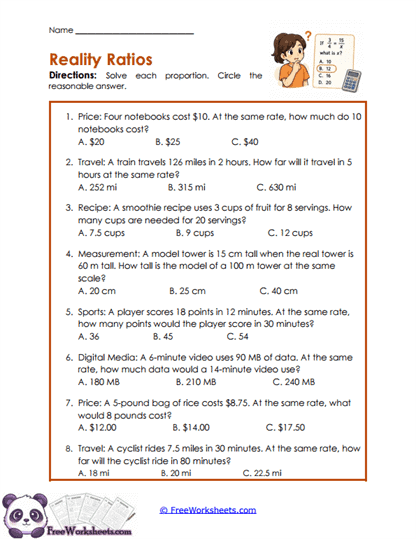
This worksheet helps eighth-grade students apply proportions to real-world problems involving price, travel, recipes, scale models, sports, data use, and distance. Students solve eight multiple-choice questions and choose the answer that matches the proportional relationship. Each problem asks them to use a known rate or ratio to find an unknown value. This gives students practice turning everyday situations into proportional math.
For example, if four notebooks cost $10, students can find the unit price and use it to determine the cost of ten notebooks. A travel problem might give a distance covered in two hours and ask how far the same rate would cover in five hours. These situations help students see proportions as useful tools instead of abstract fraction problems.
What Students Practice
Students practice identifying two equivalent ratios and solving for a missing quantity. They may use unit rates, scale factors, or cross products depending on the problem. This variety encourages flexible reasoning.
The worksheet also gives students practice checking whether an answer is reasonable. Because each problem has multiple-choice options, students can estimate before solving and then compare their result with the choices. This adds a useful layer of number sense.
Why This Skill Matters
Proportions appear in many everyday situations. Prices, speed, recipes, scale drawings, sports statistics, and data rates all depend on consistent relationships between quantities. Students who understand proportional reasoning can solve these problems more confidently.
This skill also prepares students for more advanced algebra and geometry. Proportions connect to slope, similarity, scale factors, and linear equations. Strong real-world practice helps make those later topics easier to understand.
Common Challenges
Students may set up ratios in different orders and create an incorrect proportion. Remind them to keep corresponding quantities in the same positions. If notebooks are on top in one ratio, notebooks should also be on top in the other.
Another common problem is choosing an answer that looks close without checking the scale relationship. Encourage students to estimate first and then solve carefully. A quick reasonableness check can catch many mistakes.
How To Use It
Teachers can use this worksheet as a real-world review after students have practiced solving proportions. It works well for independent work, homework, test preparation, or a mixed application lesson. You can also ask students to explain which strategy they used for a few selected problems.
Parents and homeschool teachers can help by asking, “What two quantities are being compared?” Then ask whether the relationship should stay at the same rate. Once those pieces are clear, the proportion becomes much easier to set up.
Grade Alignment
This Grade 8 worksheet reinforces proportional reasoning through real-world applications. It builds on CCSS 7.RP.A.3 and supports Grade 8 work with similarity, slope, and linear relationships. The activity also strengthens problem solving across several everyday contexts.
Students should already know how to solve basic proportions and unit-rate problems. After this practice, they can apply proportional reasoning to more complex models, graphs, and algebraic situations.