
Use Number Sense
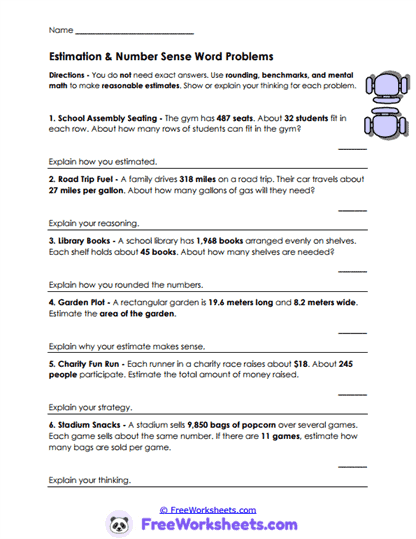
This worksheet teaches students how to estimate answers using rounding, benchmarks, and mental math strategies. Learners solve practical word problems by finding reasonable estimates instead of exact calculations. The activity strengthens number sense and problem-solving confidence through real-world situations involving seating, fuel use, bookshelves, and money. For example, students may estimate how many rows of students fit into a gym by rounding numbers to easier values. The worksheet also encourages learners to explain why their estimates make sense.
Standards Connection
This worksheet supports Grade 8 math concepts involving estimation, numerical reasoning, and problem solving. Students strengthen mental-math strategies that prepare them for algebra, measurement, and real-world quantitative analysis. Learners should already understand rounding, multiplication, division, and decimal operations before beginning this activity. The worksheet aligns with Common Core standard 8.NS.A.1 through reasoning about numerical values and approximations. It also supports TEKS 8.2D by using estimation and number sense to solve contextual problems.
Estimate The Situations
On this worksheet, students will read real-world situations and use estimation strategies to find approximate answers. Learners round numbers, use benchmark values, and apply mental math to solve problems efficiently. Some questions involve multiplication or division while others focus on estimating totals and measurements. Students also explain the reasoning behind their estimates using written responses. The activity strengthens practical problem-solving and numerical flexibility.
Common Struggles
Many students try to calculate exact answers instead of estimating with reasonable values. Some learners round numbers inconsistently, which can lead to unrealistic estimates. Others struggle to decide which numbers should be rounded up or down in context. Students may also forget to explain why their estimate makes sense. Teachers can improve understanding by modeling several estimation strategies and discussing why different estimates may still be reasonable.
Teaching Applications
Teachers can use this worksheet during number sense lessons, warm-up activities, or real-world problem-solving practice. Parents and homeschool educators may support students by discussing how estimation is used in shopping, travel, budgeting, and planning. The activity also works well for collaborative learning where students compare estimation methods and justify their reasoning. Learners benefit from seeing that estimation is useful when exact answers are unnecessary or impractical. Real-world applications help students build confidence using mental math in everyday situations.
Worksheet Features
The worksheet includes practical scenarios involving seating, fuel, books, gardens, fundraising, and concessions for engaging estimation practice. Organized writing spaces allow students to explain their reasoning clearly and neatly. Problems vary in structure to strengthen flexibility with estimation strategies. Student-friendly directions support classroom instruction and independent completion. The printable design works well for middle school classrooms, tutoring sessions, and homeschool mathematics lessons.