
About This Worksheet
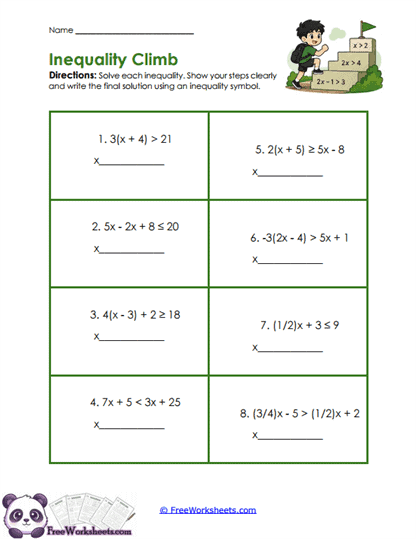
This worksheet helps eighth-grade students solve multi-step one-variable inequalities that require more than one operation before x is isolated. The eight problems include parentheses, combining like terms, variables on both sides, fractions, and negative coefficients. Students are expected to show their steps clearly and then write the final solution using an inequality symbol. This makes the page a good bridge from basic inequality solving to more involved algebra.
For example, a problem such as 3(x + 4) > 21 first requires students to distribute the 3 before isolating x. A problem with variables on both sides asks students to move variable terms to one side and constants to the other. These different forms help students practice choosing the right sequence of steps instead of using one memorized routine.
What Students Practice
Students practice distributing, combining like terms, moving variable terms, and using inverse operations. They also work with fractions and negative numbers, which means they must pay close attention to when an inequality symbol should reverse. This gives them repeated practice with several algebra skills at once.
The worksheet also strengthens organization. Because the problems take multiple steps, students need to keep their work neat enough to track what happens from one line to the next. Clear work makes it easier to catch sign or arithmetic mistakes before they affect the final answer.
Why This Skill Matters
Multi-step inequalities are important because real algebra problems are not always arranged in a simple one-step form. Students need to learn how to simplify an expression first and then solve the inequality in a logical order. This skill prepares them for more advanced algebra and real-world constraint problems.
It also reinforces equation-solving habits. The same ideas of balancing both sides, combining terms, and undoing operations still apply, but students must remember the special sign rule when multiplying or dividing by a negative number. That extra layer makes inequalities a valuable test of algebra understanding.
Common Challenges
Students may try to isolate x too early before distributing or combining like terms. Encourage them to simplify both sides first whenever possible. That usually makes the later steps much easier to manage.
Another common challenge is forgetting to reverse the inequality symbol after dividing by a negative coefficient. Remind students to check the final division step carefully. A quick note such as “negative divide = flip” can help prevent this error.
How To Use It
Teachers can use this worksheet after students are comfortable with one-step and two-step inequalities. It works well for guided practice, independent classwork, homework, or test review. Modeling one problem with parentheses and one problem with variables on both sides can help students see the main strategies before they work alone.
Parents and homeschool teachers can help by asking, “What can we simplify first?” before worrying about getting x alone. Then guide the student one step at a time and check whether any division or multiplication by a negative number requires the sign to switch. This keeps the process manageable.
Grade Alignment
This worksheet is designed for Grade 8 math and supports the algebraic reasoning students need for one-variable inequalities. It builds directly on the equation-solving skills connected with CCSS 8.EE.C.7 and extends those ideas into multi-step inequality work. The worksheet also prepares students for more advanced high-school algebra involving linear inequalities.
Students should already know how to distribute, combine like terms, and solve basic inequalities. After this practice, they can move on to word problems, compound inequalities, and more complicated constraints.