
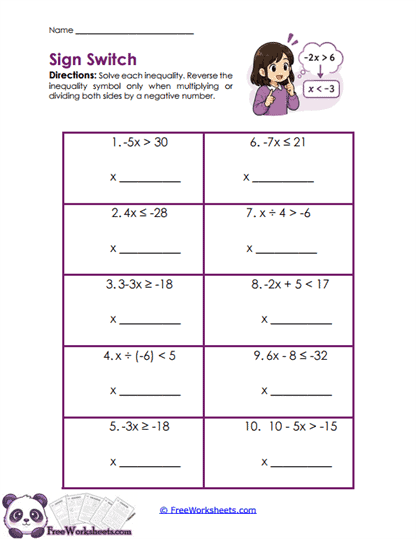
About This Worksheet
This worksheet gives eighth-grade students focused practice with one of the most important rules in inequality solving: reversing the inequality symbol when multiplying or dividing by a negative number. Ten problems include negative coefficients, negative divisors, and multi-step inequalities so students must decide carefully when the sign should change. The goal is not simply to isolate x, but to understand why the direction of the inequality sometimes reverses.
For example, solving -5x > 30 requires students to divide both sides by -5. Because that division uses a negative number, the greater-than sign changes to a less-than sign, giving x < -6. By working through many examples like this, students get repeated practice with a rule that often causes mistakes.
What Students Practice
Students practice solving inequalities that contain negative numbers in several different positions. Some problems begin with a negative coefficient, while others require students to simplify first before reaching the step where a negative multiplication or division occurs. This keeps students from treating every problem exactly the same way.
The worksheet also reinforces careful symbol reading. Students must distinguish between >, <, ≥, and ≤ and preserve the correct type of symbol when it reverses. Greater than becomes less than, while greater than or equal to becomes less than or equal to.
Why This Skill Matters
The sign-switching rule is essential for solving inequalities correctly. A student can perform every arithmetic step correctly and still get the wrong solution set if the inequality symbol points in the wrong direction. This worksheet gives that rule enough focused attention for students to build a dependable habit.
Understanding the rule also helps students see that inequalities behave differently from equations in one important way. Equations keep an equal sign throughout, while inequalities may change direction after certain operations. Recognizing that difference becomes very important when students solve more advanced algebra problems.
Common Challenges
Students may reverse the sign every time they see a negative number. The sign changes only when both sides are multiplied or divided by a negative number. Simply adding or subtracting a negative number does not cause the inequality symbol to reverse.
Another mistake is reversing the symbol but choosing the wrong new direction. A helpful reminder is to imagine turning the inequality sign around so it points the opposite way. Teachers can also have students read the finished answer aloud, such as “x is less than negative six,” to make sure the symbol matches the words.
How To Use It
Teachers can use this worksheet as targeted practice after students have already learned basic inequality solving. It works especially well for a small-group lesson or intervention because every problem gives students another chance to practice the same important rule in a slightly different form. Asking students to mark the exact step where the sign changes can make their reasoning easier to check.
Parents and homeschool teachers can help by watching for the multiplication or division step. When a negative number is involved, ask, “What special thing happens to the inequality sign now?” Repeating that question across several problems can help the rule become automatic.
Grade Alignment
This Grade 8 worksheet supports algebraic reasoning with one-variable inequalities and builds on the inverse-operation skills developed in CCSS 8.EE.C.7. The focus on negative coefficients prepares students to solve and interpret increasingly complex inequality statements. It also supports later work with graphing solution sets and comparing equivalent inequalities.
Students should already know integer multiplication and division and be comfortable solving simple equations. After this practice, they can move into multi-step inequalities, variables on both sides, and number-line representations of their solutions.