
Quadratic Equations and Inequalities Worksheets
Quadratic equations and inequalities in 11th grade math give Algebra 2 students several ways to solve, compare, graph, and interpret nonlinear relationships. These free, ready-to-print PDF worksheets are built for immediate classroom instruction, homework, review, intervention, tutoring, or independent practice with quadratics. Through factoring, radicals, completing the square, the quadratic formula, interval testing, and graph analysis, students develop the strategic reasoning expected throughout the 11th grade curriculum.
About This Collection of Worksheets
Quadratic equations give 11th grade students several different pathways for finding unknown values, and choosing the right pathway is an important part of Algebra 2 reasoning. Depending on the structure of an equation, students may factor, use square roots, complete the square, or apply the quadratic formula. They also learn how the discriminant predicts the number of real solutions and how those algebraic solutions connect with the x-intercepts of a parabola.
The collection then extends those ideas into quadratic inequalities, where the answer is often an interval rather than one or two isolated values. Students factor and solve equations, compare solving methods, classify discriminants, match equations with solution sets, analyze incorrect work, test intervals, evaluate proposed inequality solutions, interpret positive and negative regions of parabolas, and apply quadratic models to height-and-time situations. This range of activities helps students connect symbolic work, graphs, intervals, and real-world meaning.
Teachers can use these worksheets across an 11th grade Algebra 2 quadratics unit for direct instruction, guided practice, independent work, homework, intervention, review stations, or assessment preparation. Parents, tutors, and homeschool educators can also select individual pages based on whether a student needs more support with a specific solving method, discriminants, inequalities, or modeling. Because the collection moves from equation-solving techniques into graph interpretation and applications, it provides both focused practice and cumulative review.

Paul’s Teacher Tip
Before students solve a quadratic, have them look at its structure and name the method they plan to use. Encourage factoring when the expression breaks apart cleanly, the square-root method when a squared expression is isolated, and the quadratic formula when the equation does not offer an obvious shortcut. When completing the square, make students write the “half it, square it” value before adding anything so the key step stays visible. For quadratic inequalities, remind them that finding the roots only creates the boundaries; they still need to determine which intervals actually satisfy the inequality. When answers come from real-world models, require one final sentence explaining which solution makes sense in context and why.
Worksheet Collection Skill Spotlights
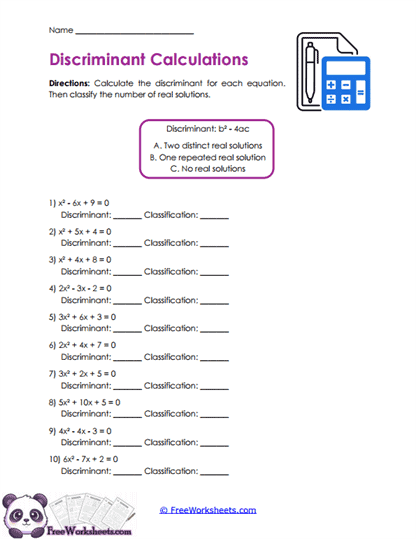
Discriminant Check
What Kids Do:
Students examine ten quadratic equations, identify the coefficients a, b, and c, and calculate the discriminant without solving the entire equation. They classify each result as producing two distinct real solutions, one repeated real solution, or no real solutions based on whether the discriminant is positive, zero, or negative.
Target Skill:
This activity helps students use the discriminant as a prediction tool rather than simply as one part of the quadratic formula. Students strengthen coefficient identification, sign accuracy, and the connection between algebraic solution counts and the number of real x-intercepts on a parabola.
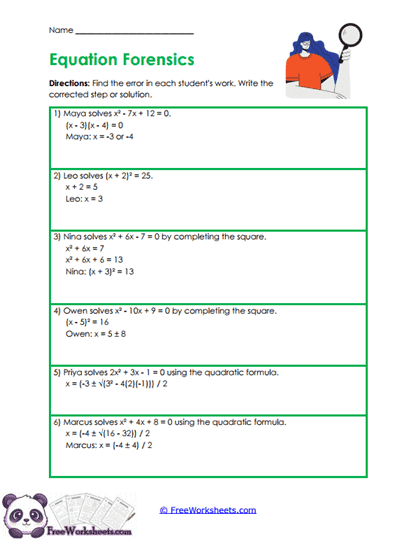
Error Detective
What Kids Do:
Students analyze worked quadratic solutions that contain mistakes in factoring, the square-root method, completing the square, or the quadratic formula. They identify the first incorrect step, explain the specific error, and then repair the work so the final solution set is mathematically correct.
Target Skill:
Error analysis develops deeper understanding of the major quadratic-solving methods by forcing students to explain why a step fails. The worksheet reinforces sign control, factoring accuracy, plus-or-minus reasoning, completing-the-square structure, and careful formula substitution in 11th grade Algebra 2.
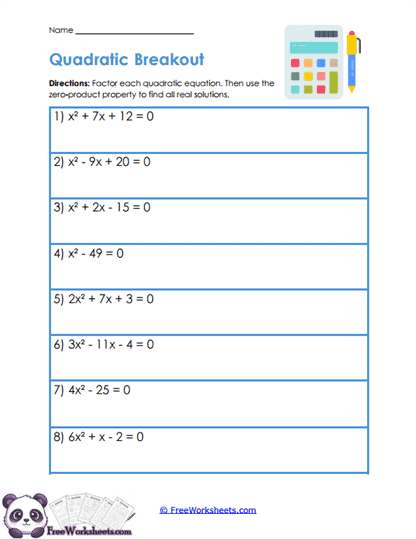
Factoring Solutions
What Kids Do:
Students solve eight quadratic equations by factoring each expression into two simpler factors and then applying the zero-product property. They work with trinomials, leading coefficients greater than one, and special patterns such as difference of squares before solving each factor separately.
Target Skill:
Students strengthen the connection among factors, zeros, solutions, and x-intercepts. The activity reinforces quadratic factoring, the zero-product property, complete solution sets, and the expectation that a quadratic may produce two different values rather than only one answer.
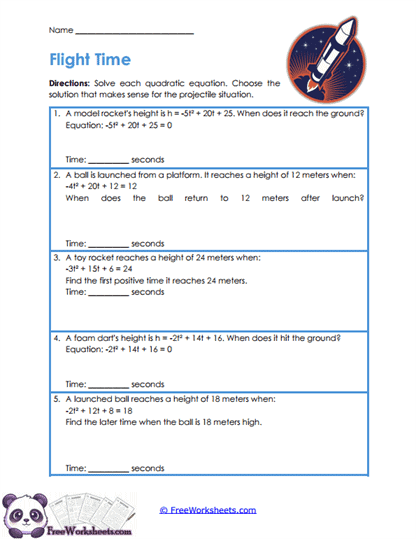
Flight Models
What Kids Do:
Students work through five real-world motion situations involving objects such as rockets and balls whose heights are modeled by quadratic functions. They set each height model equal to a target value, solve the resulting equation, and decide which time solution actually fits the situation described.
Target Skill:
This activity develops mathematical modeling and interpretation, not just equation solving. Students learn to connect roots with meaningful times, reject unrealistic negative values when appropriate, and distinguish between two valid positive times that may represent upward and downward portions of a flight path.
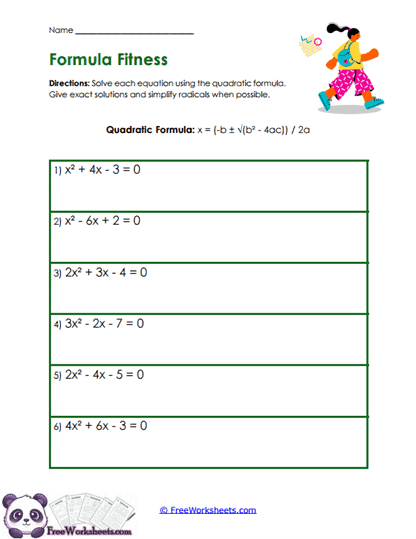
Formula Practice
What Kids Do:
Students solve six quadratic equations with the quadratic formula by first identifying a, b, and c. They substitute carefully, simplify the discriminant, reduce radicals when possible, and write exact solution sets, including rational or irrational answers depending on the equation.
Target Skill:
Students build a reliable method that works even when a quadratic does not factor conveniently. The worksheet reinforces coefficient identification, substitution with negative values, radical simplification, fraction structure, and complete two-solution reasoning in Algebra 2.
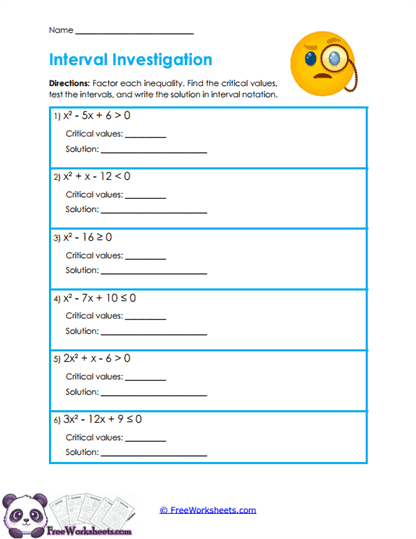
Interval Testing
What Kids Do:
Students solve six quadratic inequalities by first finding the critical values where the related quadratic equals zero. They divide the number line into intervals, test representative values in each region, determine where the expression is positive or negative, and write the final solution in interval notation.
Target Skill:
Students learn that quadratic inequalities describe ranges rather than isolated roots. The activity reinforces factoring, sign analysis, endpoint inclusion, interval notation, and the connection between roots and changes in the sign of a quadratic expression.
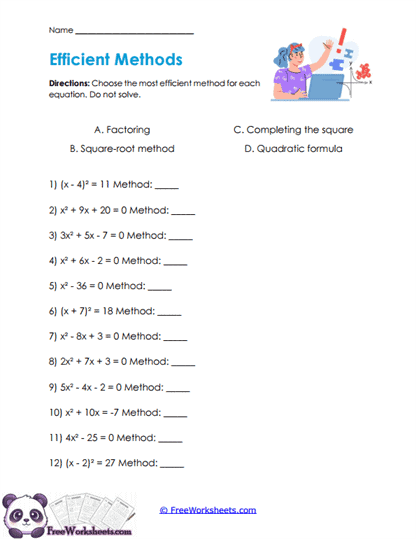
Method Selection
What Kids Do:
Students inspect twelve quadratic equations and choose the most efficient solving method from factoring, square roots, completing the square, or the quadratic formula. They do not solve the equations; instead, they use structural clues to decide which strategy would make the work simplest.
Target Skill:
This worksheet builds strategic Algebra 2 reasoning by teaching students to analyze an equation before calculating. Students compare perfect-square structures, factorability, coefficient patterns, and equation form while recognizing that several methods may work even though one is usually cleaner.
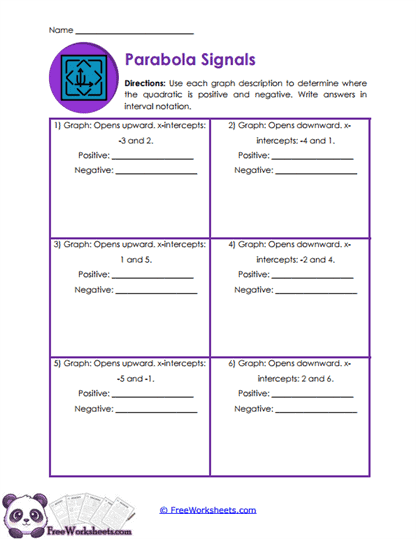
Parabola Signs
What Kids Do:
Students interpret six descriptions of parabolas that identify the opening direction and x-intercepts. Using those features, they determine where each quadratic function is above or below the horizontal axis and write the positive and negative regions in interval notation.
Target Skill:
Students connect graphical behavior with quadratic inequalities. The activity reinforces x-intercepts as boundaries, upward- versus downward-opening sign patterns, strict positive and negative intervals, and the larger idea that algebraic inequality solutions match regions of a graph.
Radical Solutions
What Kids Do:
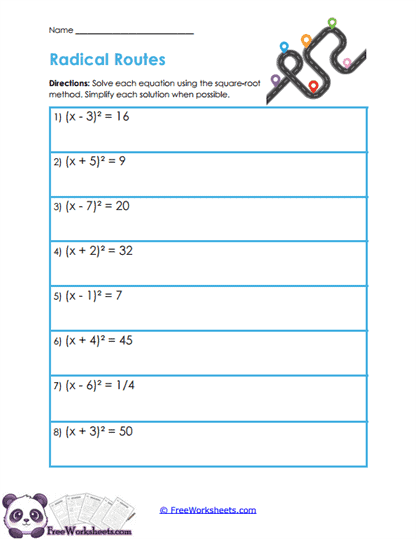
Students solve eight quadratic equations by isolating a squared expression and applying the square-root property. They take both the positive and negative roots, simplify radicals when possible, and solve the resulting linear equations to produce a complete solution set.
Target Skill:
This activity strengthens inverse-operation reasoning with squared expressions. Students learn why plus-or-minus is required, how to preserve exact radical answers, and when the square-root method is more efficient than factoring or using the quadratic formula.
Solution Matching
What Kids Do:
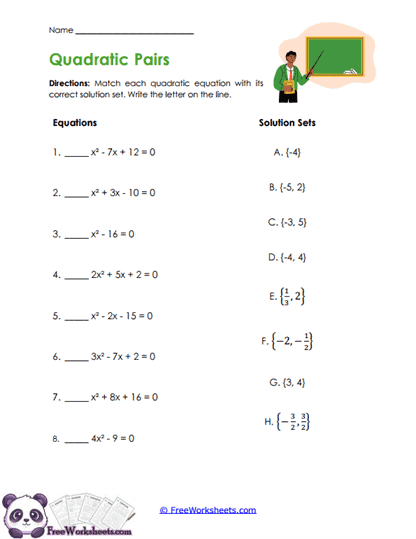
Students solve or analyze quadratic equations and match each one with the correct pair of solutions from an answer bank. The equations include factorable trinomials, difference-of-squares structures, repeated patterns, and other forms that require students to choose an appropriate method before comparing results.
Target Skill:
Students reinforce the idea that quadratic solutions form a set that may contain two values. The matching format strengthens factoring, sign interpretation, method choice, root recognition, and the connection between equation solutions and the x-values where the corresponding parabola crosses the axis.
Solution Verdicts
What Kids Do:
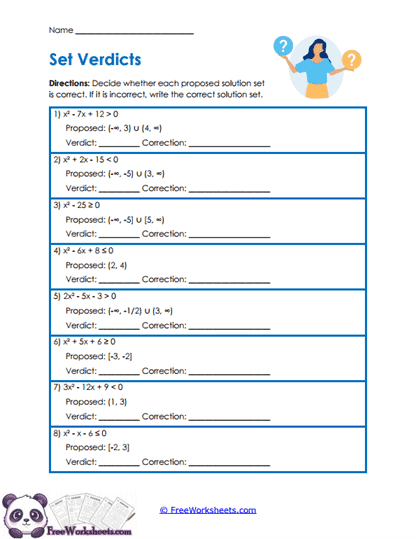
Students review eight quadratic inequalities together with proposed solution sets and decide whether each answer is correct. They verify the critical values, check which intervals satisfy the inequality, inspect endpoint inclusion, and rewrite any incorrect interval solution.
Target Skill:
This activity develops verification skills for quadratic inequalities. Students learn that correct roots alone do not guarantee a correct solution, because the direction of the intervals and whether endpoints are included must also match the original inequality.
Square Completion
What Kids Do:
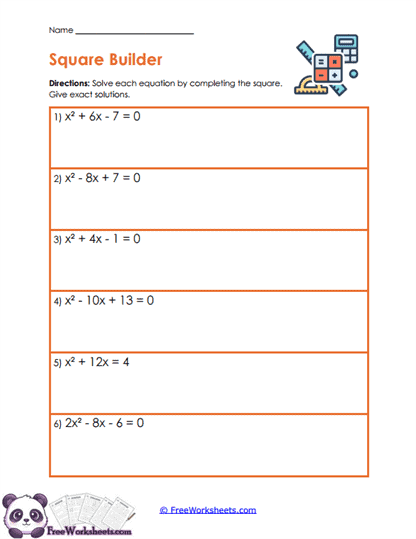
Students solve six quadratic equations by moving terms as needed, creating perfect-square trinomials, rewriting them as squared binomials, and finishing with the square-root method. Some problems require additional preparation when the leading coefficient is not already one.
Target Skill:
Students develop fluency with completing the square as both a solving method and a way to restructure quadratic expressions. The worksheet reinforces balance, perfect-square patterns, radical solving, and the foundation needed for rewriting quadratics into vertex form.