
Real Numbers Worksheets
Real numbers in 11th grade math help Algebra 2 students classify values, compare forms, interpret radicals, and reason about rational and irrational quantities. These free, ready-to-print PDF worksheets are designed for immediate classroom lessons, homework, review, intervention, tutoring, or independent practice. Students classify number sets, estimate radicals, compare and order values, and apply real-number properties while developing the reasoning expected throughout the 11th grade curriculum.
About This Collection of Worksheets
The real-number system gives 11th grade students a framework for understanding how natural numbers, whole numbers, integers, rational numbers, and irrational numbers fit together. Students learn that many values belong to several sets at once, that rational numbers can be written as fractions or terminating and repeating decimals, and that irrational numbers include values whose decimal forms never terminate or repeat. These ideas help students interpret answers throughout Algebra 2 rather than viewing numbers only as isolated values.
The worksheets in this collection approach real numbers from several directions. Students classify number families, identify the smallest containing set, justify rational and irrational classifications, simplify radicals, analyze decimal patterns, match fractions with decimals, estimate square roots, compare and order mixed values, decide between exact and approximate answers, identify real-number properties, and correct common misconceptions. Together, these activities build number sense, precision, and mathematical explanation skills that support later algebraic work.
Teachers can use these pages throughout an 11th grade Algebra 2 unit for direct instruction, guided review, independent work, homework, intervention, partner discussion, or assessment preparation. Parents, tutors, and homeschool educators can also target specific trouble spots such as irrational numbers, radical estimates, decimal behavior, or number-set relationships. The mix of classification, comparison, explanation, and error analysis helps students understand both what a real number is and how different real-number forms behave.

Paul’s Teacher Tip
Have students simplify or rewrite a number before classifying it, because its original appearance can be misleading. A radical may simplify to an integer, and a repeating decimal may look complicated even though it is rational. When teaching the number-set hierarchy, use a nested diagram and ask students for the smallest set that contains each value rather than every possible category. For comparisons, encourage students to rewrite fractions, radicals, or pi-based expressions in a common approximate form only when necessary. When exactness matters, keep radicals and pi intact so students learn that a decimal approximation is useful but not always mathematically preferable.
Worksheet Collection Skill Spotlights
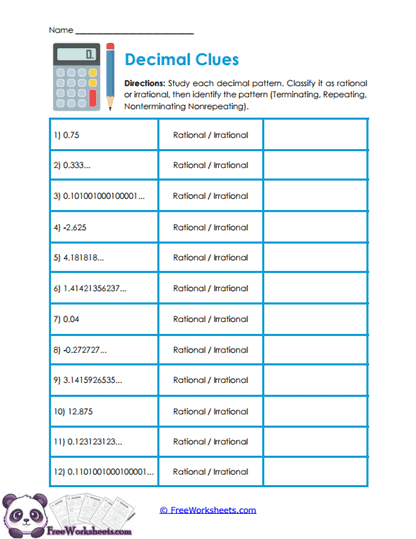
Decimal Patterns
What Kids Do:
Students examine twelve decimal values and decide whether each one terminates, repeats, or continues without a repeating pattern. They use that decimal behavior as evidence to classify the number as rational or irrational, including examples with both positive and negative values.
Target Skill:
This activity develops a clear connection between decimal representation and number type. Students learn that terminating and repeating decimals are rational, while nonterminating nonrepeating decimals are irrational, strengthening 11th grade reasoning about the structure of the real-number system.
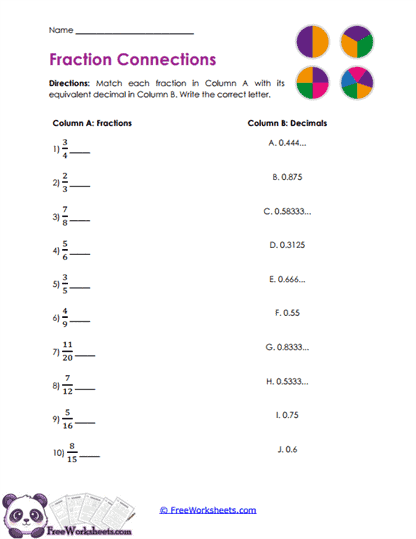
Fraction Matches
What Kids Do:
Students match ten fractions with equivalent decimal representations, including both terminating and repeating forms. They may use familiar benchmark fractions, estimation, or division to identify which decimal represents each exact rational value.
Target Skill:
Students strengthen the connection between fractional and decimal representations of rational numbers. The worksheet reinforces equivalence, conversion, terminating and repeating patterns, and the idea that repeating decimals are exact representations rather than rough approximations.
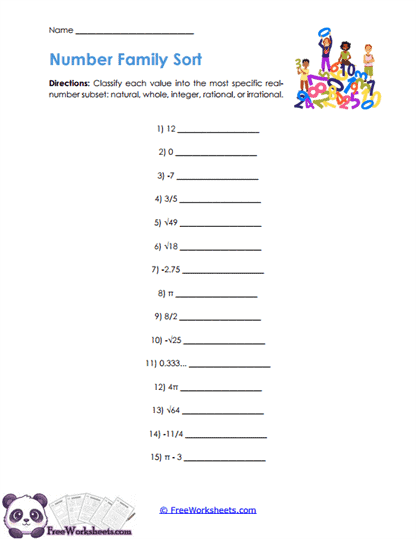
Number Families
What Kids Do:
Students classify fifteen values using the most specific real-number category possible, choosing among natural numbers, whole numbers, integers, rational numbers, and irrational numbers. They work with positive and negative values, fractions, decimals, radicals, and expressions involving pi.
Target Skill:
This worksheet develops understanding of the nested structure of the real-number system. Students reinforce number-set definitions, simplification, and classification while learning that a value may belong to several sets even though one category is more specific than the others.
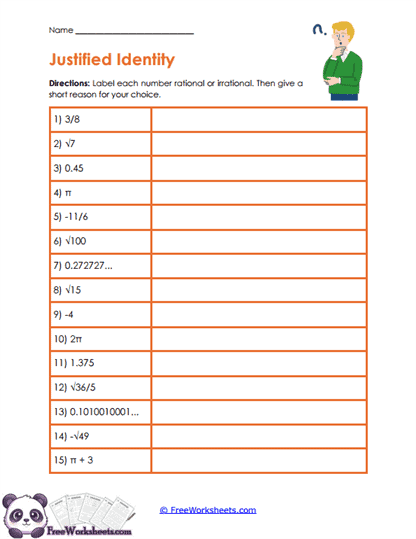
Number Justification
What Kids Do:
Students classify fifteen values as rational or irrational and give a short mathematical reason for each decision. They examine fractions, terminating and repeating decimals, square roots, pi, negative values, and simple expressions rather than relying on appearance alone.
Target Skill:
Students build mathematical explanation skills by connecting classifications to precise evidence. The activity reinforces fraction form, decimal behavior, perfect-square roots, nonperfect-square roots, and the defining distinction between rational and irrational real numbers.
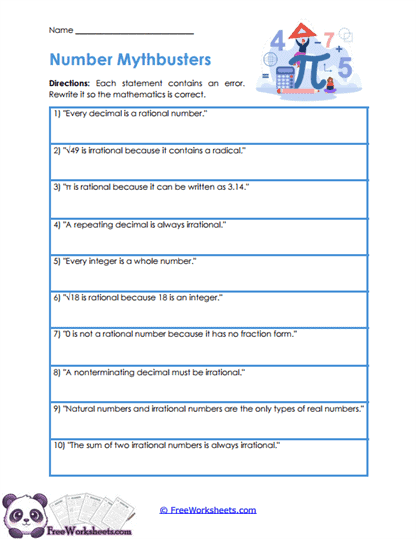
Number Myths
What Kids Do:
Students read ten incorrect statements about decimals, radicals, integers, rational numbers, irrational numbers, zero, and real-number operations. They identify what makes each claim false and rewrite it as a mathematically accurate statement, often using a counterexample to guide the correction.
Target Skill:
Error analysis helps students replace overgeneralized rules with precise mathematical ideas. The worksheet strengthens conceptual understanding of real-number categories, decimal patterns, radicals, and operations while developing the careful reasoning needed across 11th grade Algebra 2.
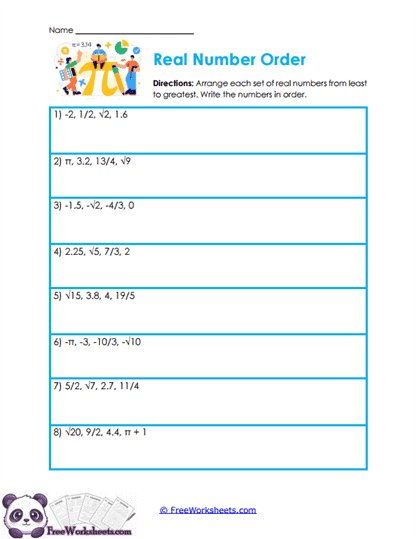
Number Ordering
What Kids Do:
Students arrange eight mixed sets of real numbers from least to greatest. Each set may contain fractions, decimals, negative values, square roots, and expressions involving pi, so students estimate or convert values as needed before placing them in complete numerical order.
Target Skill:
Students develop number-line reasoning across multiple real-number forms. The activity reinforces comparison of negative values, radical estimation, fraction-decimal conversion, and the ability to judge relative size without being distracted by unfamiliar notation.
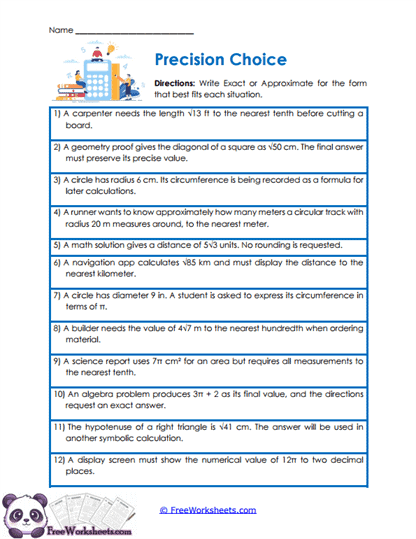
Precision Decisions
What Kids Do:
Students read twelve mathematical and real-world situations and decide whether the final answer should remain exact or be written as a decimal approximation. The contexts involve radicals, pi, geometry, measurements, navigation, construction, science, and other practical uses.
Target Skill:
This activity develops judgment about mathematical precision and communication. Students learn that exact forms preserve complete information while rounded decimals can be more useful in measurements, strengthening their ability to choose an answer form that fits the purpose of the problem.
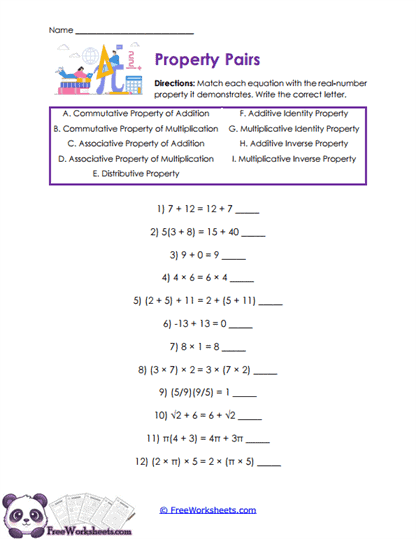
Property Matches
What Kids Do:
Students match twelve equations with the real-number property each one demonstrates. They identify commutative, associative, identity, inverse, and distributive properties by watching for changes in order, grouping, identity values, inverse pairs, and multiplication across parentheses.
Target Skill:
Students strengthen structural reasoning about why algebraic rearrangements are valid. The worksheet reinforces the distinction between changing order and changing grouping, addition and multiplication identities, inverse relationships, and the distributive property used throughout Algebra 2.
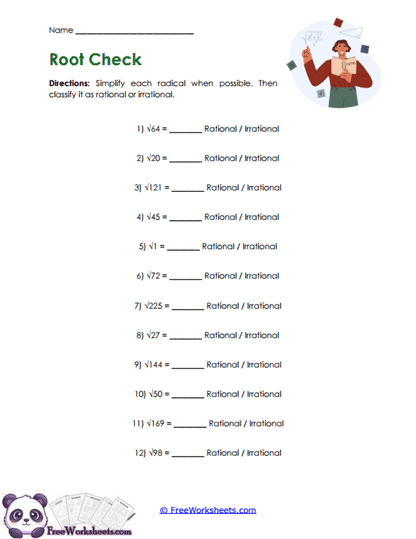
Radical Check
What Kids Do:
Students simplify twelve square roots and then classify each result as rational or irrational. They determine whether the radicand is a perfect square, simplify exact roots when possible, and avoid deciding the number type merely because a radical symbol appears.
Target Skill:
This activity reinforces the difference between a radical expression and its actual value. Students strengthen perfect-square recognition, radical simplification, and rational-versus-irrational reasoning while preparing for more advanced work with radicals and quadratic solutions.
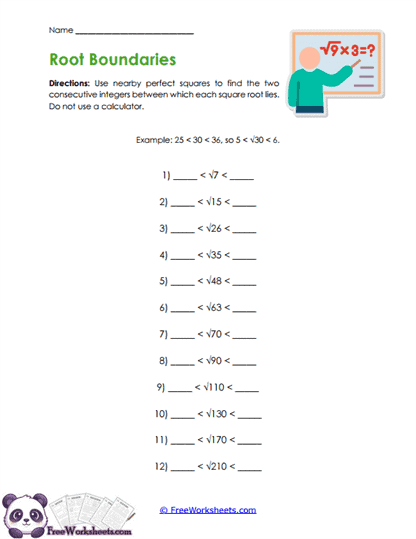
Root Bounds
What Kids Do:
Students estimate twelve irrational square roots without using a calculator by locating the perfect squares immediately below and above each radicand. They then identify the two consecutive whole numbers between which the square root must lie.
Target Skill:
Students build number sense for irrational values by using perfect squares as benchmarks. The worksheet reinforces estimation, radical size, and number-line placement while helping 11th grade students compare unfamiliar square roots with more familiar rational values.
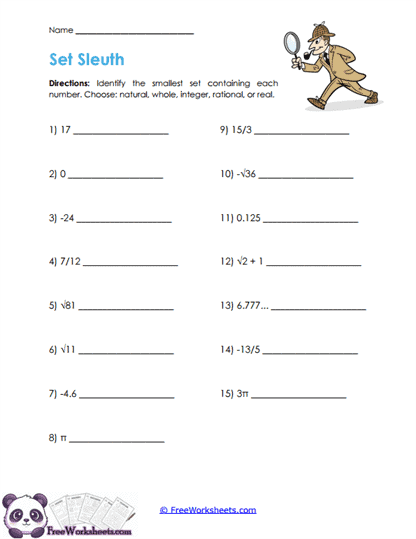
Set Search
What Kids Do:
Students determine the smallest real-number set that contains each of fifteen values. They simplify radicals and inspect integers, fractions, terminating decimals, repeating decimals, and pi-based expressions before deciding whether each belongs most specifically to the natural, whole, integer, rational, or real-number category.
Target Skill:
Students deepen their understanding of nested number sets by choosing the narrowest valid classification. The activity reinforces hierarchy, simplification, decimal interpretation, and the distinction between rational values and irrational real numbers.
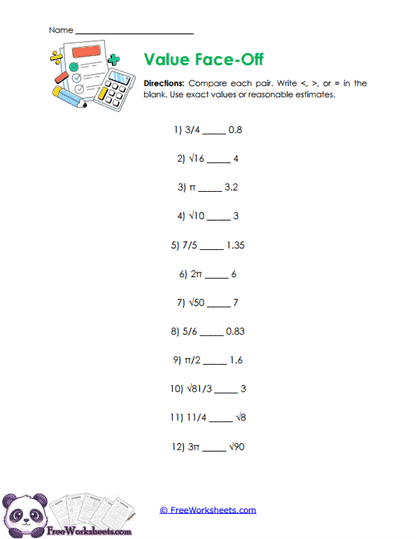
Value Compare
What Kids Do:
Students compare twelve pairs of real numbers written in unlike forms, including fractions, decimals, radicals, and multiples of pi. They convert or estimate values when needed and then choose the correct greater-than, less-than, or equal-to symbol for each pair.
Target Skill:
This worksheet develops flexible comparison strategies across the real-number system. Students strengthen approximation, equivalent forms, radical estimation, and symbolic accuracy while learning that a number’s notation does not determine its size.