
Sentences, Fragments, And Run-ons Worksheets
11th Grade Grammar and Mechanics Sentences, Fragments, And Run-ons worksheets help students become stronger writers by turning common grammar mistakes into opportunities for real growth. Every worksheet is free, ready-to-print in PDF format, and designed for immediate classroom use, whether you're teaching a full class, homeschooling, or providing one-on-one support. Along the way, students build curriculum-aligned skills in sentence construction, revision, editing, and clear written communication that they'll use far beyond English class.
About This Collection of Worksheets
By the time students reach 11th Grade, they usually know what a sentence is. The challenge is recognizing when their own writing slips into fragments, run-ons, or awkward sentence patterns. That’s exactly what these worksheets are designed to address. Rather than asking students to memorize grammar definitions, they give learners repeated opportunities to notice sentence problems in realistic writing and fix them in ways that make their ideas stronger, clearer, and easier to follow.
You’ll also notice that these activities go well beyond correcting isolated sentences. Students combine ideas, revise paragraphs, analyze persuasive writing, edit authentic passages, and experiment with different ways to organize their thoughts. As they work through the collection, they begin to understand that sentence structure isn’t just about avoiding mistakes-it’s one of the most powerful tools writers have for keeping readers interested and communicating ideas effectively.
Whether you’re introducing sentence structure for the first time, reviewing before an assessment, or helping students polish larger writing assignments, these worksheets fit naturally into almost any lesson. They’re equally useful as independent practice, small-group activities, homework, or writing workshop resources. Most importantly, they help students become confident editors who can recognize and fix their own writing before anyone else has to point out the mistakes.
Paul’s Teacher Tip
One thing I’ve learned over the years is that students rarely make sentence mistakes because they don’t know the rule-they make them because they’re focused on getting their ideas onto the page. After students complete one of these worksheets, have them pull out a recent essay and look for the same kinds of errors in their own writing. You’ll often see the lesson click immediately because they’re applying the skill to work that actually matters to them. It’s also helpful to encourage students to explain why they made each revision instead of simply fixing it. When they can talk through their thinking, they’re much more likely to remember the concept the next time they write.
Worksheet Collection Skill Spotlights
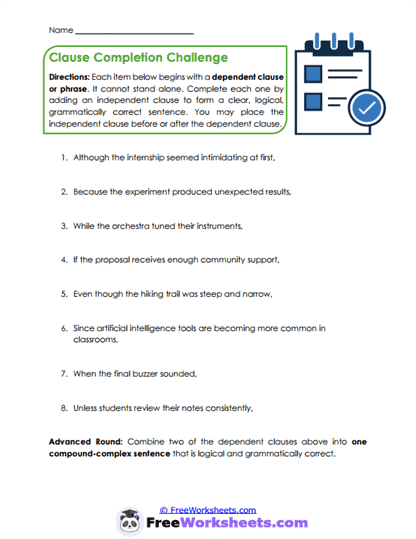
Clause Completion
What Kids Do:
Students begin with sentence starters that aren’t complete thoughts and figure out how to finish them naturally. As they add independent clauses, they’ll experiment with different ways to connect ideas, making each sentence sound smooth while practicing the kinds of sentence structures they’ll use in essays and research papers.
Target Skill:
This worksheet helps students feel more comfortable writing complex sentences without creating fragments or awkward wording. They’ll strengthen sentence construction, clause recognition, punctuation, and logical organization while building confidence that carries into longer pieces of academic writing.
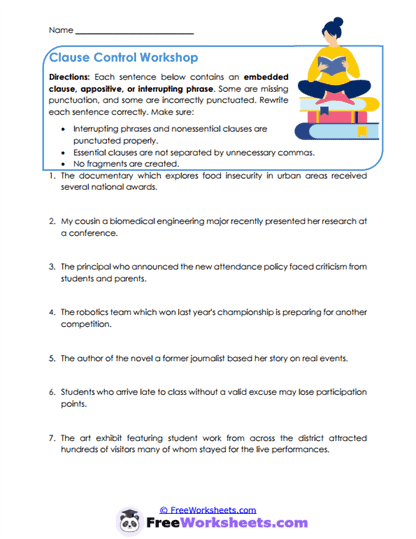
Clause Control
What Kids Do:
Students act like editors as they work through sentences filled with extra information, interrupting phrases, and appositives. Their job is to decide where commas belong, improve readability, and make each sentence easier for a reader to understand without changing its meaning.
Target Skill:
Students develop a stronger sense of how punctuation helps organize ideas instead of simply decorating sentences. As they complete the activity, they’ll improve editing skills, sentence fluency, and their ability to recognize when information is essential or simply adds helpful detail.
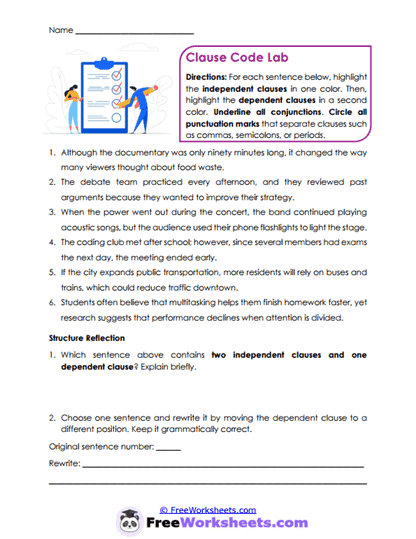
Clause Mapping
What Kids Do:
Instead of just reading a sentence, students pull it apart piece by piece. They’ll highlight independent clauses, identify dependent clauses, locate conjunctions, and examine punctuation so they can actually see how well-written sentences are built from the inside out.
Target Skill:
By breaking sentences into manageable parts, students develop a much deeper understanding of sentence structure than they would through memorization alone. This supports stronger reading comprehension, better editing habits, and more confident writing across every academic subject.
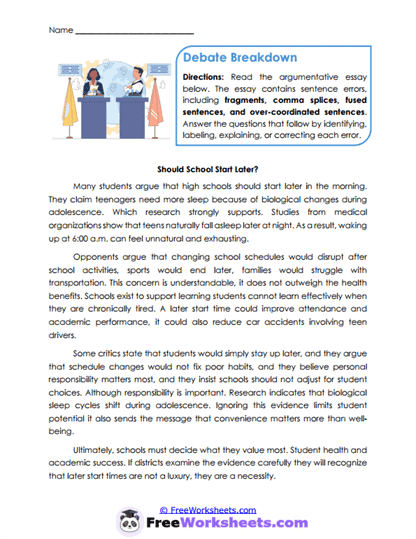
Debate Breakdown
What Kids Do:
Students step into the role of a real proofreader by editing an argumentative essay that’s packed with fragments, comma splices, run-ons, and other sentence problems. Instead of correcting isolated examples, they’ll improve an entire piece of writing from beginning to end.
Target Skill:
Working inside a complete essay helps students recognize grammar mistakes in context-the same way they’ll encounter them in their own writing. They’ll strengthen proofreading skills, revision strategies, and sentence-level editing while becoming more thoughtful writers.
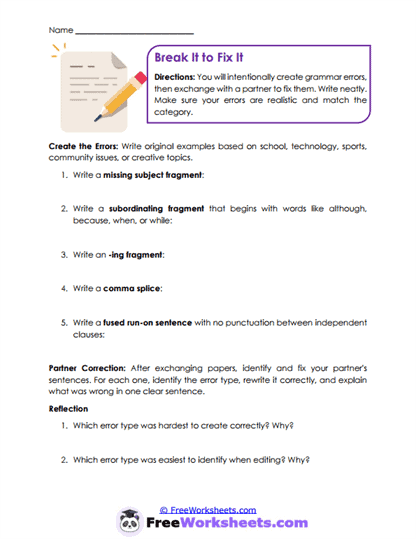
Error Exchange
What Kids Do:
This activity turns students into both writers and editors. They’ll intentionally create sentence mistakes, exchange papers with a partner, and then work together to find and fix each error. It’s a fun twist that keeps students engaged while reinforcing important grammar concepts.
Target Skill:
Creating mistakes is often one of the fastest ways to understand why they happen. Students build stronger editing skills by thinking from both perspectives, improving their ability to recognize fragments, comma splices, and run-ons before those errors appear in their own writing.
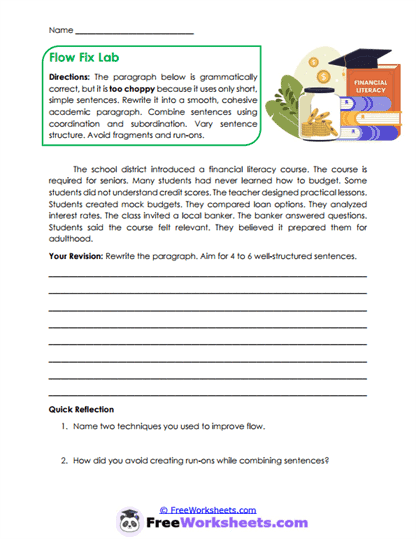
Flow Builder
What Kids Do:
Students take a paragraph that feels choppy and disconnected and transform it into writing that sounds natural and polished. They’ll combine sentences, improve transitions, and vary sentence structure until the paragraph flows smoothly from one idea to the next.
Target Skill:
Rather than focusing only on grammar rules, this worksheet teaches students how sentence variety improves the overall reading experience. They’ll strengthen revision skills, paragraph organization, and writing fluency while learning techniques they’ll use in essays throughout high school and beyond.
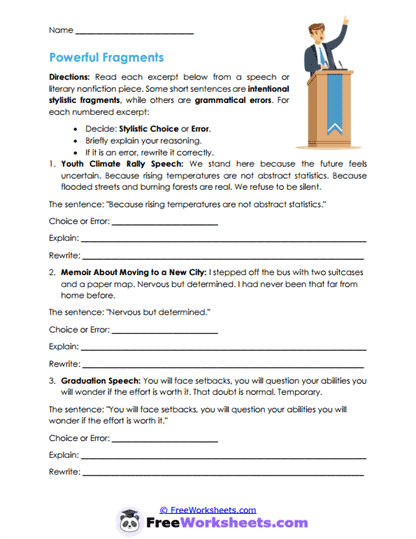
Fragment Analysis
What Kids Do:
Students read short passages from speeches, stories, and other authentic writing before deciding whether a sentence fragment was used on purpose or whether it’s actually a grammar mistake. They’ll explain their thinking, defend their answers, and rewrite only the fragments that weaken the writing, helping them see that good writers sometimes bend the rules-but only when there’s a reason.
Target Skill:
This worksheet helps students move beyond simply labeling fragments as “right” or “wrong.” They’ll learn to consider purpose, audience, and style while strengthening grammar knowledge, close reading, literary analysis, and revision skills. It’s an excellent bridge between grammar instruction and higher-level writing analysis.
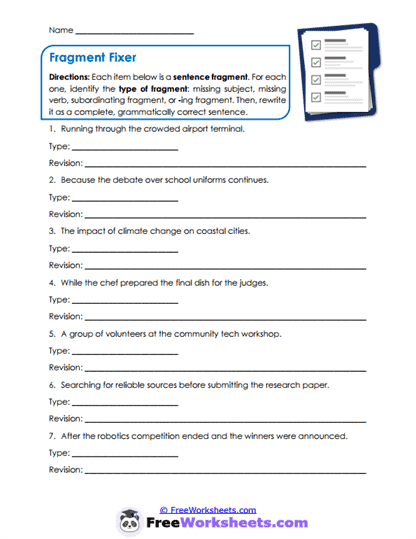
Fragment Fixer
What Kids Do:
Students become grammar detectives as they figure out what’s missing from each incomplete sentence. Some fragments need a subject, others need a complete predicate, and some need an independent clause to make sense. Once they spot the problem, they’ll rewrite each example into a complete sentence that sounds natural and communicates a clear idea.
Target Skill:
As students repair each fragment, they build a stronger understanding of what makes a sentence complete. They’ll improve sentence construction, proofreading, and editing while developing habits that help them catch incomplete thoughts before turning in essays, reports, and other classroom writing.
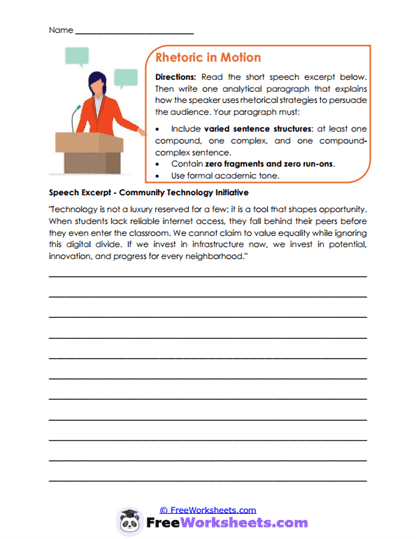
Rhetoric Review
What Kids Do:
Students read a persuasive speech and think about more than just what the author says-they look at how the author says it. After analyzing the writing, they’ll compose their own response using a variety of sentence structures, putting grammar skills to work in an authentic writing assignment instead of isolated practice.
Target Skill:
This activity shows students that sentence structure is a writing tool, not just another grammar lesson. They’ll strengthen rhetorical analysis, sentence variety, organization, and formal writing while learning how effective authors use different sentence patterns to persuade and engage readers.
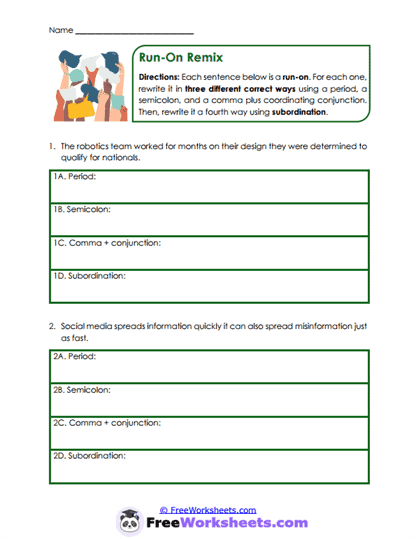
Run-On Repair
What Kids Do:
Instead of correcting a run-on sentence one way and moving on, students explore several different solutions. They’ll separate ideas with periods, connect them with semicolons, use coordinating conjunctions, and build complex sentences, comparing how each revision changes the rhythm and flow of the writing.
Target Skill:
Students discover that strong editing is about making thoughtful choices, not memorizing a single rule. By practicing multiple correction strategies, they’ll gain flexibility as writers while improving punctuation, sentence variety, and the confidence to revise their own work independently.
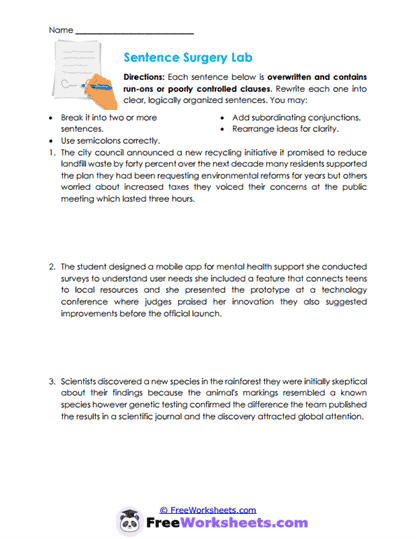
Sentence Surgery
What Kids Do:
Some sentences simply have too much going on, and that’s where this worksheet comes in. Students carefully “operate” on long, confusing passages by breaking ideas apart, reorganizing information, and rebuilding sentences that are much easier to read without losing any important details.
Target Skill:
Students strengthen one of the most valuable writing skills they’ll ever develop: revision. They’ll practice organizing ideas logically, improving sentence clarity, correcting run-ons, and creating polished academic writing that communicates ideas with confidence and precision.
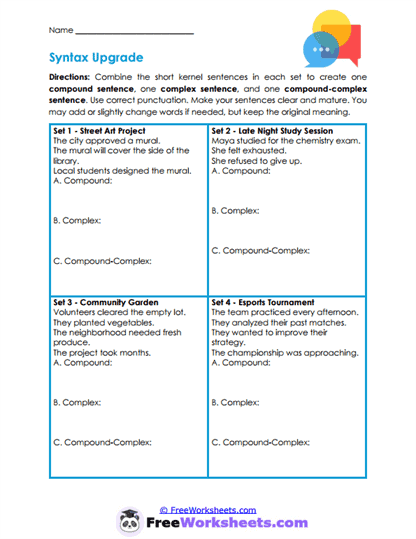
Syntax Upgrade
What Kids Do:
Students start with short, simple statements and turn them into writing that sounds more polished and mature. They’ll experiment with compound, complex, and compound-complex sentences while discovering that there are often several effective ways to combine the same ideas into stronger writing.
Target Skill:
Rather than writing a series of short, repetitive sentences, students learn how sentence variety makes their work more engaging to read. They’ll strengthen grammar, syntax, organization, and writing fluency while developing the flexibility needed for essays, research papers, and college-level assignments.