
Logarithms Worksheets
These worksheets help students understand logarithmic relationships, rewrite exponential forms, apply logarithm properties, and solve logarithmic equations through structured algebra practice. These free, ready-to-print worksheets come in PDF format for immediate classroom use, homework assignments, intervention support, or independent review. Students strengthen algebra reasoning, exponent relationships, symbolic manipulation, and equation-solving skills while connecting logarithms to real-world applications and scientific modeling.
About This Collection of Worksheets
This collection of logarithms worksheets gives students meaningful practice interpreting logarithmic notation, rewriting exponential relationships, expanding and condensing logarithms, solving logarithmic equations, and comparing logarithmic expressions. Students work with bases, exponents, logarithm properties, exact evaluations, and inverse relationships while building stronger connections between logarithms and exponential functions. The activities support both conceptual understanding and procedural fluency through repeated symbolic reasoning.
The worksheets include logarithm rewriting exercises, property-based simplification problems, logarithmic equation solving, comparison tasks, exact-value evaluations, and real-world applications involving sound intensity, earthquakes, and population growth. Students practice applying product, quotient, and power properties while learning how logarithms model exponential relationships in practical situations. The progression of activities helps learners move from introductory notation toward more advanced logarithmic reasoning and equation-solving skills.
Teachers can use these printable PDF worksheets for guided instruction, homework, intervention, review lessons, enrichment, assessment preparation, or independent study. The layouts provide organized workspaces for rewriting, solving, algebraic explanations, and symbolic simplification. The variety of problem types also helps students connect logarithms to exponents, equations, graphs, and real-world scientific applications while strengthening overall algebra confidence.

Paul’s Teacher Tip
Students usually understand logarithms more clearly when they consistently connect them back to exponents. Encourage learners to rewrite logarithmic expressions as exponential equations before solving or simplifying because it helps them see what the logarithm is actually asking. Many mistakes happen when students try to memorize rules without understanding the inverse relationship between logarithms and exponents. It also helps to remind students that logarithms cannot contain negative or zero values inside the argument, especially when solving equations. Real-world examples involving earthquake magnitudes, decibel scales, and population growth often make logarithms feel more meaningful and less abstract. Asking students to explain a logarithm in words before solving can improve both conceptual understanding and algebra accuracy.
Worksheet Collection Skill Spotlights
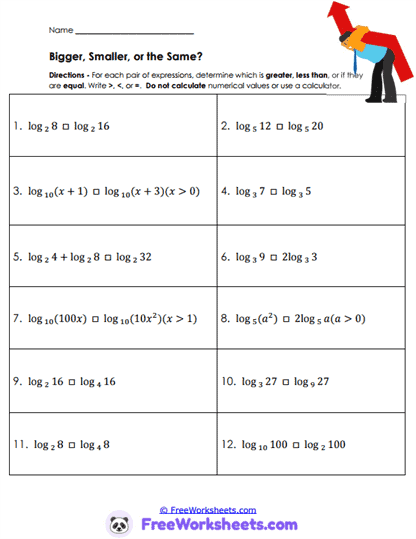
Compare Logs
- What Kids Do:
Students compare logarithmic expressions with different bases, arguments, and powers while determining which values are greater, smaller, or equivalent through reasoning. - Target Skill:
Students strengthen conceptual logarithm understanding by analyzing exponent relationships and comparing logarithmic behavior without relying on calculator approximations.
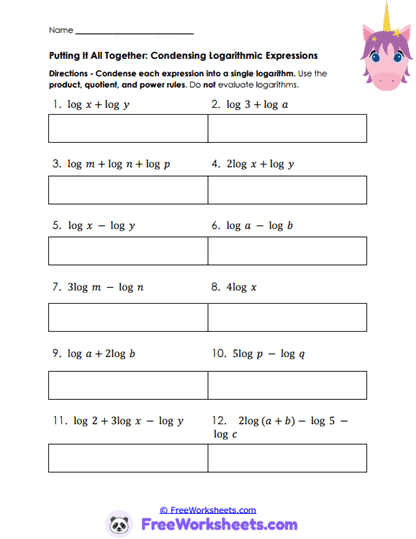
Condense Logs
- What Kids Do:
Students combine multiple logarithmic expressions into single logarithms using product, quotient, and power properties while simplifying symbolic expressions carefully. - Target Skill:
Students improve symbolic manipulation and algebra structure skills by applying logarithm properties accurately to condense expressions efficiently.
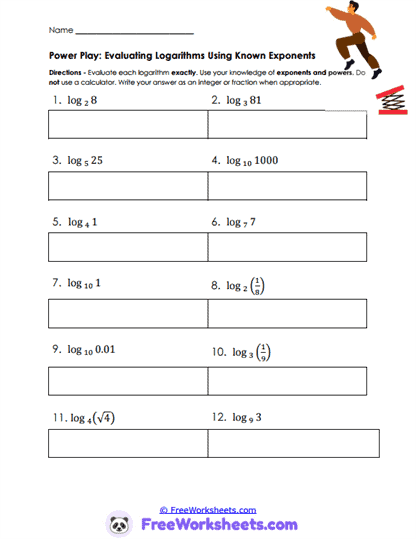
Evaluate Powers
- What Kids Do:
Students evaluate logarithms involving powers, roots, fractions, and integers by identifying the exponent needed to produce the given value. - Target Skill:
Students strengthen exponent reasoning and logarithm fluency by connecting logarithmic expressions directly to exponential relationships and powers.
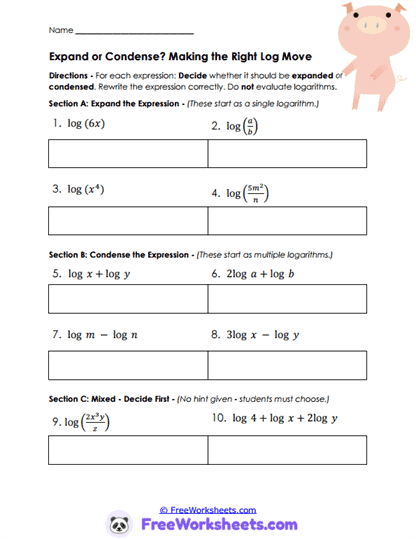
Expand Decide
- What Kids Do:
Students determine whether logarithmic expressions should be expanded or condensed and apply the appropriate logarithm property to rewrite the expression correctly. - Target Skill:
Students improve algebra reasoning and property recognition skills by analyzing expression structure before choosing a logarithmic strategy.
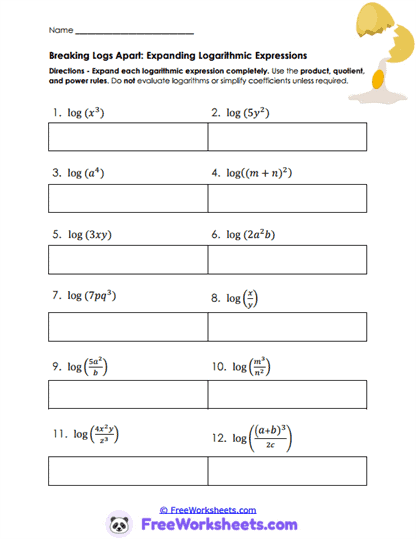
Expand Logs
- What Kids Do:
Students expand logarithmic expressions involving products, quotients, and exponents into sums, differences, and coefficient forms using logarithm properties. - Target Skill:
Students strengthen logarithm property fluency by applying product, quotient, and power rules systematically to symbolic expressions.
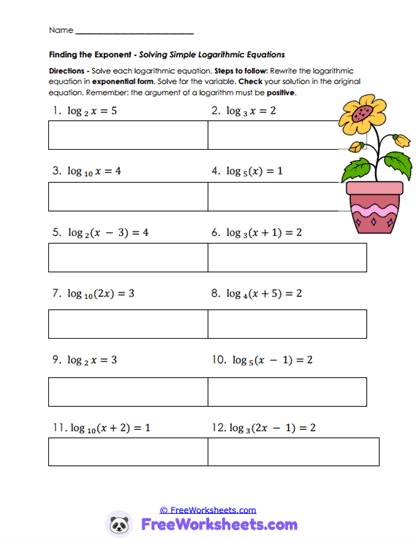
Find Exponents
- What Kids Do:
Students solve simple logarithmic equations by rewriting them in exponential form, solving algebraically, and checking that logarithm arguments remain positive. - Target Skill:
Students build equation-solving confidence by connecting logarithmic notation to exponent relationships and verifying valid solutions carefully.
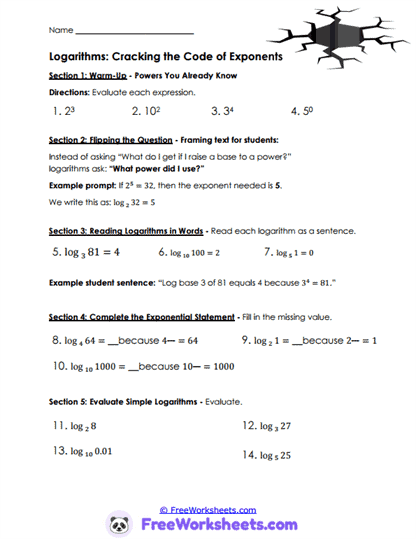
Log Basics
- What Kids Do:
Students interpret logarithms as inverse exponent questions, rewrite logarithmic expressions in words, and connect logarithms to exponential equations. - Target Skill:
Students develop foundational logarithm understanding by recognizing logarithms as inverse operations of exponents and interpreting notation accurately.
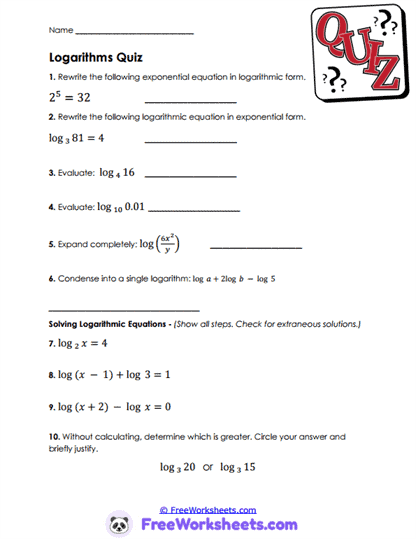
Log Review
- What Kids Do:
Students complete mixed review problems involving rewriting, evaluating, expanding, condensing, comparing, and solving logarithmic expressions and equations. - Target Skill:
Students reinforce overall logarithm fluency by applying multiple logarithm concepts and algebra strategies across varied problem formats.
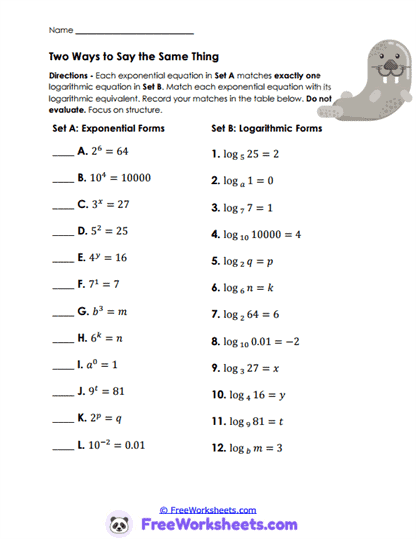
Match Forms
- What Kids Do:
Students match exponential equations to equivalent logarithmic forms while analyzing how bases, exponents, and outputs relate mathematically. - Target Skill:
Students strengthen inverse-operation reasoning by recognizing equivalent exponential and logarithmic relationships across different representations.
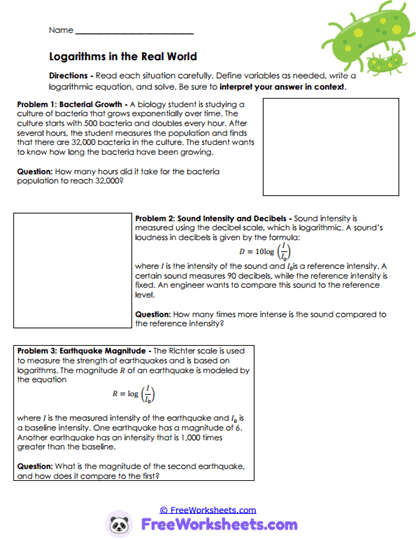
Real Logs
- What Kids Do:
Students apply logarithms to real-world situations involving earthquake scales, sound intensity, bacterial growth, and scientific measurement systems. - Target Skill:
Students improve applied algebra reasoning by interpreting logarithmic relationships within practical science and measurement contexts.
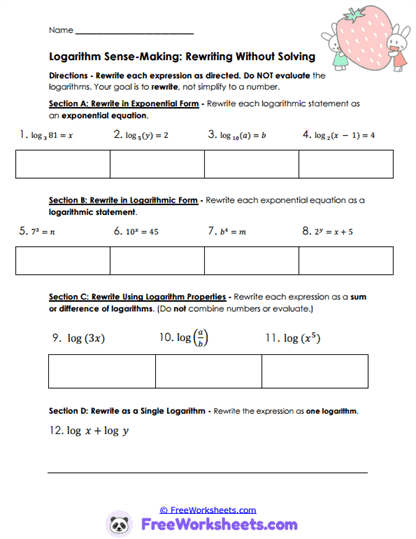
Rewrite Logs
- What Kids Do:
Students rewrite expressions between logarithmic and exponential forms while applying logarithm properties to expand and condense symbolic expressions. - Target Skill:
Students strengthen flexibility with logarithmic notation by translating equivalent forms and applying algebraic rewriting rules accurately.
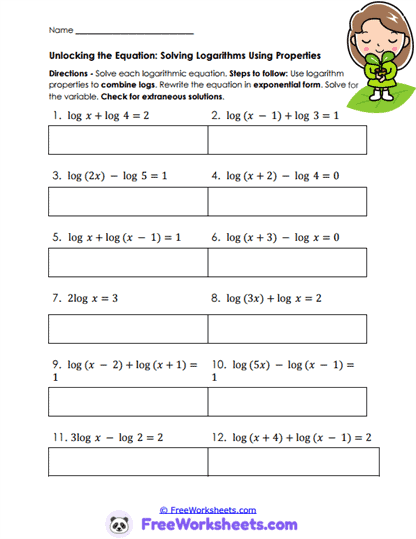
Solve Logs
- What Kids Do:
Students solve logarithmic equations using logarithm properties, exponential rewriting, and algebraic simplification while checking for invalid solutions. - Target Skill:
Students improve logarithmic equation-solving skills by combining properties, solving carefully, and verifying domain restrictions accurately.