
Functions And Relations Worksheets
These worksheets help students identify functions, analyze relations, interpret graphs, and connect algebra concepts across multiple representations. These free, ready-to-print worksheets come in PDF format for immediate classroom use, homework assignments, intervention support, or independent review. Students strengthen reasoning skills involving ordered pairs, mapping diagrams, function rules, domain and range, graphs, and real-world algebra relationships.
About This Collection of Worksheets
This collection of functions and relations worksheets gives students structured practice identifying functions, interpreting relations, analyzing graphs, and writing algebraic rules. Students work through ordered pairs, input-output tables, coordinate graphs, mapping diagrams, function machines, and real-world scenarios while learning how functions connect inputs to outputs in consistent ways. The activities help students build a strong conceptual foundation for algebraic thinking and function analysis.
The worksheets include graph interpretation tasks, domain-and-range analysis, relation mapping activities, rule-writing exercises, function comparisons, and real-world modeling problems. Students practice determining whether relations are functions, applying the vertical line test, analyzing patterns in tables, writing algebraic equations from situations, and comparing function behavior across different formats. The progression of activities supports both procedural fluency and deeper understanding of how functions behave mathematically and practically.
Teachers can use these printable PDF worksheets for guided instruction, independent practice, review lessons, intervention, enrichment, homework, or assessment preparation. The layouts provide organized workspaces for graphing, written explanations, equation writing, and logical reasoning. The variety of visual and numerical representations also helps students connect abstract algebra ideas to patterns, graphs, and everyday situations.
Paul’s Teacher Tip
Students often understand functions more clearly when they focus on inputs first instead of outputs. Remind learners that a function only fails when one input connects to more than one output. Many students mistakenly believe repeated outputs automatically mean a relation is not a function, so repeated practice with ordered pairs and mapping diagrams can help clear up that confusion. It also helps to connect functions to real-life situations students recognize, such as ride-share pricing, streaming subscriptions, or school schedules. Encouraging students to explain what the input and output represent in words often strengthens their understanding more than simply memorizing definitions. Visual models like function machines and mapping diagrams are especially useful for helping students see how functions work step by step.
Worksheet Collection Skill Spotlights
Function Basics
- What Kids Do:
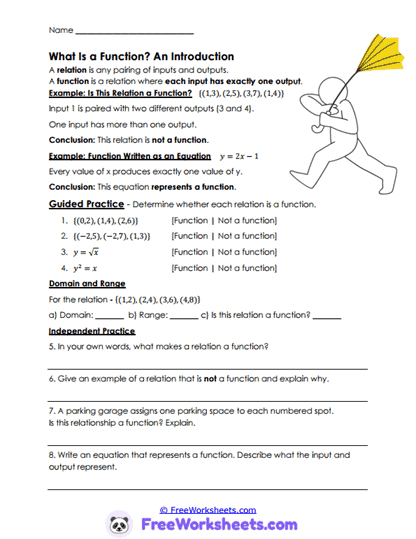
Students study ordered pairs, equations, and real-world examples to determine whether relations are functions while identifying domains, ranges, and input-output relationships. - Target Skill:
Students strengthen foundational algebra reasoning by distinguishing between relations and functions, analyzing ordered pairs carefully, and explaining function rules using mathematical vocabulary.
Function Check
- What Kids Do:
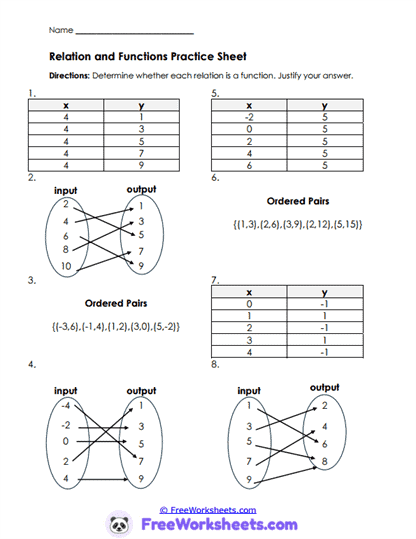
Students examine mapping diagrams, tables, and ordered pairs to decide whether each relation follows the function rule and justify their reasoning using input-output analysis. - Target Skill:
Students build confidence identifying functions across multiple representations by tracking repeated inputs carefully and applying the definition of a function accurately.
Function Compare
- What Kids Do:
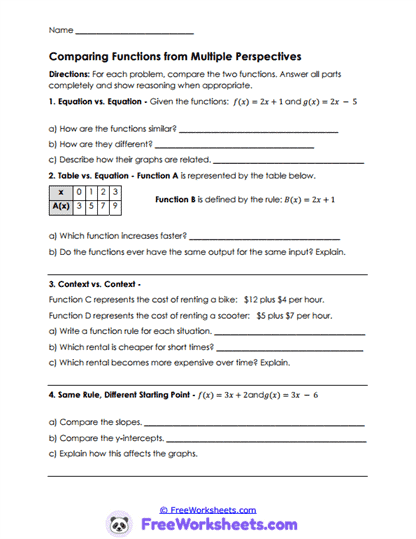
Students compare functions shown through equations, tables, graphs, and real-world situations while analyzing slopes, starting values, and rates of change. - Target Skill:
Students strengthen function analysis skills by comparing patterns and rates of change across multiple representations and interpreting how functions behave differently.
Function Machines
- What Kids Do:
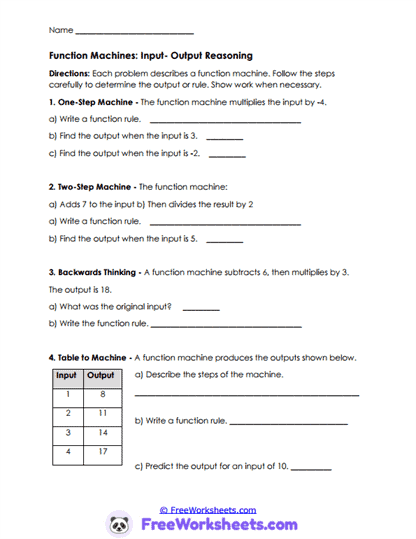
Students solve input-output problems using one-step and multi-step function machines while identifying numerical patterns and writing algebraic rules for each process. - Target Skill:
Students improve algebraic reasoning and rule-writing skills by analyzing how operations transform inputs into outputs through structured function processes.
Function Quiz
- What Kids Do:
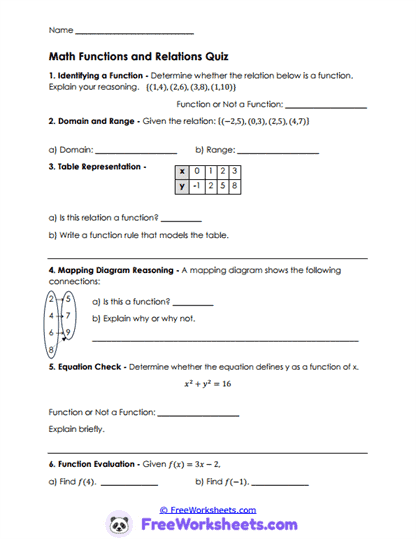
Students complete mixed review problems involving mapping diagrams, domain and range, equations, function evaluation, and identifying whether relations are functions. - Target Skill:
Students reinforce overall function fluency by applying multiple algebra concepts, analyzing relationships carefully, and interpreting functions across varied representations.
Function Views
- What Kids Do:
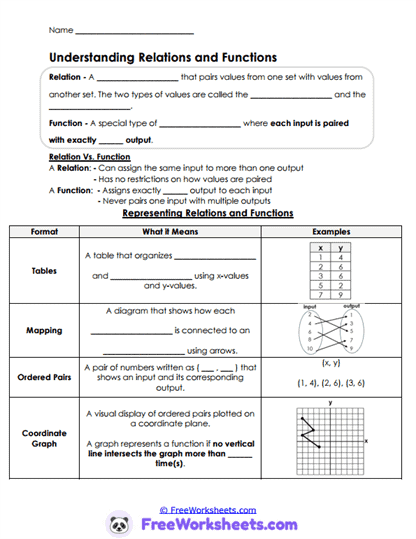
Students analyze tables, graphs, ordered pairs, and mapping diagrams while identifying how each representation shows functions and relations differently. - Target Skill:
Students deepen conceptual understanding of functions by connecting multiple representations and interpreting graphs, tables, and mappings consistently and accurately.
Graph Relations
- What Kids Do:
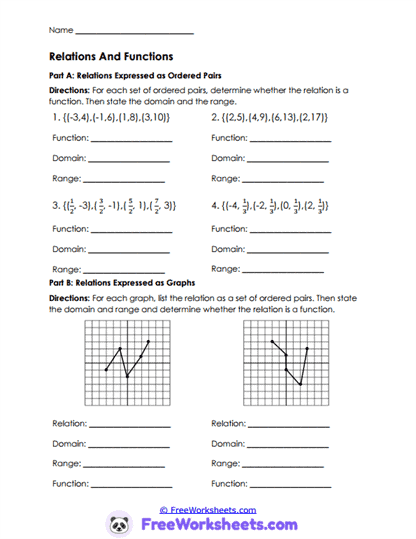
Students analyze graphs and ordered pairs to determine domains, ranges, and whether relations pass the vertical line test while interpreting coordinate relationships visually. - Target Skill:
Students strengthen graph interpretation and function reasoning skills by identifying domains and ranges correctly and applying the vertical line test accurately.
Ordered Logic
- What Kids Do:
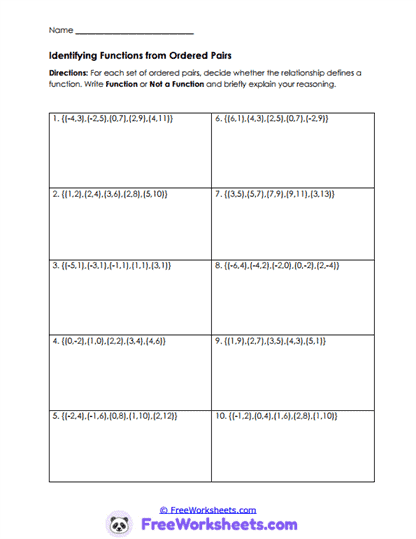
Students examine sets of ordered pairs and determine whether repeated inputs create valid functions while explaining their reasoning using function definitions. - Target Skill:
Students improve logical analysis skills by focusing on input-output structure and recognizing when ordered pairs violate the function rule.
Real Relations
- What Kids Do:
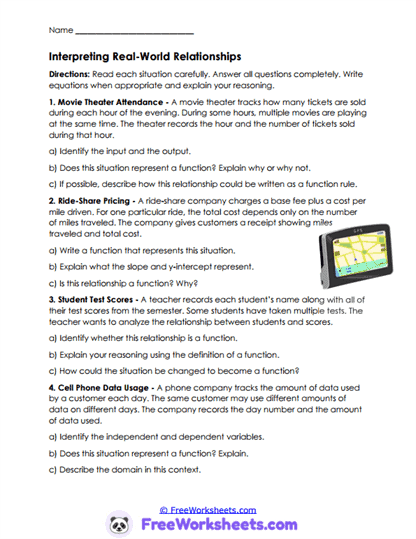
Students analyze real-world situations involving transportation, technology, grades, and pricing while identifying inputs, outputs, and function relationships. - Target Skill:
Students strengthen applied algebra reasoning by connecting functions to practical situations and explaining how mathematical relationships model everyday experiences.
Relation Mapping
- What Kids Do:
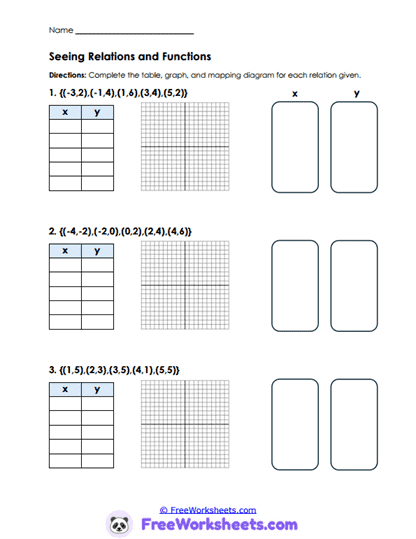
Students organize ordered pairs into tables, coordinate graphs, and mapping diagrams while comparing how the same relation appears across different formats. - Target Skill:
Students build representation and graphing skills by connecting visual models, ordered pairs, and mappings to identify functions and relations accurately.
Relation Skills
- What Kids Do:
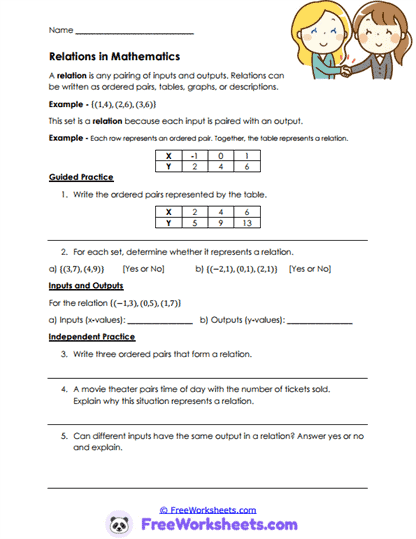
Students write ordered pairs from tables, identify inputs and outputs, and describe mathematical relations using multiple forms and real-world examples. - Target Skill:
Students strengthen understanding of relations and input-output structure by interpreting tables carefully and connecting algebra concepts across representations.
Rule Writing
- What Kids Do:
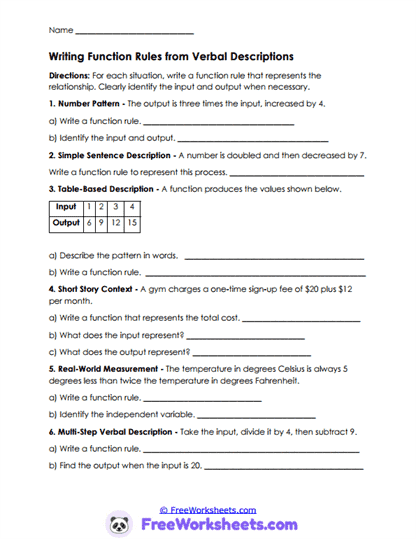
Students write algebraic function rules from verbal descriptions, numerical patterns, and real-world scenarios while identifying variables and analyzing relationships. - Target Skill:
Students improve algebra modeling and equation-writing skills by translating patterns and situations into clear algebraic function rules.