
Main Idea Worksheets
These worksheets help students identify central ideas, connect evidence, and explain how meaning develops across complex texts. These free, ready-to-print PDF worksheets are designed for immediate classroom use or easy at-home learning. Students strengthen skills like writing precise central ideas, analyzing structure, and refining their thinking.
About This Collection of Worksheets
This collection focuses on helping students move from simple main idea identification to deeper, more precise understanding. Each worksheet uses real-world topics like technology, inequality, media, and automation to make reading meaningful and relevant. Students learn how to take smaller ideas and combine them into one clear, thoughtful central message.
Students are also guided to revise and improve their thinking. Many activities ask them to compare possible main ideas, refine unclear statements, and support their ideas with evidence. This helps them build strong habits for both reading comprehension and analytical writing. Over time, students become more confident in expressing complex ideas clearly.
The worksheets are designed to build skills step-by-step, from identifying central ideas to evaluating, revising, and abstracting them. Students also practice connecting tone, purpose, and structure to meaning. These resources align with Grade 11 standards and prepare students for advanced reading, writing, and test performance.
Paul’s Teacher Tip
At this level, remind students that a strong central idea is not just what the text is about-it’s what the author wants the reader to understand. Encourage them to ask, “What is the deeper message here?” It also helps to revise ideas more than once, improving clarity each time. If students get stuck, have them start with key details and build up to a bigger idea. Over time, this process becomes much more natural.
Worksheet Collection Skill Spotlights
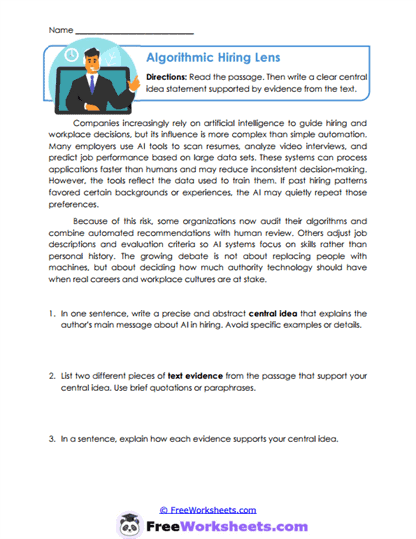
Algorithmic Hiring Lens
- What Kids Do:
Students read a passage about AI in hiring and write a clear central idea sentence. They find evidence from the text and explain how it supports their idea. This helps them connect big ideas to details. - Target Skill:
Students build skills in writing precise central ideas supported by evidence. They learn how to connect details to meaning. This supports strong comprehension and writing.
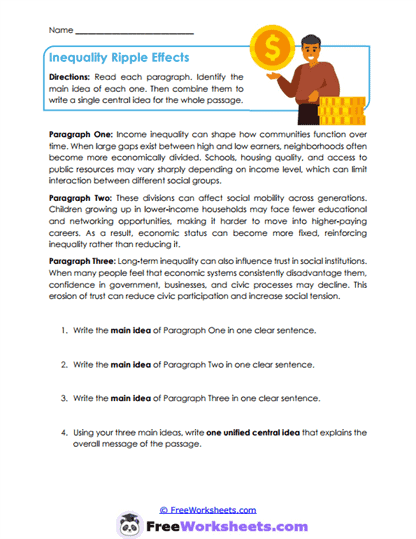
Inequality Ripple Effects
- What Kids Do:
Students read multiple paragraphs and identify the main idea of each one. They then combine those ideas into one central idea. This helps them see how ideas build across a text. - Target Skill:
Students develop skills in synthesizing ideas across paragraphs. They learn how to form one clear message from multiple parts. This supports deeper comprehension.
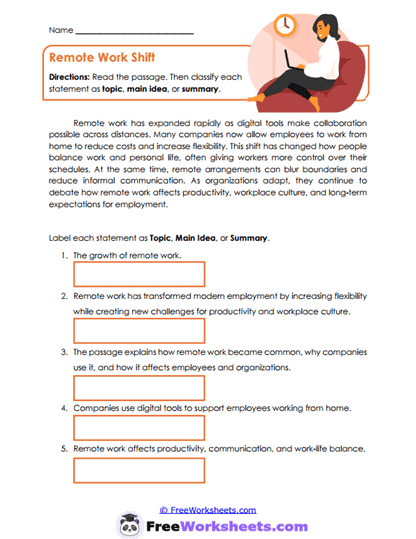
Remote Work Shift
- What Kids Do:
Students label statements as topic, main idea, or summary. They compare how each type of idea works. This helps them organize information clearly. - Target Skill:
Students strengthen their understanding of text structure by distinguishing between types of ideas. They learn how information is organized. This supports comprehension.
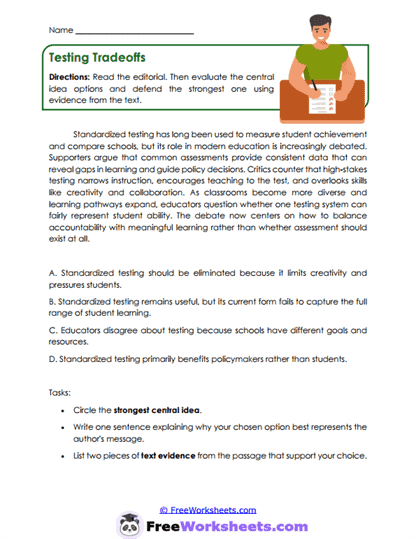
Testing Tradeoffs
- What Kids Do:
Students evaluate several possible central ideas for a passage and choose the strongest one. They explain their reasoning using evidence. This builds decision-making skills. - Target Skill:
Students develop skills in evaluating and defending central ideas. They learn how to choose the most accurate interpretation. This supports critical thinking.
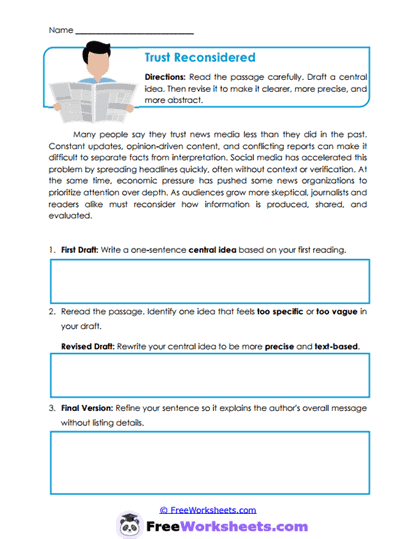
Trust Reconsidered
- What Kids Do:
Students write a first draft of a central idea and then revise it to improve clarity and precision. They reflect on how their thinking improves. This builds strong writing habits. - Target Skill:
Students strengthen their ability to revise and refine ideas. They learn how to make ideas more accurate and clear. This supports analytical writing.
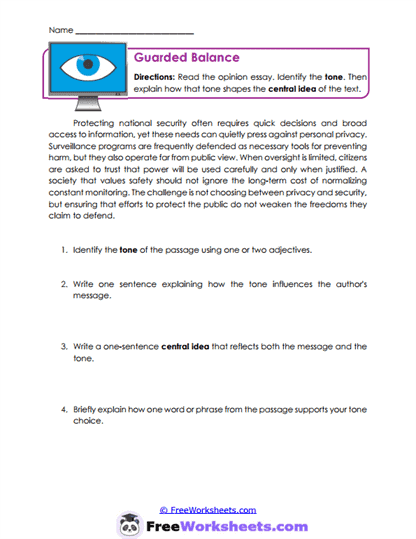
Guarded Balance
- What Kids Do:
Students identify tone in a passage and explain how it shapes the central idea. They write a balanced main idea that reflects both tone and meaning. This builds deeper understanding. - Target Skill:
Students develop skills in connecting tone to central idea. They learn how attitude shapes meaning. This supports advanced analysis.
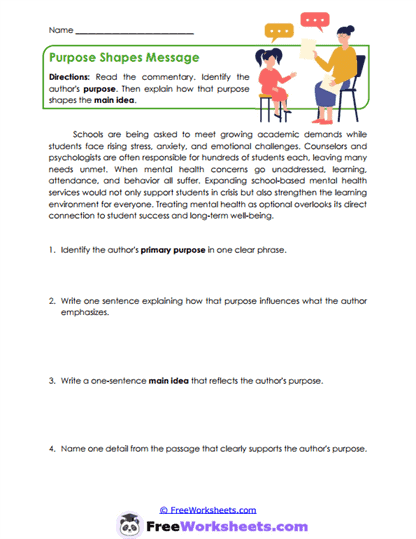
Purpose Shapes Message
- What Kids Do:
Students identify the author’s purpose and explain how it influences the main idea. They support their thinking with evidence. This builds strong reasoning. - Target Skill:
Students strengthen their ability to analyze purpose and central idea together. They learn how intent shapes meaning. This supports comprehension.
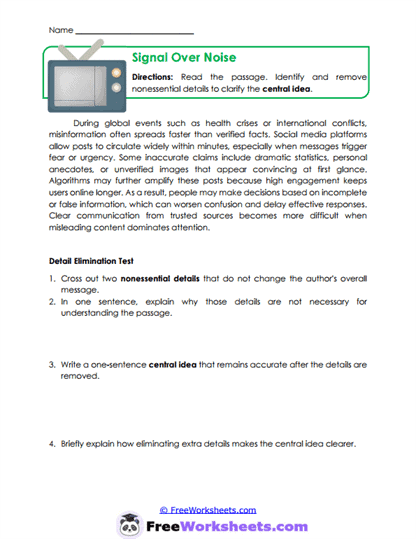
Signal Over Noise
- What Kids Do:
Students identify unnecessary details in a passage and remove them. They rewrite the central idea more clearly. This helps them focus on what matters most. - Target Skill:
Students build skills in identifying essential information and improving clarity. They learn how to refine ideas. This supports summarizing and writing.
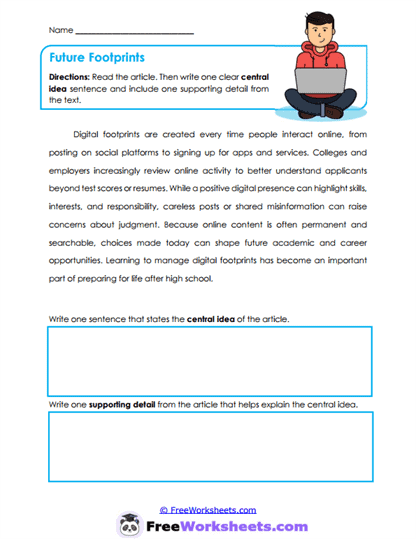
Future Footprints
- What Kids Do:
Students write a central idea and support it with a key detail. They focus on keeping both clear and connected. This builds concise thinking. - Target Skill:
Students improve their ability to connect central ideas with evidence. They learn how to support ideas effectively. This supports comprehension.
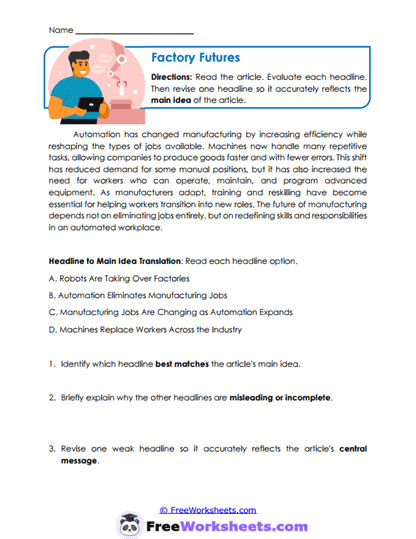
Factory Futures
- What Kids Do:
Students evaluate headline options and choose the one that best represents the central idea. They explain why other options are incorrect. This builds analysis skills. - Target Skill:
Students develop skills in evaluating summaries and identifying accurate main ideas. They learn how wording affects meaning. This supports critical reading.
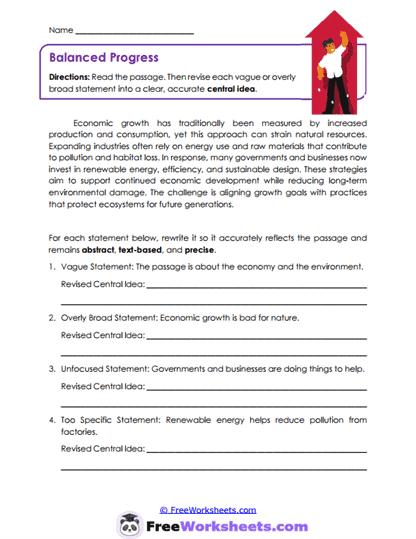
Balanced Progress
- What Kids Do:
Students revise weak or vague central idea statements to make them clearer and more accurate. They improve wording step by step. This builds precision. - Target Skill:
Students strengthen their ability to refine ideas for clarity and accuracy. They learn how to write stronger central ideas. This supports writing development.
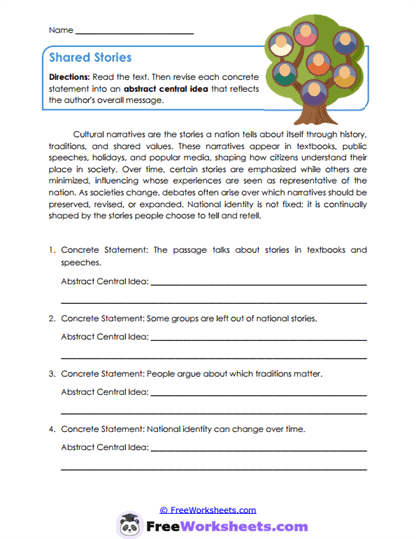
Shared Stories
- What Kids Do:
Students turn specific details into broader, more abstract central ideas. They connect examples to larger themes. This builds higher-level thinking. - Target Skill:
Students develop skills in creating abstract central ideas from concrete details. They learn how to express deeper meaning. This supports advanced comprehension and analysis.