
Spelling Worksheets
Grade 11 Grammar and Mechanics Spelling worksheets help students move beyond memorizing word lists and start understanding how words are built, used, and edited in real writing. Every worksheet is free, ready-to-print in PDF format, and designed for immediate classroom use whether you're teaching a class, homeschooling, or working one-on-one with a student. Along the way, students strengthen curriculum-aligned skills in spelling, proofreading, vocabulary development, and clear written communication.
About This Collection of Worksheets
By 11th Grade, students already know how to spell thousands of words. What often trips them up isn’t everyday vocabulary; it’s the academic language they encounter in essays, research papers, science labs, government classes, and college-prep writing. That’s why this collection focuses on the spelling challenges older students actually face. Instead of memorizing another weekly list, they’ll explore word roots, edit authentic passages, work with commonly confused words, and discover the spelling patterns that make advanced vocabulary much easier to remember.
Another thing I really like about these worksheets is that they always connect spelling to a larger purpose. Students aren’t just correcting words because someone told them to-they’re proofreading college application essays, improving professional emails, revising formal writing, and editing passages that feel like something they’d actually read in school. Those authentic situations help students see that accurate spelling isn’t about getting 100% on a quiz. It’s about communicating ideas clearly and leaving readers with confidence in what they’ve written.
Whether you’re helping students prepare for college, strengthen their editing skills, or simply become more confident writers, these printable worksheets fit naturally into almost any English classroom. They’re just as effective for independent practice as they are for small groups, homework, tutoring sessions, or writing workshops. More importantly, they help students develop habits they’ll continue using long after high school whenever they proofread an essay, send an email, or prepare an important document.
Paul’s Teacher Tip
One thing I’ve noticed over the years is that students remember spelling patterns much longer than they remember spelling lists. When a student understands why credible, credit, and credibility all share the same root, they’re much more likely to spell each one correctly later. After finishing one of these worksheets, I like asking students to find two or three examples of the same spelling pattern in a book they’re reading or an article they’ve found online. It’s a simple activity, but it helps them realize that these words are everywhere-and that spelling becomes much easier when you start recognizing the patterns behind the words instead of trying to memorize each one separately.
Worksheet Collection Skill Spotlights
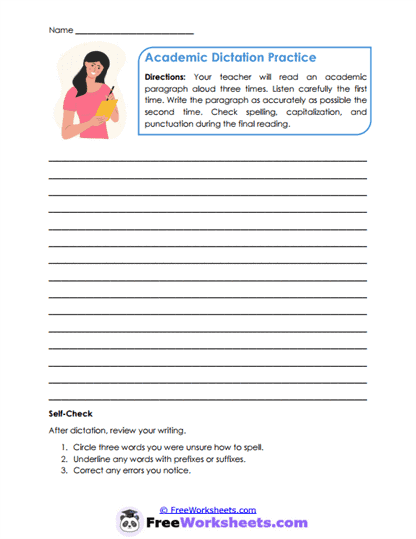
Academic Dictation
What Kids Do:
Students listen to an academic passage, write it as accurately as they can, and then become their own editor. They’ll check spelling, punctuation, capitalization, and word formation while comparing what they wrote with what they intended to hear. It’s a practical activity that mirrors the note-taking and listening skills they’ll use throughout college and beyond.
Target Skill:
This worksheet helps students slow down and pay attention to details that are easy to overlook when writing quickly. Along the way, they’ll strengthen spelling, proofreading, listening comprehension, and self-editing while developing the habit of reviewing their work before considering it finished.
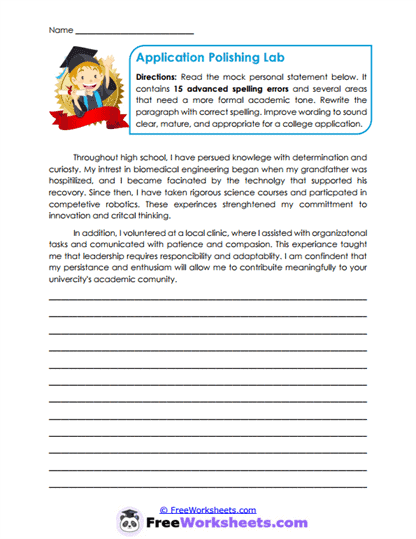
Application Polish
What Kids Do:
Students step into the role of a college admissions editor as they revise a personal statement filled with spelling mistakes, awkward wording, and grammar errors. Rather than making quick corrections, they’ll think carefully about how each revision helps the writer sound more polished, confident, and professional.
Target Skill:
Students discover that strong writing is about much more than correct spelling. They’ll improve proofreading, formal writing, vocabulary, and editing skills while learning how thoughtful revisions can completely change the impression a piece of writing leaves on its reader.
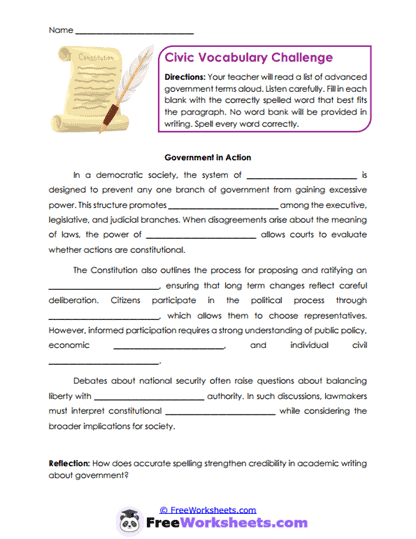
Civic Vocabulary
What Kids Do:
Students work with advanced government and civics vocabulary by spelling challenging academic terms and placing them into a meaningful informational passage. Instead of studying disconnected vocabulary words, they’ll see how these terms naturally appear in discussions about government, history, and current events.
Target Skill:
This worksheet builds confidence with academic language that students regularly encounter in social studies, government, and college-preparatory courses. They’ll strengthen spelling, vocabulary, reading comprehension, and content-area literacy while becoming more comfortable with sophisticated terminology.
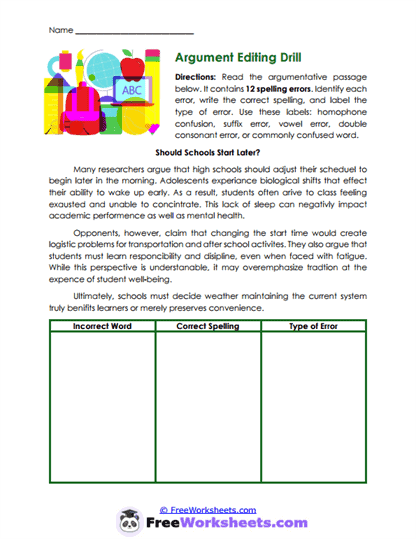
Editing Evidence
What Kids Do:
Students become proofreaders as they search through an argumentative essay looking for intentional spelling mistakes. Once they find each error, they’ll correct it and identify the type of mistake that caused it, turning a simple editing activity into a much deeper investigation of spelling patterns.
Target Skill:
Rather than memorizing words one at a time, students learn to recognize the kinds of spelling mistakes they make most often. They’ll strengthen proofreading, editing, vocabulary, and spelling analysis while building habits that transfer directly into their own essays and writing assignments.
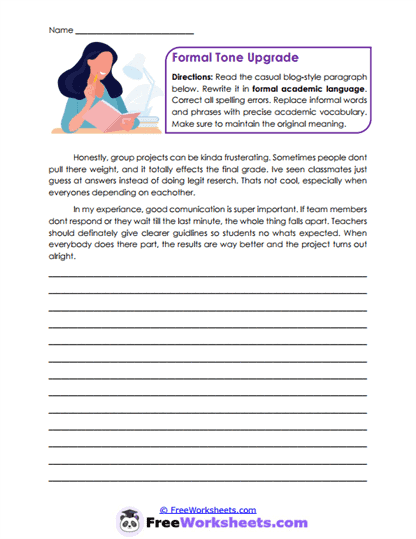
Formal Revision
What Kids Do:
Students take an informal paragraph that sounds more like a casual conversation and rewrite it using stronger vocabulary, accurate spelling, and a more professional tone. As they revise, they’ll discover how even small changes can make writing sound much more polished and appropriate for an academic audience.
Target Skill:
Students learn how to adjust their writing for different audiences while strengthening spelling, vocabulary, proofreading, and editing skills. The activity reinforces the idea that formal writing isn’t about using bigger words-it’s about choosing the right words for the situation.
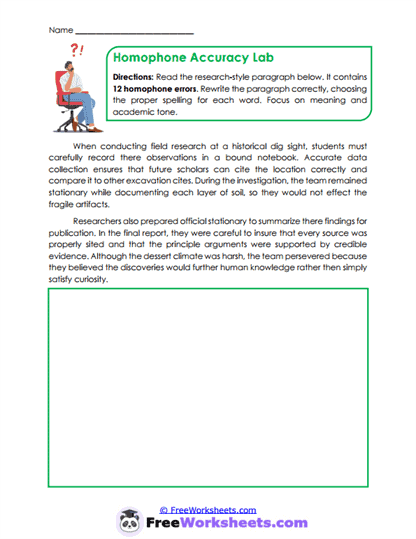
Homophone Mastery
What Kids Do:
Students carefully read a research passage filled with homophone mistakes and use context clues to decide which spelling belongs in each sentence. They’ll quickly discover that sounding alike doesn’t mean two words can be used interchangeably, especially in academic writing.
Target Skill:
This worksheet strengthens one of the most common areas of spelling confusion by encouraging students to think about meaning instead of pronunciation. They’ll improve proofreading, vocabulary, contextual reading, and editing while becoming more accurate and confident writers.
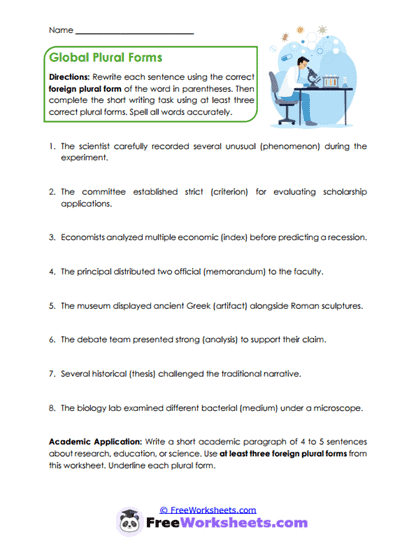
Plural Precision
What Kids Do:
Students explore the unusual plural forms they often see in science, math, history, and other advanced classes. They’ll practice changing words like criterion to criteria and phenomenon to phenomena, then use those words naturally in their own academic writing. Along the way, they’ll begin noticing that many of these spellings follow predictable patterns rather than random rules.
Target Skill:
This worksheet helps students become more comfortable with the formal vocabulary they’ll encounter in textbooks, research articles, and college-level writing. They’ll strengthen spelling, academic vocabulary, and sentence-writing while building confidence with words that often confuse even experienced writers.
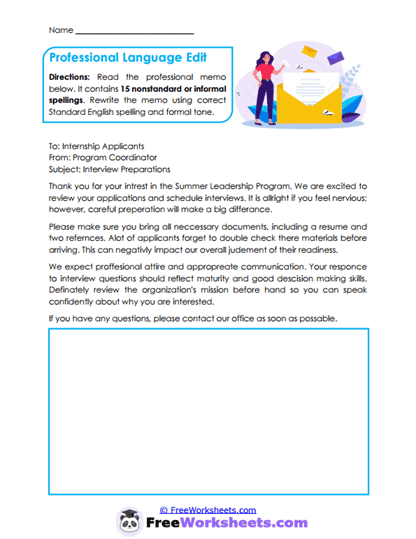
Professional Editing
What Kids Do:
Students polish a workplace memo that contains spelling mistakes, informal language, and other editing problems. As they revise the document, they’ll think like a professional editor by making sure the message sounds clear, respectful, and appropriate for a business setting instead of a casual text message.
Target Skill:
Students see firsthand how careful proofreading affects the way readers view both the writing and the writer. They’ll strengthen spelling, grammar, editing, and professional communication skills while preparing for the kinds of emails, resumes, and workplace documents they’ll eventually write themselves.
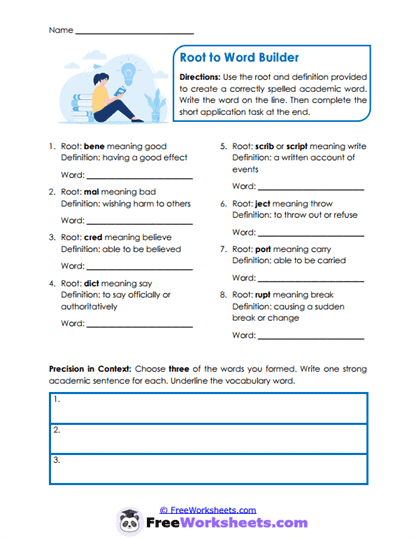
Root Builder
What Kids Do:
Students build new academic vocabulary by working with common Latin roots and discovering how those roots appear in dozens of familiar words. After creating correctly spelled words, they’ll use several of them in original sentences, helping the vocabulary become part of their everyday writing instead of something they simply memorized.
Target Skill:
Understanding word roots gives students a huge advantage whenever they encounter unfamiliar vocabulary. They’ll strengthen spelling, vocabulary development, morphology, and reading comprehension while learning strategies they can apply across English, science, history, and many other subjects.
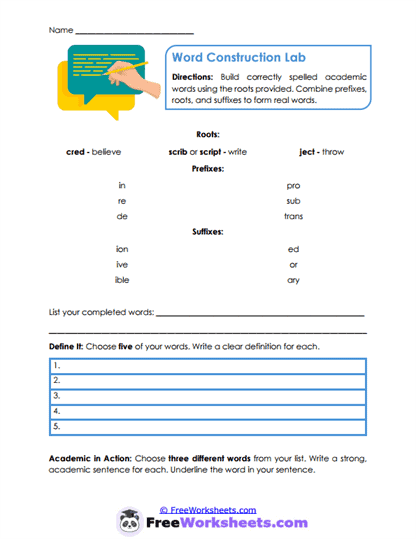
Word Building
What Kids Do:
Students mix and match prefixes, suffixes, and roots to create correctly spelled academic vocabulary. It feels a little like putting together a puzzle because each word part contributes something different to the final meaning. Once they’ve built new words, they’ll define them and use them in complete sentences to reinforce what they’ve learned.
Target Skill:
Rather than memorizing long vocabulary lists, students begin recognizing the building blocks that appear in thousands of English words. This strengthens spelling, word analysis, vocabulary growth, and reading comprehension while making advanced language feel much less intimidating.
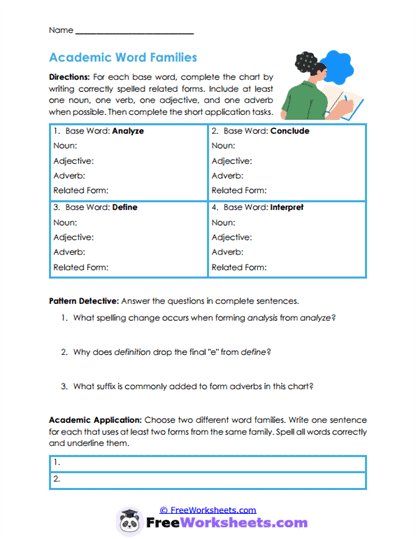
Word Families
What Kids Do:
Students discover how one familiar word can lead to several related words simply by changing endings or adding prefixes and suffixes. As they complete word family charts and write their own examples, they’ll start seeing the connections between vocabulary words that once seemed completely unrelated.
Target Skill:
This worksheet helps students understand that learning one word often means learning an entire family of related words. They’ll strengthen spelling, grammar, vocabulary, and word analysis while becoming more confident readers and writers who recognize spelling patterns instead of relying on memorization alone.
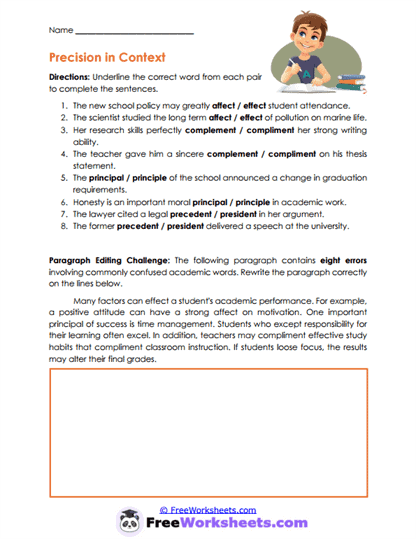
Word Precision
What Kids Do:
Students work through commonly confused word pairs like affect and effect by choosing the correct spelling in realistic academic situations. Afterward, they’ll edit a longer passage where careful reading and context clues matter just as much as spelling itself.
Target Skill:
Students learn that choosing the right word is every bit as important as spelling it correctly. They’ll strengthen vocabulary, proofreading, contextual reading, and editing while becoming more thoughtful writers who understand how precise language improves communication.